
Cohen Circle Acquisition Corp. II: Management Track Record, Fintech Focus, and the SPAC Execution Imperative
Cohen Circle Acquisition Corp. II enters the critical stage of its SPAC lifecycle with over $260 million in trust and a management team experienced in fintech and blank check transactions. The company's success now hinges on securing and executing a value-creating business combination amid a crowded and evolving SPAC and fintech landscape.
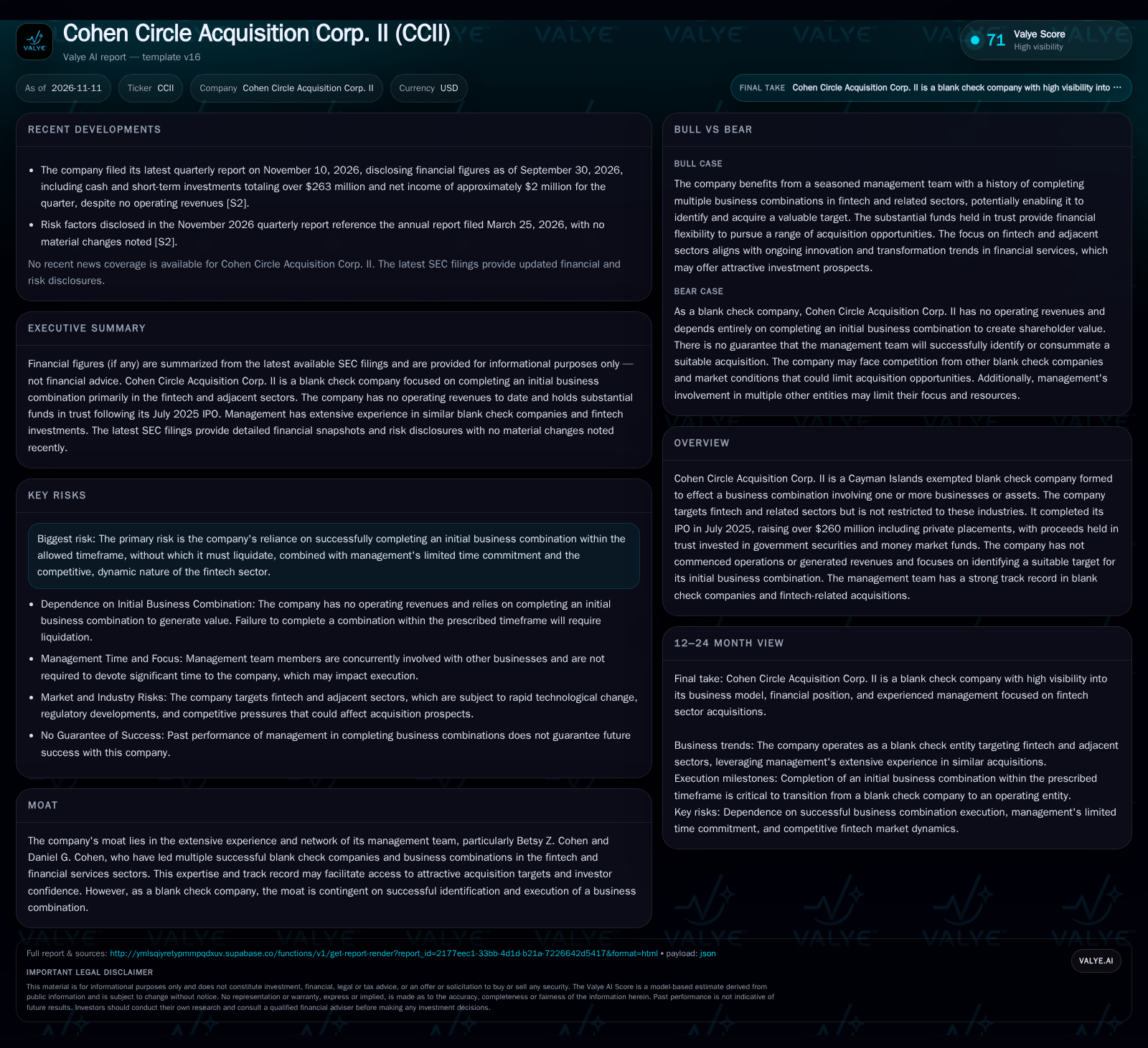
Cohen Circle Acquisition Corp. II is a Cayman Islands-based SPAC with $253 million from its July 2025 IPO and an additional $7.2 million from sponsor placement, all held in trust pending a business combination. Led by experienced fintech dealmakers Betsy Z. Cohen and Daniel G. Cohen, the firm has generated no operating revenue, with interest income on trust assets driving reported net income. The central risk is failure to identify and complete an attractive acquisition within the required timeframe, a challenge amplified by SPAC market competition and management’s attention spread across multiple entities. Execution of a compelling fintech acquisition will determine whether CCII transitions from a cash shell to an operating company with enduring value.
Cohen Circle Acquisition Corp. II (CCII) sits at a pivotal juncture typical of late-stage SPACs: flush with $260+ million in trust from its 2025 IPO and sponsor placements and led by one of the sector’s most experienced management teams, it must now identify, negotiate, and close a business combination—ideally in the fintech or adjacent sectors that have been its stated focus. With no operating revenues to date and income derived solely from trust asset interest, CCII’s future value for shareholders hinges on its ability to secure a compelling target in a competitive and rapidly evolving market. The next phase will test whether management’s dealmaking pedigree can overcome execution risk and sector headwinds to deliver a transition from cash shell to growth platform.
Trust Assets, Management Experience, and the Acquisition Clock
As of September 30, 2026, Cohen Circle Acquisition Corp. II held $253 million in trust from its July 2025 IPO, plus $7.2 million from a concurrent sponsor private placement, all invested in U.S. government securities and money market funds [S2]. The company reported net income of $1.97 million for the quarter, entirely attributable to interest on these trust assets, as no operating revenues have been generated to date [S2].Current assets of $950,663 and current liabilities of $159,554 yield a reported current ratio, but these figures are functionally a byproduct of the SPAC structure rather than ongoing operations. The management team, led by Betsy Z. Cohen and Daniel G. Cohen, brings a notable history of successful fintech and blank check transactions, which may help in sourcing and executing a suitable business combination [S2]. The primary operational imperative is to complete an acquisition before the SPAC’s designated deadline, or else return funds to shareholders and liquidate.
SPAC Economics: Interest Income, Sponsor Incentives, and the Value-Creation Event
Cohen Circle Acquisition Corp. II’s economic model is typical of SPACs: until a business combination is consummated, the company generates no operating revenue and minimal expenses aside from public company compliance and deal search costs. Interest income from trust assets can provide modest net income (as seen in the latest quarter), but this is not a sustainable source of shareholder value [S2]. Upon closing an acquisition, the economics will shift dramatically, with the acquired company’s operating results, capital needs, and sector dynamics dictating future cash flow and valuation.
Sponsor incentives are structurally important: sponsors typically receive a significant equity stake (the 'promote') if a deal is closed, which can create pressure to pursue a transaction even if target quality is marginal. Conversely, management’s track record and reputation—particularly in repeat SPAC cycles—may align interests toward higher-quality deals. The capital structure is highly levered to the outcome of the business combination: failure to close a deal results in liquidation and return of trust funds to shareholders, with sponsors losing their at-risk capital. The economics post-merger will depend on the target’s growth, margin profile, and ability to access further capital if required.
Sourcing Fintech Targets: Advantages, Crowding, and the SPAC Market Backdrop
CCII’s relative advantage lies in its management team’s fintech domain experience and established network, which can be critical in sourcing and negotiating with high-quality targets. The Cohen family’s track record in the SPAC and fintech space could bolster credibility with both target companies and investors, potentially differentiating CCII from less-experienced competitors.
However, the competitive landscape for SPACs targeting fintech and related sectors is notably crowded. Dozens of blank check companies have pursued similar mandates in recent years, leading to competition for attractive targets and upward pressure on acquisition valuations. In addition, traditional private equity, venture capital, and direct listings offer alternative exit and funding paths for high-growth fintechs, forcing SPACs to compete not just on price but also on value proposition, speed, and certainty of close.
A further counterforce is the shifting regulatory and market sentiment toward SPACs, including increased scrutiny from the SEC and evolving investor expectations around post-merger performance. The question is whether CCII’s management can leverage its network and reputation to secure a deal with a target that would not otherwise come to market, or structure a transaction that creates clear value for public shareholders.
If Management Secures a Breakout Fintech Target
The most favorable outcome for CCII would involve identifying and completing a business combination with a high-growth, scalable fintech or fintech-adjacent company that leverages secular trends—such as embedded finance, digital payments, insurtech, or real estate technology. If the management team can use its credibility and network to access a proprietary or under-the-radar target, and structure a transaction with favorable terms, the post-combination entity could command a premium valuation and attract further capital.
Confirmation of this scenario would include a deal announcement with a differentiated target that has demonstrable revenue growth, defensible technology, and clear market traction, ideally with explicit management and sponsor alignment through meaningful equity rollover or performance-based earnouts. Early post-announcement trading and analyst reactions, as well as PIPE (private investment in public equity) participation, would further support the upside case.
Falsification would occur if CCII fails to announce a transaction with attractive economics before the SPAC’s deadline, or if the selected target is perceived as lacking growth, scale, or strategic fit.
A Conventional SPAC Path: Competitive Deal, Modest Near-Term Upside
The most plausible outcome is that CCII, leveraging its management team’s experience, is able to identify a competent fintech or related target and close a business combination within the allotted timeframe. However, given competitive pressures in the SPAC and fintech sectors, the chosen target may be mature or less differentiated, leading to a transaction at a valuation that offers only modest near-term upside for shareholders.
In this scenario, the post-merger company may face significant execution risk, including the challenge of scaling in a competitive fintech market, integration hurdles, and the need to demonstrate sustainable growth and profitability to justify its public valuation. Confirmation would come from a deal announcement with a credible but not category-defining target, tepid PIPE participation or limited post-announcement stock movement, and a business model that is proven but undifferentiated.
Falsification would be indicated by an inability to announce a deal at all, or by significant shareholder redemptions and lack of market enthusiasm for the selected target.
Failure to Close: Liquidation Risk and Sponsor Forfeiture
The principal downside scenario is that CCII is unable to identify or consummate a business combination before the SPAC’s mandated deadline. This could occur due to an inability to secure a target at an acceptable valuation, regulatory or market disruptions, or loss of management focus as team members juggle multiple commitments.
In this outcome, trust funds are returned to public shareholders, sponsor capital is forfeited, and the company is liquidated. For investors, this typically means receiving the original trust value per share plus accrued interest, but missing out on any upside optionality. The opportunity cost is particularly relevant for those who entered above trust value or anticipated a compelling deal. Confirmation would be the absence of deal announcements as the deadline approaches, increasing regulatory filings referencing the approaching liquidation window, and no evidence of active negotiations.
Falsification would require a credible deal announcement or regulatory extension of the SPAC’s life with explicit shareholder approval.
Milestones and Evidence to Assess SPAC-to-Operating Company Transition
Announcement of a letter of intent or definitive agreement for a business combination, including target sector and rationale for selection.
Details on the valuation, capital structure, and PIPE financing participation, if disclosed, which would indicate market confidence and deal quality.
Nature of the target company’s revenue growth, profitability, and market position—especially if accompanied by audited financials.
Sponsor and management equity rollover or earnout structure, which would signal alignment and confidence in post-merger performance.
Shareholder redemption rates at the time of merger vote, as high redemptions may indicate skepticism regarding deal quality.
SEC or regulatory scrutiny of the proposed transaction, which could delay or derail deal closure.
Updates on management time allocation and focus, especially if disclosure suggests increasing involvement with other entities.
If disclosed, post-announcement trading performance and analyst commentary, which would help test market perception of the deal.
Disclaimer: This is research-only, informational analysis and not investment advice. It may include AI-generated interpretation and general industry context. Always verify important details using primary sources.

Comments