
TELA Bio: Product Innovation and Market Opportunity Collide
TELA Bio’s OviTex and OviTex PRS products, underpinned by exclusive supply and manufacturing agreements, have achieved FDA clearances and clinical validation, supporting commercial momentum in soft-tissue reconstruction.
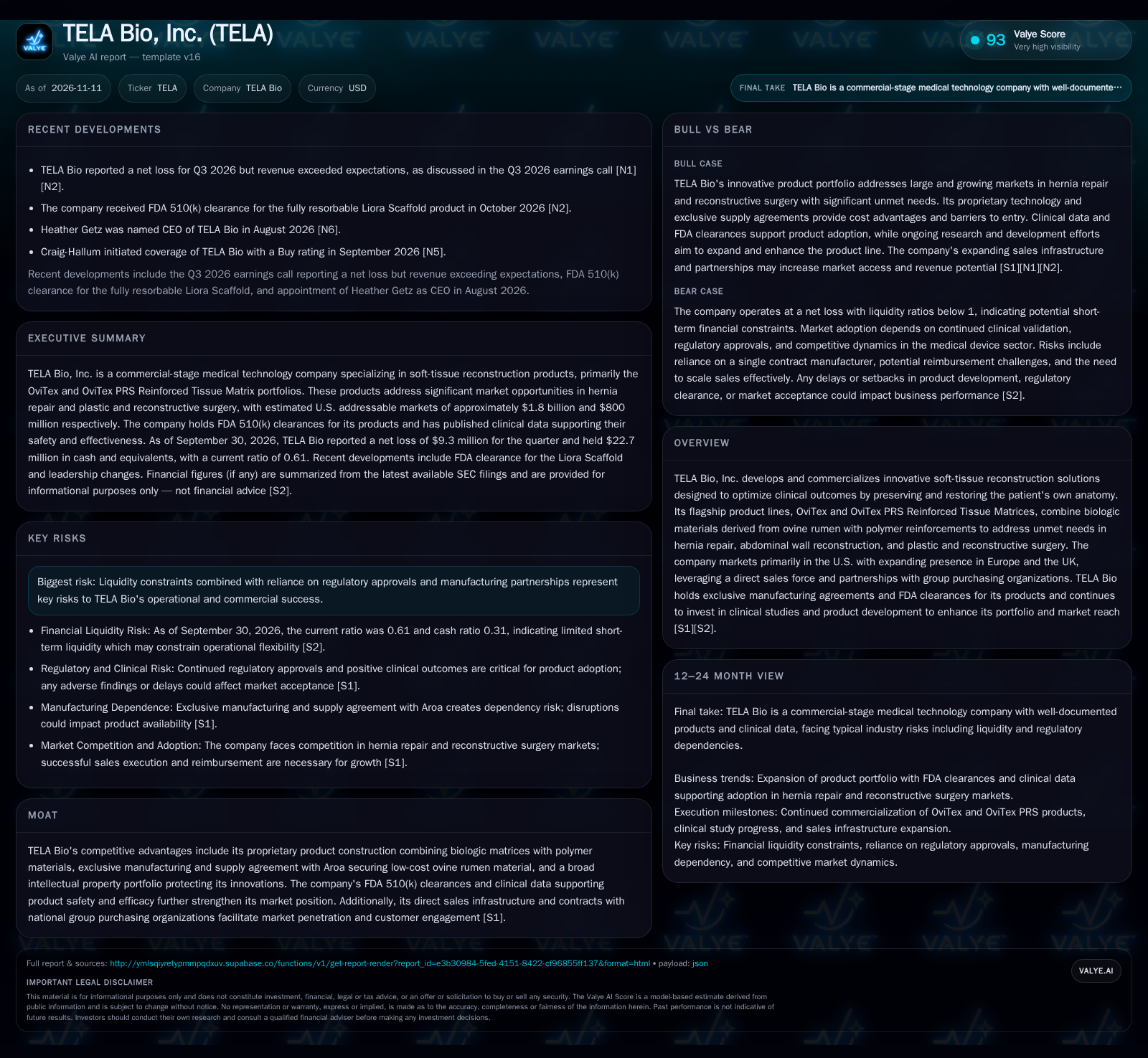
TELA Bio’s OviTex and OviTex PRS products, underpinned by exclusive supply and manufacturing agreements, have achieved FDA clearances and clinical validation, supporting commercial momentum in soft-tissue reconstruction. However, a net loss of $9.3 million in Q3 2026 and a current ratio of 0.61 highlight tightening liquidity, making continued revenue growth and operational efficiency critical to bridge the path to profitability or strategic alternatives. Market expansion and clinical adoption are plausible, but execution risk remains elevated given capital needs and manufacturing dependency. [S1] [S2]
TELA Bio stands at a pivotal juncture as it seeks to translate clinical and regulatory advances into sustainable commercial scale. Its OviTex product family, built on proprietary biologic-polymer matrices and protected by an exclusive supply chain, addresses large markets with significant unmet needs. The central question for investors is whether TELA Bio’s innovation engine and market access strategies can outpace its capital burn, or if near-term financial constraints will force a shift in strategy or ownership.
Recent Financial and Regulatory Milestones Shape the Risk-Reward Equation
TELA Bio’s 2025 revenue reached $80.3 million, a 16% increase over the prior year, reflecting commercial momentum in its core OviTex and OviTex PRS product lines for hernia repair and reconstructive surgery. However, the company reported a net loss of $38.8 million for 2025 and a further $9.3 million loss in Q3 2026, highlighting continued negative operating leverage [S1] [S2]. As of September 30, 2026, TELA Bio held $22.7 million in cash and equivalents, with a current ratio of 0.61 and cash ratio of 0.31, indicating tightening short-term liquidity [S2].
FDA 510(k) clearances for new product variants—including OviTex PRS Long-Term Resorbable and OviTex IHR—support portfolio expansion, while clinical studies such as BRAVO have demonstrated low recurrence rates and improved patient quality of life [S1]. The company’s exclusive supply agreement with Aroa and contracts with national group purchasing organizations remain central to its commercial strategy [S1].
Understanding the Economics of Biologic-Polymer Implants in Soft-Tissue Repair
TELA Bio’s revenue model is built around the sale of proprietary tissue matrices for surgical repair, primarily through a direct sales force targeting hospitals and surgical centers. Pricing for biologic-based implants tends to command a premium over synthetic-only solutions, especially when supported by clinical validation and FDA clearances. However, the capital intensity of commercializing novel medical devices—encompassing R&D, clinical trials, regulatory filings, inventory, and salesforce expansion—creates substantial fixed costs relative to current revenue scale.
The exclusive manufacturing and supply agreement with Aroa secures TELA Bio access to a unique ovine rumen-derived material, potentially lowering input costs and enhancing gross margin versus non-exclusive or commodity biomaterials. Yet, the company’s persistent net losses and shrinking liquidity indicate that fixed costs, including sales and clinical infrastructure, are not yet being offset by volume growth. Operating leverage could improve if adoption accelerates and sales ramp through group purchasing organization channels, but this is contingent on sustained clinical evidence, reimbursement coverage, and competitive pricing dynamics.
The company reported cash and liquidity metrics for the period; these figures do not by themselves establish operating runway, investment capacity, financial flexibility, or financing capacity. The degree of future funding required will hinge on the pace of market adoption and the company’s ability to manage working capital and SG&A relative to revenue growth.
Barriers, Differentiators, and Competitive Threats in the Surgical Matrix Market
TELA Bio’s core differentiators lie in its proprietary combination of biologic and polymer materials, FDA-cleared products, and exclusive access to ovine rumen through Aroa. This construction targets the clinical trade-off between biologic tissue integration and mechanical strength, aiming to reduce recurrence and complications. The intellectual property portfolio, together with clinical study results, provides a defensible position in a market where traditional biologic, synthetic, and hybrid devices compete.
However, the company faces entrenched competition from large established medical device manufacturers, as well as emerging players with alternative biologic or synthetic matrices. Key competitive levers in this space include clinical data, pricing, reimbursement access, surgeon preference, and the ability to secure and manage large-scale hospital contracts. TELA Bio’s reliance on a single-source supplier (Aroa) introduces vulnerability: any supply disruption or contract renegotiation could impact product availability and cost structure.
There is also the risk of substitute technologies—such as next-generation synthetics, tissue engineering, or regenerative medicine approaches—eroding the long-term differentiation of the OviTex platform if they demonstrate superior outcomes or lower costs. The critical test will be whether TELA Bio can sustain clinical, cost, and access advantages as the market evolves.
How Accelerated Adoption and Clinical Validation Could Drive a Breakout Phase
TELA Bio’s upside rests on a scenario where expanded FDA clearances, strong clinical outcomes, and effective sales execution drive rapid market share gains in both hernia and reconstructive surgery segments. If OviTex products continue to demonstrate superior patient outcomes with low recurrence in large-scale, real-world studies, surgeon adoption could accelerate, especially as group purchasing contracts expand hospital access.
Confirmation of this scenario would come from sustained double-digit revenue growth, improving gross margins as scale is achieved, and narrowing net losses quarter over quarter. Additional clinical endorsements, inclusion in clinical guidelines, or expanded reimbursement could further catalyze adoption. Evidence of successful expansion into the $800 million reconstructive surgery market, beyond hernia repair, would be a strong positive signal.
If these dynamics play out, TELA Bio could reach cash flow breakeven or attract strategic acquisition interest from larger device manufacturers seeking differentiated biologics platforms.
Commercial Progress Tempered by Ongoing Losses and Capital Needs
The most plausible near-term scenario is that TELA Bio continues to grow revenue in the mid-teens percent annually, driven by incremental adoption of existing and newly cleared OviTex configurations. Clinical data supports continued hospital and surgeon engagement, but adoption curves remain gradual given entrenched incumbent products and the conservative nature of surgical practice change.
Net losses persist as fixed costs for sales infrastructure, clinical studies, and regulatory compliance remain high relative to revenue. Cash burn continues, with the company likely needing to pursue additional capital—via equity, debt, or strategic partnership—within the next year if current trends hold. Manufacturing dependency on Aroa remains a manageable but non-trivial risk, and any operational hiccups could exacerbate financial pressures.
Falsification of this scenario would come from either a dramatic acceleration in revenue (suggesting upside adoption) or a liquidity event, restructuring, or slowdown in sales (pointing to downside risks).
Liquidity Shortfall or Supply Disruption Forces Strategic Reset
A more adverse scenario develops if revenue growth stalls due to competitive pushback, reimbursement headwinds, or loss of clinical momentum.
Manufacturing dependency on Aroa could become acute if supply is interrupted or contract terms change, jeopardizing product availability and exacerbating cost pressures. Regulatory or clinical setbacks—such as adverse study results or delayed clearances—would further undermine confidence in the adoption curve.
Evidence confirming the downside would include flat or declining quarterly revenues, widening net losses, deteriorating gross margins, or disclosure of going-concern risks or capital-raising events under duress.
Milestones That Will Clarify TELA Bio’s Commercial and Financial Trajectory
Quarterly revenue growth rates for OviTex and OviTex PRS—acceleration would support the adoption thesis while stagnation would indicate competitive or market access headwinds.
Gross margin trends, especially as sales volumes rise—improving margins would signal economies of scale and better cost absorption.
Cash and equivalents as of each quarterly report—a declining balance without offsetting revenue growth would raise liquidity flags.
Updates on the status or terms of the Aroa manufacturing and supply agreement—any changes or disclosed disruptions would materially impact operations.
New or expanded contracts with group purchasing organizations—would validate scaling hospital access and could drive step-change adoption.
Results from new or ongoing clinical studies—particularly real-world or long-term outcome data to reinforce product differentiation.
Disclosure of financing events, partnerships, or strategic alternatives—would signal management’s approach to bridging the capital gap.
Any changes in reimbursement coverage or policies for biologic-polymer matrices—a critical lever for hospital adoption and pricing power.
Disclaimer: This is research-only, informational analysis and not investment advice. It may include AI-generated interpretation and general industry context. Always verify important details using primary sources.

Comments