
Terrestrial Energy: DOE-Backed Reactor Ambitions, Capital Demands, and the Nuclear Commercialization Hurdle
Terrestrial Energy’s Integral Molten Salt Reactor (IMSR) program is progressing under the auspices of U.S.
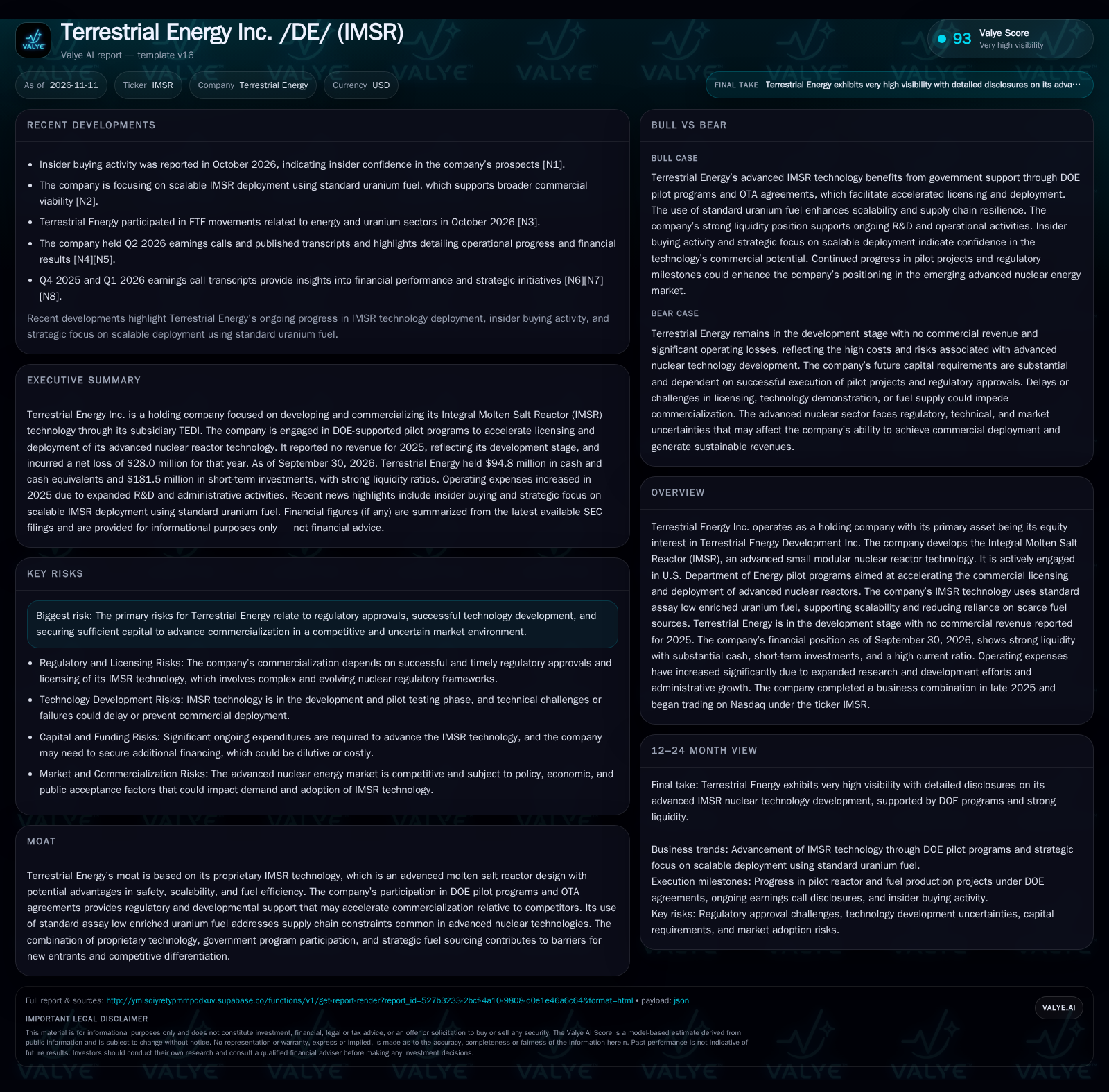
Terrestrial Energy is advancing its proprietary IMSR nuclear technology through DOE-supported pilot projects and has substantial liquidity, but remains pre-revenue and faces high operating losses.Insider transaction activity was reported in the cited source; this activity does not by itself establish insider confidence. The critical test will be successful project execution and regulatory approval, as capital needs and development risks remain high. [S1] [S2] [N1] [N2]
Terrestrial Energy is positioning itself at the forefront of advanced nuclear innovation with its Integral Molten Salt Reactor (IMSR) technology, supported by U.S. DOE pilot programs and a strategic focus on scalable, standard-fuel deployment. As of late 2026, the company enjoys reported liquidity position and regulatory backing, yet remains pre-revenue and faces mounting operating losses. The next phase will test Terrestrial’s ability to convert technical milestones and government partnerships into commercial traction, all while navigating the capital intensity and regulatory uncertainty that define the advanced nuclear sector.
DOE Partnerships and Financial Position Define Terrestrial’s 2026 Reality
Terrestrial Energy’s operational landscape in late 2026 is shaped by its participation in U.S. Department of Energy (DOE) pilot programs, including executed OTA agreements to support both a pilot IMSR reactor (Project TETRA) and a pilot fuel production facility (Project TEFLA). These initiatives are intended to fast-track regulatory approval and technical validation for the company’s advanced reactor design. Despite these strategic milestones, Terrestrial reported no commercial revenue for 2025, underscoring its ongoing status as a development-stage enterprise. Operating expenses have climbed sharply, with research and development rising to $9.8 million and general and administrative costs reaching $14.3 million in 2025, resulting in a net loss of $28.0 million for the year. The company reported cash and liquidity metrics for the period; these figures do not by themselves establish operating runway, investment capacity, financial flexibility, or financing capacity. [S1] [S2]
IMSR Commercialization: The Economics of Advanced Nuclear Deployment
Terrestrial Energy’s business model is predicated on the successful commercialization of its IMSR technology, which, if achieved, could position the company as a supplier of modular nuclear reactors and potentially as a long-term operator or technology licensor. At this stage, the company’s economics are defined by heavy fixed costs—substantial R&D investment, regulatory compliance, and administrative expansion—against a backdrop of zero revenue. The capital requirements for bringing a first-of-kind nuclear reactor to market are exceptionally high, with multi-year timelines before any meaningful revenue generation is plausible.
If IMSR technology is licensed or sold to utilities or industrial customers, revenue could be structured as upfront milestone payments, engineering/procurement/commissioning fees, and potentially recurring maintenance or fuel supply contracts. The use of standard assay low enriched uranium (SALEU) is strategically significant: it could lower future operating costs and reduce the risk of supply bottlenecks that can afflict more exotic fuel cycles. However, Terrestrial’s current burn rate and lack of cash flow from operations mean that external funding—via government grants, equity, or strategic partnerships—will continue to be essential until commercial deployment is achieved. Operating leverage may eventually be realized if the company can scale production and win multiple deployments, but the path to that inflection point is long and capital-intensive.
Proprietary Reactor Design, Fuel Strategy, and the Advanced Nuclear Field
Terrestrial’s moat is built on its proprietary IMSR molten salt reactor design, which promises advantages in safety, modularity, and efficiency over legacy light-water reactors and other advanced nuclear concepts. The company’s use of standard uranium fuel (SALEU) is a differentiator, as it sidesteps the procurement and regulatory complexities associated with high-assay low enriched uranium (HALEU) or novel fuel forms. Participation in DOE pilot programs and successful execution of OTA agreements provide Terrestrial with regulatory engagement and potential early-mover advantages, but these are not insurmountable barriers—other advanced reactor developers are also securing government partnerships and pursuing similar fast-track mechanisms.
Competition includes both established nuclear vendors (pursuing small modular reactors) and a new generation of advanced reactor startups targeting similar markets. Substitutes include renewables, energy storage, and advanced gas or hydrogen technologies. The enduring challenge for all nuclear innovators is converting technical promise and regulatory support into sustained commercial demand—particularly in a market still shaped by cost, public acceptance, and policy uncertainty.
Pathway to Commercialization: Technical Milestones and Regulatory Acceleration
The upside scenario for Terrestrial Energy is anchored in successful completion of its DOE-supported pilot projects, culminating in regulatory approval and technical validation of the IMSR design. If the company can demonstrate reliable, safe operation of its pilot reactor and secure timely licensing, it could attract commercial orders from utilities or industrial customers seeking scalable, low-carbon baseload power. The use of standard uranium fuel would facilitate supply chain readiness and could accelerate deployment relative to peers reliant on less accessible fuel types.
Confirmation of this scenario would come from: (1) achievement of major technical milestones—such as first criticality or successful long-term pilot operations; (2) public announcements of commercial offtake agreements or customer commitments; (3) further DOE or third-party funding earmarked for commercial buildouts; and (4) evidence of policy support or regulatory streamlining for advanced reactor adoption.
Development-Stage Burn Continues as Terrestrial Pursues Pilot Results
The most plausible trajectory is that Terrestrial Energy continues as a high-burn, development-stage company for the next 12–24 months, focused on progressing its pilot projects under DOE oversight. Expenses are likely to remain elevated as R&D, regulatory, and administrative activities intensify ahead of any potential commercialization. Commercial traction will depend on both technical success and a favorable regulatory environment.
Evidence confirming this scenario would include ongoing net losses, continued reliance on government or external funding, and incremental technical progress updates without near-term commercial contracts. Falsification would require earlier-than-expected commercial deals, major licensing breakthroughs, or a dramatic reduction in operating losses due to a shift in business model or funding structure.
Regulatory, Technical, or Funding Setbacks Stall Progress
The principal downside risk for Terrestrial Energy is a failure to achieve key technical or regulatory milestones, resulting in delayed or stalled commercialization. This could stem from technical setbacks in pilot reactor operation, unforeseen regulatory hurdles, or safety/performance concerns that undermine confidence in the IMSR design. Additionally, if operating losses persist and government or private funding becomes constrained, the company could face liquidity stress before reaching commercial viability.
Downside confirmation would come from: (1) negative pilot project outcomes or publicized technical failures; (2) regulatory delays or denials; (3) evidence of funding shortfalls, such as emergency financings or adverse going-concern disclosures; and (4) a lack of customer interest or policy support for advanced nuclear deployment.
Milestones That Will Determine Terrestrial Energy’s Commercial Breakthrough
Progress and public disclosure on Project TETRA (pilot IMSR reactor) technical milestones, including initial operation and safety validation.
Updates on Project TEFLA (pilot fuel production facility) commissioning, throughput, and integration with IMSR development.
Any evidence of commercial customer engagement, such as signed offtake agreements, letters of intent, or MOUs for reactor deployment.
Announcements of additional DOE or third-party funding that would extend runway or accelerate transition to commercial scale.
R&D expense trajectory and operating loss trends, as indicators of both capital burn and potential efficiency improvements.
Status of regulatory submissions, reviews, and feedback from the U.S. Nuclear Regulatory Commission or equivalent authorities.
If disclosed, the timing, size, and terms of any future capital raises, which would signal both investor appetite and required dilution.
Public policy developments affecting advanced nuclear adoption, such as tax incentives, clean energy mandates, or changes in permitting frameworks.
Disclaimer: This is research-only, informational analysis and not investment advice. It may include AI-generated interpretation and general industry context. Always verify important details using primary sources.

Comments