
IPM’s Strategic Pivot: Can Specialist Cloud and Security Services Outmaneuver Larger IT Rivals?
Intelligent Protection Management Corp. has restructured its portfolio to focus on enterprise IT and secure cloud services, targeting regulated and high-compliance industries. The company’s recent acquisition and planned AI-enabled offerings set the stage for growth, but supply chain disruptions, integration risk, and strong competition test its ability to scale profitably.
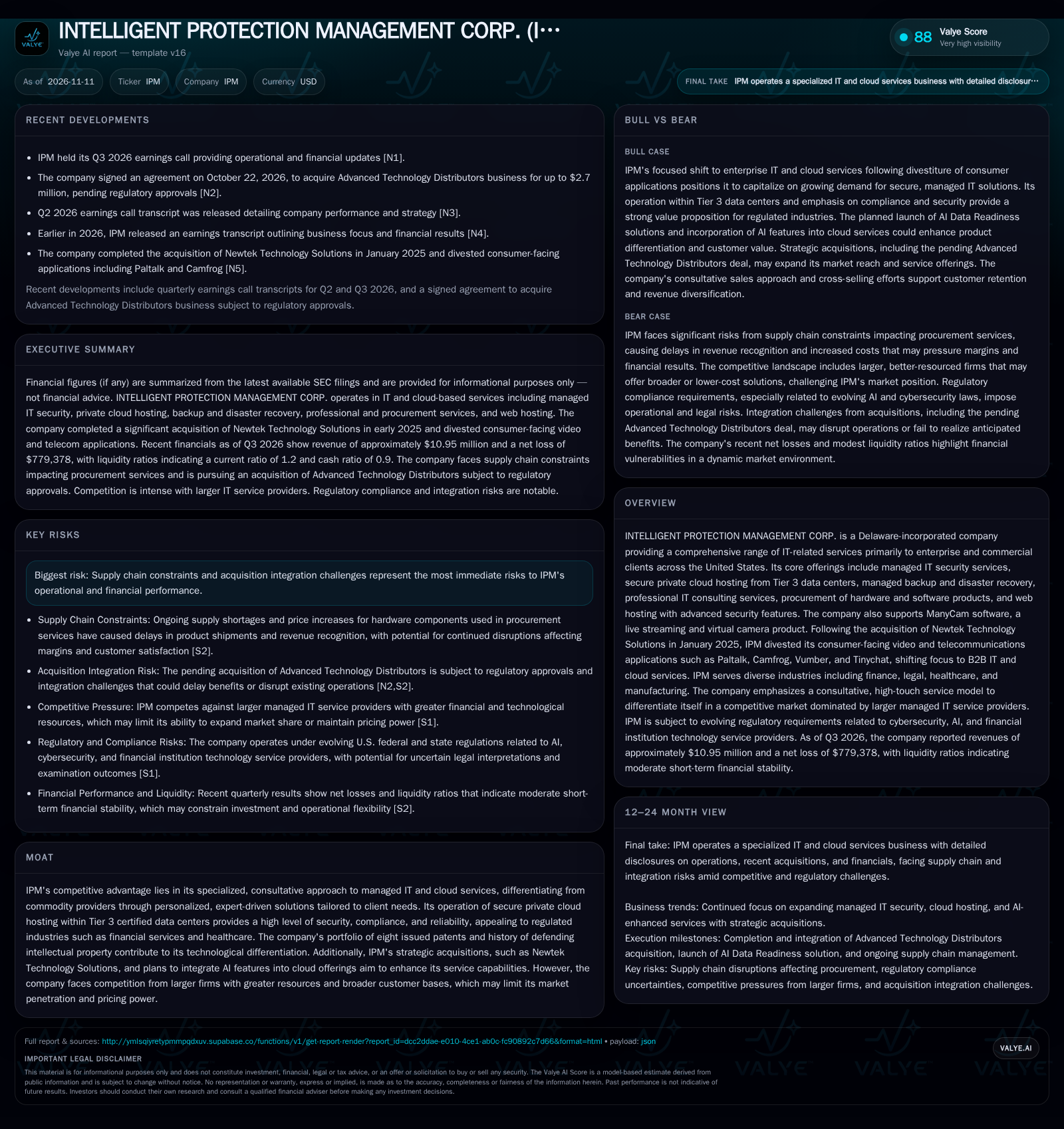
IPM is sharpening its focus on managed IT security and private cloud services for enterprise clients following a major portfolio realignment and acquisition. The company’s revenues reached $10.95M in Q3 2026 but it remains unprofitable, reporting a net loss of $779K. While new AI solutions and acquisitions could enhance its competitive edge, persistent supply chain delays and the challenge of integrating new businesses pose risks to margin expansion and operational execution. The outcome depends on IPM’s ability to differentiate against much larger IT service providers while managing financial and operational pressures. [S1] [S2]
Intelligent Protection Management Corp. (IPM) has reoriented its business to focus on enterprise-grade IT, managed security, and secure cloud hosting, following the acquisition of Newtek Technology Solutions and the divestiture of its consumer-facing apps. This move positions IPM to serve industries with high compliance requirements, such as finance and healthcare. However, the company’s recent financials reflect both opportunity and challenge: while revenues are growing, profitability remains elusive, and ongoing supply chain issues continue to pressure procurement margins. With new AI-powered services and another acquisition in the pipeline, IPM’s next phase hinges on its ability to execute amid heightened competition and operational complexity.
Portfolio Realignment and Operational Headwinds Shape the Current Landscape
IPM’s strategic focus has shifted decisively toward B2B managed IT security, private cloud hosting, and compliance-driven services following its 2025 acquisition of Newtek Technology Solutions and the divestiture of consumer apps like Paltalk and Tinychat. As of Q3 2026, the company reported $10.95 million in quarterly revenue and a net loss of $779,378, reflecting the transitional nature of its operations and ongoing investment in growth [S2].
Procurement services—a key part of IPM’s offering—remain affected by supply chain constraints, resulting in delayed revenue recognition and increased costs. While some improvement was noted in Q3 2026, the company still faces uncertainty in procuring hardware and software for clients, impacting both customer satisfaction and gross margin [S2].
Liquidity as measured by a current ratio of 1.2 and cash ratio of 0.9 as of September 30, 2026, suggests moderate short-term financial stability but does not provide a substantial cushion against shocks or funding needs for large-scale initiatives [S2].
A pending acquisition of Advanced Technology Distributors, valued at up to $2.7 million, underscores IPM’s strategy to expand its capabilities and customer base, but also introduces integration and execution risk [N2].
How IPM’s Revenue Streams and Cost Structure Influence Profit Potential
IPM generates revenue from a blend of contract-based and subscription models across managed IT security, cloud hosting, disaster recovery, professional services, procurement, and web hosting [S1]. The company recognizes revenue ratably for ongoing services (cloud, managed IT), while procurement revenue is recognized net or gross depending on whether IPM acts as principal or agent—an important distinction for understanding margin variability [S1] [S2].
Managed IT and cloud services typically offer higher margins and recurring revenue potential, especially when bundled with compliance and security features valued by regulated industries. These services are capital-light relative to large-scale infrastructure players, as IPM leases space in Tier 3 data centers rather than owning them outright. This model can provide operating leverage if utilization increases and churn remains low.
Procurement services, while useful for deepening client relationships, expose IPM to volatile hardware/software costs and supply chain disruptions. Margins here are generally thin, and persistent delays can defer revenue and erode profitability. The company’s professional services (consulting, design, and AI initiatives) may carry higher gross margins but are likely to be less predictable and more labor-intensive.
IPM’s cost base is weighted toward personnel (53 full-time and 1 part-time employee as of March 2026 [S1]), leased data center expenses, licensing fees, and technology investments. The high-touch, consultative sales model may support retention and cross-selling but limits scalability compared to automated or self-service competitors.
Specialization Versus Scale: IPM’s Place in a Crowded IT Services Arena
IPM competes with a spectrum of managed IT and cloud service providers, including giants like Cognizant, NTT, DXC Technology, and CDW, as well as more specialized firms such as Konica Minolta’s All Covered and Flexential [S1]. These competitors often have broader product portfolios, deeper technical resources, and the ability to price aggressively—advantages that can squeeze smaller players on both market share and margin.
IPM’s differentiation strategy is rooted in its consultative, high-touch approach, which is attractive to regulated clients needing bespoke security and compliance solutions. The company’s operation of secure, leased Tier 3 data centers in Phoenix and New Jersey, along with an emphasis on advanced security protocols (encryption, segmentation, firewalls, continuous monitoring), positions it well for industries like finance, healthcare, and legal [S1].
However, this specialization comes with limits to scale, as the sales and onboarding process is labor-intensive and less amenable to automation. Larger competitors may also invest heavily in AI, automation, and global service delivery, eroding some of IPM’s perceived edge.
Switching costs in IT services can be high—especially when services are tightly integrated with client workflows and compliance processes—but price competition and bundled offerings from larger firms can still threaten retention. IPM’s ability to expand wallet share within its existing client base will be a critical driver of growth and stickiness.
AI-Driven Expansion and Successful Integration Could Catalyze Margin Growth
A favorable outcome for IPM would see the company successfully integrating the Advanced Technology Distributors acquisition, expanding its procurement and service capabilities while cross-selling to a broader client base. The planned launch of the AI Data Readiness solution in 2026 could further differentiate IPM in the market, enabling premium pricing for advanced analytics and compliance automation, especially in regulated verticals [S1] [N2].
If supply chain constraints ease and procurement margins stabilize, IPM’s revenue recognition would normalize, supporting both top-line growth and improved gross margins. The company’s consultative model, if scaled via platform partnerships or targeted sales expansion, could drive higher retention and recurring revenue.
Evidence confirming this scenario would include sequential improvements in gross margin, successful onboarding of new clients post-acquisition, and higher attach rates for AI-enabled services. Announcements of multi-year contracts or renewals, particularly in regulated industries, would further validate the strategy.
Gradual Progress Amid Competitive Pressure and Operational Friction
The most plausible near-term trajectory for IPM is one of moderate revenue growth driven by its core managed IT and cloud services, with ongoing volatility in procurement due to lingering supply chain issues. Operating losses may persist as the company invests in new solutions and absorbs integration costs from the Advanced Technology Distributors acquisition.
Competitive pressure from larger IT service providers will likely constrain pricing power, forcing IPM to rely on service differentiation and customer intimacy to retain and upsell existing clients. The high-touch model should yield stable, if not rapidly expanding, recurring revenue streams in regulated markets, but limits to scalability and margin expansion persist.
This scenario would be confirmed by continued mid-single-digit revenue growth, steady (but not dramatically improving) gross margins, and incremental adoption of new solutions without major client churn or disruptions. Evidence of improved supply chain reliability and a successful, if not transformative, integration of new acquisitions would further support this outlook.
Margin Compression and Integration Missteps Could Undercut Strategic Gains
In a negative scenario, persistent supply chain disruptions would continue to delay procurement revenue and inflate costs, driving further margin compression and customer dissatisfaction. If the Advanced Technology Distributors acquisition stalls, fails regulatory approval, or proves difficult to integrate, anticipated synergies and cross-selling opportunities could evaporate, straining both operations and financials [N2] [S2].
Competitive inroads by larger, better-capitalized players could erode IPM’s client base or force price concessions, particularly if those competitors introduce automated, AI-enhanced solutions at scale. Regulatory or compliance missteps—especially in the context of evolving AI and cybersecurity laws—could lead to reputational damage, fines, or costly remediation.
Signs of this scenario would include declining gross margins, flat or shrinking revenue, rising operating losses, customer attrition, or publicized regulatory or integration setbacks.
Milestones and Metrics That Will Reveal IPM’s Competitive Trajectory
Gross margin trends by segment (managed services vs. procurement) would help clarify whether IPM is successfully shifting toward higher-value offerings.
Updates on the timing, cost, and integration progress of the Advanced Technology Distributors acquisition will indicate whether expected synergies are being realized.
The pace and scope of adoption for the AI Data Readiness solution, if disclosed, will demonstrate whether the company can capture premium business in regulated verticals.
Client retention and renewal rates, particularly among regulated industry customers, would signal the strength of the company’s high-touch model and switching frictions.
Revenue recognition timing and procurement backlog levels, if disclosed, would provide transparency into lingering supply chain constraints.
Employee headcount growth relative to revenue would show whether the consultative model is scaling efficiently or becoming a drag on margins.
Any regulatory findings, compliance incidents, or cybersecurity breaches could materially impact reputation and client trust.
Disclaimer: This is research-only, informational analysis and not investment advice. It may include AI-generated interpretation and general industry context. Always verify important details using primary sources.

Comments