
BTC Development Corp.: SPAC Ambitions in the Bitcoin Ecosystem Face Competition and Execution Risk
BTC Development Corp. enters the crowded SPAC landscape with a bitcoin-centric acquisition mandate, a seasoned management team, and robust trust proceeds. While its financial position is currently strong and its strategy is tailored to the evolving bitcoin ecosystem, success hinges on executing a timely, differentiated business combination amid intensifying competition and inherent crypto-market volatility.
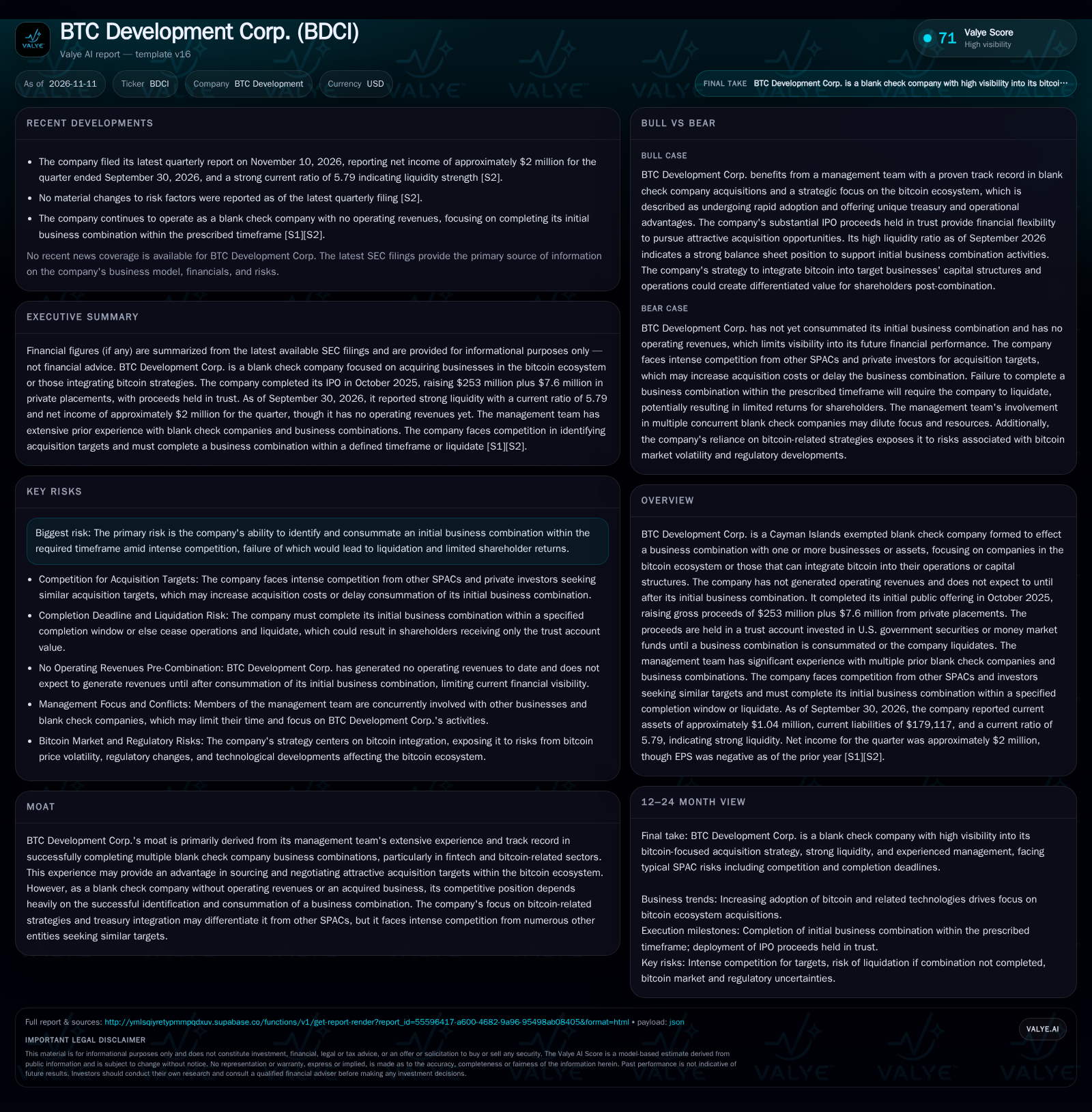
BTC Development Corp. is a Cayman Islands-based blank check company with no operating revenues, targeting businesses in the bitcoin ecosystem or those integrating bitcoin into their operations. Following its October 2025 IPO, it holds $253 million in trust plus $7.6 million from private placement. The company reported net income of $2 million for the quarter ending September 2026, driven by interest income, and maintains a reported current ratio of 5.79. It must consummate an initial business combination within a defined window or liquidate, and faces stiff competition from other SPACs and investors in the crypto sector [S1] [S2].
BTC Development Corp. stands at the intersection of two dynamic trends: the proliferation of special purpose acquisition companies (SPACs) and the accelerating adoption of bitcoin as both a technology and a treasury asset. With $253 million in IPO proceeds and a further $7.6 million from private placement reserved in trust, the company is well-capitalized for its mandate. Yet, as with all SPACs, the real test will be its ability to identify, negotiate, and close a value-accretive transaction—particularly in the highly competitive and rapidly evolving bitcoin ecosystem. The next several quarters will determine whether BTC Development can translate its financial and managerial resources into a successful combination or join the growing list of SPACs facing liquidation.
BTC Development Corp.'s Financial Footing and Strategic Mandate Post-IPO
BTC Development Corp. completed its initial public offering in October 2025, raising $253 million in gross proceeds, supplemented by $7.6 million from a private placement to sponsors and affiliates. These funds are currently held in a trust account invested in U.S. government securities or money market funds, pending the consummation of a business combination. As of September 30, 2026, the company reported current assets of $1.04 million and current liabilities of $179,117, resulting in a current ratio of 5.79. The company posted net income of $2,004,449 for the quarter, but this was entirely attributable to interest income from trust assets rather than any operating business. Importantly, BTC Development has not generated, and does not expect to generate, operating revenues until after it completes its initial business combination. The company's business strategy is tightly focused on identifying opportunities within the bitcoin ecosystem or companies that can integrate bitcoin into their operations or capital structures. However, it must secure a qualifying business combination within a prescribed timeframe or face liquidation, returning trust proceeds to shareholders [S1] [S2].
How SPAC Economics and Bitcoin Integration Could Shape Value Creation
BTC Development Corp.'s economics are, at this stage, characteristic of a SPAC: capital is raised upfront and sits in trust, earning interest until deployed in a business combination. The primary lever for value creation is the identification and successful merger with an operating business in the bitcoin ecosystem or a firm seeking to integrate bitcoin into its treasury or operations. Post-combination, the economics could vary widely depending on the target—ranging from bitcoin infrastructure providers (exchanges, custodians, mining firms), to fintechs adopting bitcoin as a treasury reserve asset, or companies leveraging blockchain for operational efficiencies.
The economics of a SPAC-sponsored business typically hinge on scale, operating leverage, and the ability to command premium valuations either through rapid growth or differentiated positioning. If BTC Development acquires a business with high gross margins or recurring revenue streams—such as a bitcoin exchange, custody provider, or SaaS platform for bitcoin financial services—the resulting entity could benefit from strong operating leverage and network effects. However, if the target is capital-intensive (e.g., bitcoin mining), the merged company may face volatile margins and substantial ongoing capital needs, with profitability tightly linked to bitcoin price cycles and energy costs.
The company’s stated intent to help targets implement bitcoin treasury strategies also introduces idiosyncratic risks and opportunities. If bitcoin appreciates, treasury gains could supplement operating income; if it falls, the opposite is true. This creates a layer of financial performance volatility that traditional operating businesses may not face. The eventual business mix, capital structure, and exposure to bitcoin price movements will ultimately determine the economic profile post-combination.
Competing for Bitcoin-Linked Deals: Advantages and Headwinds
BTC Development’s management team brings a notable track record in executing SPAC deals, particularly in fintech and digital asset sectors. This experience can be an advantage in sourcing, negotiating, and closing transactions, potentially making the SPAC more attractive to sellers seeking a smooth public listing process. The company's focus on bitcoin integration and treasury strategies may also differentiate its pitch from more generic SPACs, appealing to companies that see strategic value in aligning with the bitcoin narrative.
However, the competitive landscape is intense. Dozens of SPACs and a growing pool of private equity and venture investors are targeting the same high-growth digital asset and fintech companies. This competition can drive up acquisition prices, compressing potential returns for SPAC sponsors and public shareholders. Furthermore, many attractive targets may prefer traditional IPOs or private funding, especially if public market conditions are volatile or if SPACs carry stigma from failed or underperforming deals. Additionally, BTC Development’s reliance on the bitcoin ecosystem introduces sector-specific risks: regulatory scrutiny, technology shifts, and the cyclical nature of crypto markets all threaten deal pipelines and post-merger performance.
What Success Looks Like: A Timely, Differentiated Deal in a Rising Bitcoin Cycle
The most favorable scenario for BTC Development shareholders is the identification and consummation of a business combination with a high-growth company that is a clear beneficiary of bitcoin adoption—such as a leading bitcoin infrastructure provider, a fintech with material bitcoin-driven revenue, or an enterprise with a compelling bitcoin treasury strategy. Ideally, this deal would be struck during a period of rising bitcoin prices and regulatory clarity, boosting both the value of any bitcoin holdings and the perceived strategic relevance of the target.
Key evidence confirming this scenario would include a merger announcement with a well-known, rapidly scaling bitcoin company, positive pre- and post-announcement market reaction, and clear disclosures of robust pro forma revenue and margin profiles. Additional confirmation would come if the post-combination entity demonstrates strong capital markets support, achieves or beats revenue and profitability projections, and leverages its public listing to accelerate growth through further acquisitions or product launches.
Most Likely Trajectory: Deal Execution Amid Competitive Pressures and Market Cycles
The most plausible pathway is that BTC Development secures a business combination within the required timeframe, but the target is more modest or the deal terms are less favorable due to intense competition for high-quality assets. The post-combination company may operate in a bitcoin-adjacent segment—such as digital payments, custody, or mining—but face margin compression or integration challenges. In this scenario, the initial post-merger performance is mixed: the entity is public, but market enthusiasm is tempered, and the business must prove its durability amid bitcoin’s ongoing volatility.
Confirming this scenario would be a timely combination announcement with a credible (but not market-leading) bitcoin ecosystem player, reasonable but not spectacular pro forma financials, and a muted or volatile stock market response. Falsification would occur if the company fails to announce a deal before the deadline, or if the market sharply revalues the entity post-merger due to underwhelming performance or unforeseen risks.
Execution Failure: Liquidation Risks and Value Erosion for Shareholders
The most adverse outcome is failure to consummate a qualifying business combination within the specified window. In this case, BTC Development would be forced to liquidate, returning trust proceeds (less expenses) to shareholders, with warrants and founder shares likely becoming worthless. This scenario could materialize if competition for targets remains too intense, if market conditions deteriorate (e.g., a sharp bitcoin downturn or unfavorable regulatory changes), or if the management team is unable to secure a deal that meets both their investment criteria and shareholder approval.
Evidence confirming this scenario would include the passage of the SPAC’s deadline without a signed merger agreement, public disclosure of liquidation plans, and redemption of public shares at trust value. Shareholder value would be limited to trust asset returns, with no upside from operating business performance.
Milestones and Market Forces That Will Define BTC Development’s SPAC Outcome
Announcement of a definitive business combination agreement: The timing, quality, and sector alignment of any announced deal will be the single most important KPI.
Pro forma financial disclosures of the target (if disclosed): Revenue, margin, growth projections, and bitcoin exposure for the acquired business would help test the thesis.
Shareholder and regulatory approval process for the merger: Smooth progress or unexpected hurdles would indicate likelihood of deal closure.
Market reaction to deal announcement: Trading volume, price movement, and warrant activity can reveal investor confidence in the transaction.
Bitcoin market conditions and regulatory developments: A rising bitcoin price or positive regulatory news would support the value proposition; adverse moves could undermine it.
Updates on management focus and resource allocation: Given the team’s involvement in multiple SPACs, evidence of dedicated attention to BTC Development would help assess execution risk.
SPAC completion window countdown: Proximity to the liquidation deadline and any extensions sought would signal urgency and risk of non-completion.
If disclosed, details of any PIPE (private investment in public equity) or additional financing arrangements supporting the business combination.
Disclaimer: This is research-only, informational analysis and not investment advice. It may include AI-generated interpretation and general industry context. Always verify important details using primary sources.

Comments