
Insight Digital Partners II: SPAC Structure, Incentive Tensions, and the Digital Infrastructure Targeting Dilemma
With $172.5 million in trust and a two-year clock ticking, Insight Digital Partners II faces the classic SPAC challenge: leveraging sector expertise to secure a high-quality digital economy merger while balancing sponsor incentives and shareholder outcomes.
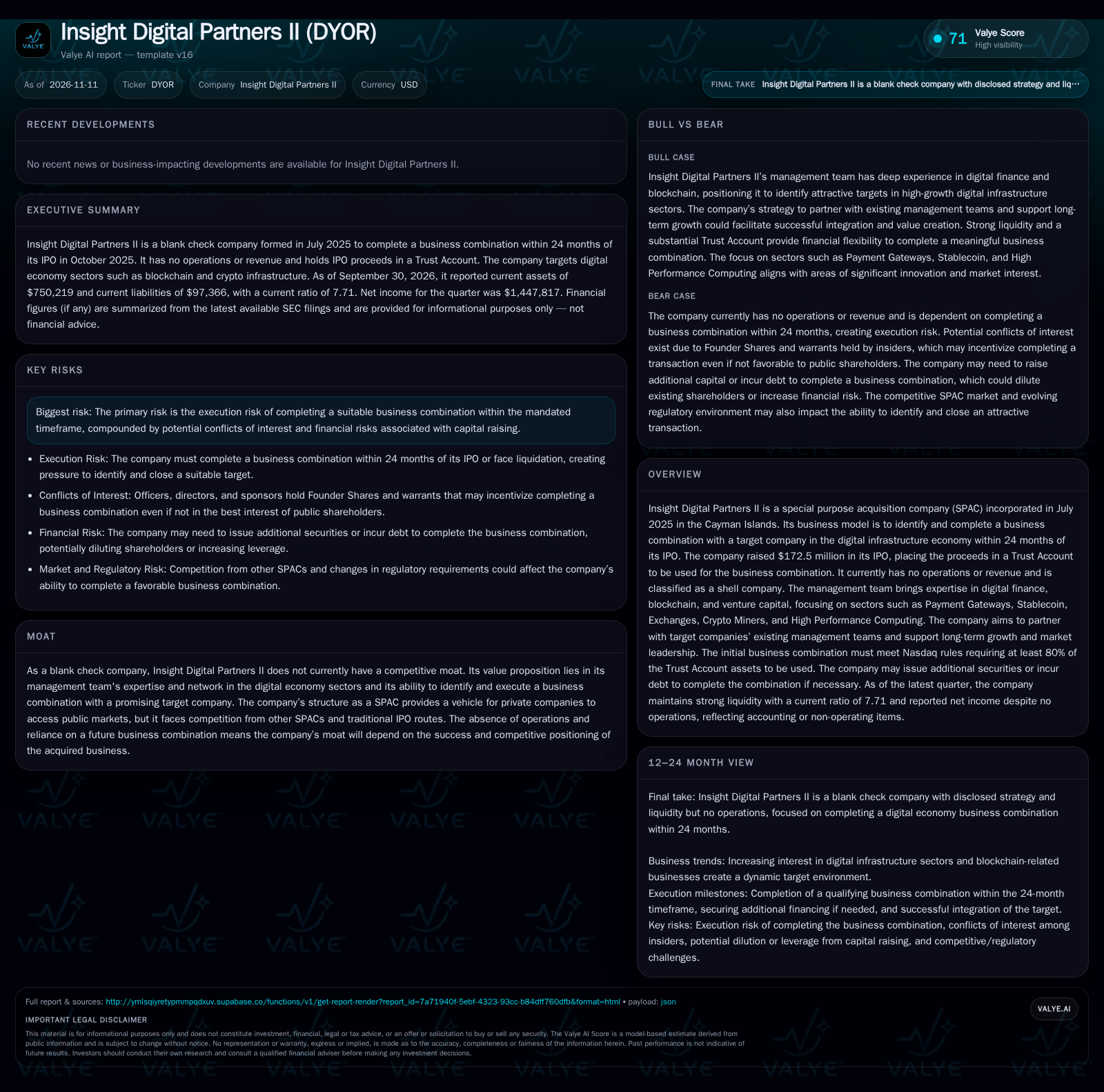
Insight Digital Partners II is a Cayman Islands-based SPAC with $172.5 million from its October 2025 IPO, targeting a business combination in digital infrastructure sectors such as payment gateways, stablecoins, and high-performance computing.As of September 30, 2026, it remains a shell company with no operations or revenue, reporting net income from trust interest and a reported current ratio. The management team’s blockchain and venture capital experience could help identify an attractive target, but the SPAC faces execution risk, dilution potential, and sponsor-shareholder incentive misalignment as it seeks a deal within its 24-month deadline. [S2]
Insight Digital Partners II typifies the next wave of SPACs focused on digital infrastructure, boasting $172.5 million in trust and an experienced team with digital finance and blockchain roots. Yet, as of September 2026, the company has no operations, no revenue, and faces the classic blank-check company conundrum: the need to secure a high-quality target within a tight time window, while managing sponsor incentives and the risk of shareholder dilution. With a 24-month deadline from its October 2025 IPO, the next year will test the management team’s ability to identify, structure, and integrate a transaction that justifies the SPAC premium and delivers value beyond the trust’s cash baseline. [S2]
Snapshot: Trust Capital, Operating Status, and the SPAC Clock
As of September 30, 2026, Insight Digital Partners II remains a shell company with no operating business or revenue. The company completed its IPO on October 30, 2025, raising $172.5 million that is held in a trust account and earmarked for a business combination. Its current assets are $750,219, with current liabilities of $97,366, yielding a current ratio of 7.71—indicative of reported liquidity position at this stage. Net income of $1.45 million for the quarter is entirely attributable to interest earned on trust assets, offset by administrative costs, reflecting the absence of operating activity. The company must complete a qualifying merger or acquisition within 24 months of its IPO (by October 2027) or return funds to public shareholders, making the next year a critical execution window. [S2]
SPAC Economics: From Trust Interest to Post-Combination Revenue Models
A SPAC like Insight Digital Partners II functions as a financial shell until a merger closes—its only current income is interest on the trust account. The value proposition for shareholders depends entirely on the quality of the eventual target and the economics of the acquired business. If the SPAC merges with a digital infrastructure company, future economics could vary widely: payment gateways and exchanges typically operate with transaction-based or fee-based models, stablecoin issuers may monetize through reserve interest and ecosystem fees, while high-performance computing and crypto miners rely on asset utilization and market cycles.
SPACs generally face fixed costs—legal, audit, listing, and due diligence expenses—while the variable economics begin only after a merger. Post-combination, operating leverage and margin structure depend on the target’s business model; for example, software-driven platforms often scale efficiently, while capital-intensive mining or computing businesses may require significant ongoing investment. Funding needs may arise if the chosen target exceeds the trust size, requiring additional equity or debt, which could dilute existing shareholders or pressure returns if not managed carefully.
Competing for Targets in a Crowded Digital Economy SPAC Market
Insight Digital Partners II operates in a highly competitive SPAC environment, where dozens of blank-check firms are chasing a finite pool of high-quality digital economy targets. The company’s stated focus—payment gateways, stablecoins, exchanges, crypto miners, and high-performance computing—places it in direct competition with both other SPACs and traditional IPO routes, as well as private equity and late-stage venture investors.
Unlike established operating companies, Insight’s current competitive differentiation lies in its management team’s digital finance and blockchain expertise, which could help source and structure a compelling deal. However, the absence of a pre-existing moat means any sustainable advantage must be created through the selection and successful integration of a target with its own defensible market position. The crowded landscape and evolving regulatory scrutiny of crypto-related businesses further compress the window for identifying and securing a deal with favorable terms.
Unlocking Value: When Sector Expertise and Target Quality Align
The most attractive scenario for Insight Digital Partners II is the identification and acquisition of a high-growth, cash-generative digital infrastructure business at a reasonable valuation. If the management team leverages its network to source a proprietary deal in a sector with strong secular tailwinds—such as a leading payment gateway or a stablecoin platform with regulatory clarity—the SPAC could deliver significant post-merger value. Confirmation would come from a merger announcement featuring a target with robust revenue growth, positive cash flow, and a clear path to public market scalability.
Shareholder value could be enhanced if the transaction structure minimizes dilution, preserves the trust’s cash value, and retains key management from the acquired company. Robust PIPE (private investment in public equity) participation and low redemption rates would further validate market confidence in the deal. Falsification would be evidence of a deal with a distressed or unproven target, excessive dilution, or a lack of institutional investor support.
Most Likely Outcome: Competitive Pressures and Dilution Risk Shape the Deal
The most plausible path is that Insight Digital Partners II completes a business combination within its 24-month window, but likely faces competitive pressure for high-quality targets. This could result in the selection of a mid-tier digital infrastructure company—potentially with some growth and cash flow, but not a market leader. The deal may require additional capital via PIPE or debt, introducing dilution for public shareholders and potentially reducing the post-merger equity value.
Confirmation would include a timely merger announcement with a target that meets Nasdaq’s asset requirements and demonstrates at least some operating traction. Falsification would be a failure to announce a deal by mid-2027, or a transaction with highly speculative or distressed assets that trigger high redemption rates and negative market reaction.
Sponsor Incentives and the Risk of a Suboptimal Merger
The principal risk is that sponsor and insider incentives—driven by founder shares and warrants—lead to a rushed or low-quality business combination as the deadline approaches. If the SPAC fails to secure a strong target, management may still push through a merger to avoid liquidation and preserve their upside, even if the acquired business is speculative, underperforming, or structurally challenged.
This scenario could be confirmed by a late-stage deal announcement with a marginal or distressed target, high dilution from additional equity issuance, and a spike in shareholder redemptions. Regulatory scrutiny or adverse market conditions in the digital asset sector could further impair deal quality. Falsification would be a disciplined approach: opting for liquidation and returning cash to shareholders rather than completing a value-destructive merger.
Milestones and Metrics That Will Define Insight Digital Partners II’s Outcome
Announcement of a definitive business combination agreement—timing, sector, and target profile will be critical in assessing deal quality.
Redemption rates by public shareholders upon merger announcement, as high redemptions signal skepticism about the target’s value.
PIPE (private investment in public equity) participation, if disclosed, indicating institutional confidence and reducing dilution.
Valuation and capital structure of the merger—specifically, the proportion of debt or additional equity needed to close the deal.
Evidence of target company’s revenue, cash flow, and growth profile, as disclosed in merger filings.
Retention of key target management and operational leadership post-merger, as this often supports integration and performance.
Regulatory or market developments affecting digital infrastructure sectors, especially those impacting crypto or blockchain business models.
Sponsor and insider actions (e.g., exercising warrants, selling shares) post-combination, which could signal confidence or concern.
Disclaimer: This is research-only, informational analysis and not investment advice. It may include AI-generated interpretation and general industry context. Always verify important details using primary sources.

Comments