
BETA Technologies: Certification Milestone Sets the Stage, but Execution and Adoption Remain the Next Proving Grounds
BETA Technologies has achieved a historic FAA eVTOL certification, built a $3.47 billion order backlog, and maintains reported liquidity position. The challenge now shifts to scaling production, delivering certified aircraft, and converting early regulatory wins into sustained commercial momentum across diverse aviation markets.
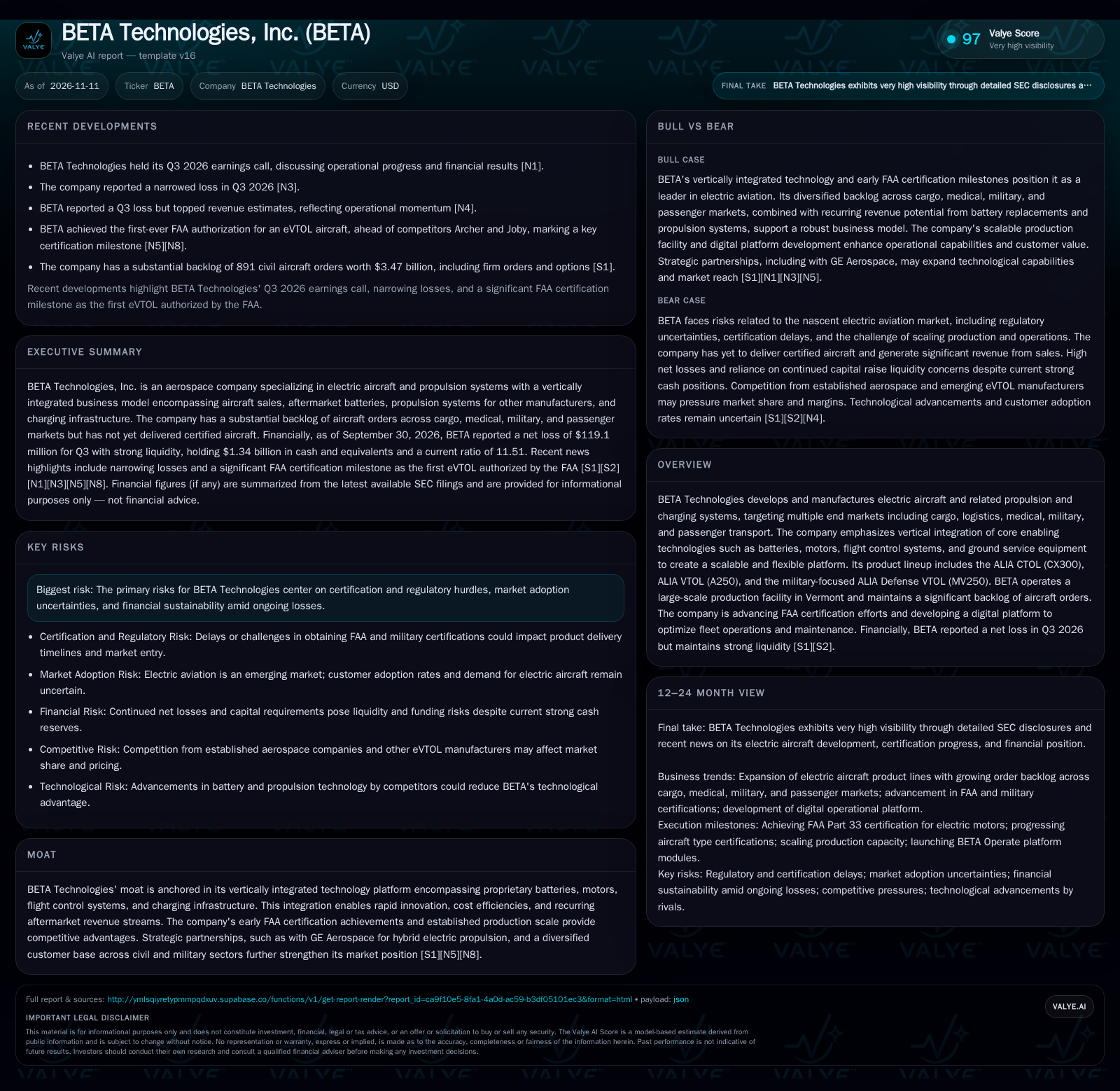
BETA Technologies, an electric aircraft company, has reached a significant FAA certification milestone ahead of key peers, holds a $3.47 billion civil aircraft backlog, and maintains reported liquidity position with $1.34 billion in cash. The company’s vertically integrated approach spans aircraft, batteries, propulsion, and charging, targeting cargo, passenger, and military markets. The next phase hinges on ramping up production, delivering certified aircraft, and realizing recurring aftermarket revenues, all while navigating adoption risk and competitive pressures. [S1] [S2] [N5]
BETA Technologies stands at a pivotal moment for the electric aviation sector, having secured the first-ever FAA authorization for an eVTOL aircraft—a milestone that both validates its technology and raises the stakes for execution. With an order backlog valued at $3.47 billion and a robust balance sheet, BETA has strong tangible support for its ambitions. The company’s future, however, will be determined less by regulatory firsts than by its ability to scale production, deliver on multi-market commitments, and foster real-world adoption in a nascent but rapidly evolving industry landscape.
FAA Authorization, Order Backlog, and Financial Position: What’s Changed for BETA?
BETA Technologies achieved a historic regulatory milestone by securing the first FAA authorization for an eVTOL aircraft, ahead of notable competitors Archer and Joby [N5]. This accomplishment marks a critical inflection point, as FAA certification is a prerequisite for commercial deliveries and revenue recognition in the regulated aviation space. The company reports a civil aircraft backlog of 891 units (firm orders plus options), representing $3.47 billion in potential contract value. Despite this substantial pipeline, BETA has yet to deliver a certified aircraft or recognize revenue from these sales [S1]. On the financial front, BETA posted a Q3 2026 net loss of $119.1 million, but maintains $1.34 billion in cash and equivalents, with a current ratio of 11.5—a liquidity buffer that supports near-term operational scaling and certification efforts [S2]. The convergence of regulatory progress, a robust order book, and available cash reframes the company’s risk/reward profile: execution risk and market adoption now become the central variables.
How BETA’s Vertically Integrated Model Could Drive Revenue and Margin Expansion
BETA’s business model is built on four revenue streams: aircraft sales (to both commercial and military customers), replacement battery sales, propulsion system sales to other eVTOL manufacturers, and ground service equipment (notably charging infrastructure) [S1]. The vertical integration of core technologies—batteries, motors, flight control, and charging—could yield both cost efficiencies and differentiated product performance. This approach may allow BETA to capture a greater share of the aviation value chain and reduce reliance on external suppliers, potentially improving gross margins over time if manufacturing scale is achieved.
Aircraft sales are expected to be high-ticket, episodic transactions, while battery replacements (estimated on 12–24 month cycles) and digital fleet management subscriptions could generate recurring, higher-margin aftermarket revenue over the aircraft lifecycle. Propulsion system sales to peer manufacturers represent a platform opportunity, but actual uptake will depend on BETA's ability to offer superior performance or cost advantages versus established aerospace suppliers. Ground service equipment sales, particularly chargers, are likely to be lower-margin but strategically important for customer adoption and network effects.
Scaling fixed-cost-intensive manufacturing is capital- and labor-intensive, but BETA’s Vermont facility is designed for production of over 300 aircraft annually, with expansion potential to more than 355,000 square feet [S1]. If production ramps as planned and backlog converts to deliveries, operating leverage could improve meaningfully. However, the capital intensity and production learning curve pose risks to near-term profitability, especially if demand or certification timelines slip.
Competitive Advantages, Substitutes, and the Race for Market Share in Electric Aviation
BETA’s primary competitive advantage lies in its early regulatory lead and vertically integrated technology stack, from proprietary batteries and motors to digital fleet management [S1] [N5]. This breadth could enable rapid iteration, improved system reliability, and cost control. The company’s backlog—spanning cargo, medical, military, and passenger markets—suggests a diversified initial customer base, reducing single-market dependency.
However, BETA faces competition from both incumbent aerospace companies and emerging eVTOL manufacturers. Incumbents bring established manufacturing, certification, and customer relationships, while eVTOL peers like Archer and Joby are aggressively pursuing similar FAA milestones. Technological substitution risk remains high: advances in battery energy density, hybrid propulsion, or alternative sustainable fuels could shift the basis of competition.
Adoption barriers—such as operator conservatism, regulatory hurdles in new markets, and the need for robust charging infrastructure—could favor companies with broad ecosystem offerings, but also raise the cost and complexity of market entry. The question is whether BETA’s integrated approach will yield a durable moat, or if larger aerospace players will eventually replicate or outscale these advantages.
From Certification to Commercial Leadership: What a Breakout Success Would Require
The most favorable scenario for BETA involves a rapid conversion of its backlog into certified aircraft deliveries, validating both its technology and operational capacity. Early fleet deployments—particularly with high-visibility customers in cargo, medical, or military sectors—could catalyze broader market adoption and attract additional orders. Recurring revenue streams from battery replacements, propulsion system sales to other manufacturers, and digital platform subscriptions could support gross margin expansion and reduce earnings volatility.
BETA’s early FAA certification could create a ‘first-mover’ perception, helping to secure additional contracts and locking in infrastructure standards (e.g., charging protocols) that become industry defaults. Strategic partnerships, such as with GE Aerospace for hybrid propulsion, may accelerate technological differentiation and open new market verticals.
Evidence supporting this scenario would include: sustained growth in firm orders (not just options), on-time delivery of certified aircraft, visible adoption of BETA’s charging ecosystem by third parties, and positive gross margin trends as production scales. Early digital platform adoption and recurring aftermarket revenue would further validate the long-term business model.
Execution Realities: Navigating Production Ramp, Deliveries, and Measured Adoption
The most plausible scenario is that BETA transitions from a pre-revenue, development-focused company to one gradually delivering certified aircraft to a core set of customers, with revenue recognition beginning in late 2026 or 2027. Production ramp-up may be slower than order book headline numbers suggest, as manufacturing, supply chain, and regulatory challenges typically create bottlenecks in new aerospace programs.
Recurring revenue from batteries and digital services may begin to materialize, but is likely to be modest in the near term given fleet size and customer learning curves. Competitive pressure from incumbents and peer eVTOL firms may limit pricing power and slow market share gains, particularly in the passenger and logistics segments.
Confirming this scenario would be evidence of incremental deliveries (even in small batches), initial customer testimonials or case studies, and gradual recognition of aftermarket revenue. Delays in certification for specific aircraft models or slower-than-expected option conversion rates would be signs that BETA is tracking a more measured commercial trajectory.
What If Adoption Lags or Execution Falters? The Impact of Delays and Competition
The adverse scenario centers on execution risk—delays in certification for key aircraft models, production bottlenecks, or quality issues could push out deliveries and erode customer confidence. If military or commercial customers defer option conversions or cancel orders due to regulatory uncertainty or better alternatives, BETA’s backlog could prove less durable than headline numbers suggest.
Competitive advances—such as a rival offering superior range, payload, or total cost of ownership—could shift demand away from BETA’s platforms, particularly if established aerospace players accelerate their own electric or hybrid programs.
Falsifying evidence would include: persistent delays in type certification, order cancellations, negative customer feedback, or a lack of traction for BETA’s digital and aftermarket services. Any sign of deteriorating gross margins as production scales would also be a warning signal that the vertically integrated model is not delivering expected efficiencies.
Milestones and Metrics That Will Define BETA’s Transition from Promise to Performance
Conversion rate of backlog: The pace at which firm orders and options translate into actual deliveries and recognized revenue will be a primary test of commercial traction.
Certification progress for ALIA CTOL (CX300), ALIA VTOL (A250), and Defense VTOL (MV250): Delays or successful milestones will directly impact the timing and scale of market entry.
Production throughput and yield at the Vermont facility: Actual aircraft output relative to stated capacity and reported bottlenecks or quality issues would signal operational execution.
Recurring revenue from battery replacements and digital platform subscriptions: If disclosed, this would validate the aftermarket economics central to BETA’s long-term thesis.
Gross margin trends as production scales: Improving or deteriorating margins will test the effectiveness of vertical integration.
Adoption of BETA’s charging infrastructure by third-party operators: Evidence of network effects or ecosystem lock-in would support the moat narrative.
Customer retention and option conversion rates: Actual customer stickiness versus headline backlog is critical to long-term revenue visibility.
Regulatory and policy developments: Changes in eVTOL certification standards or incentives could reshape the competitive landscape and adoption curve.
Disclaimer: This is research-only, informational analysis and not investment advice. It may include AI-generated interpretation and general industry context. Always verify important details using primary sources.

Comments