
Darling Ingredients: Global Scale, Feed Strength, and the Renewable Fuels Integration Dilemma
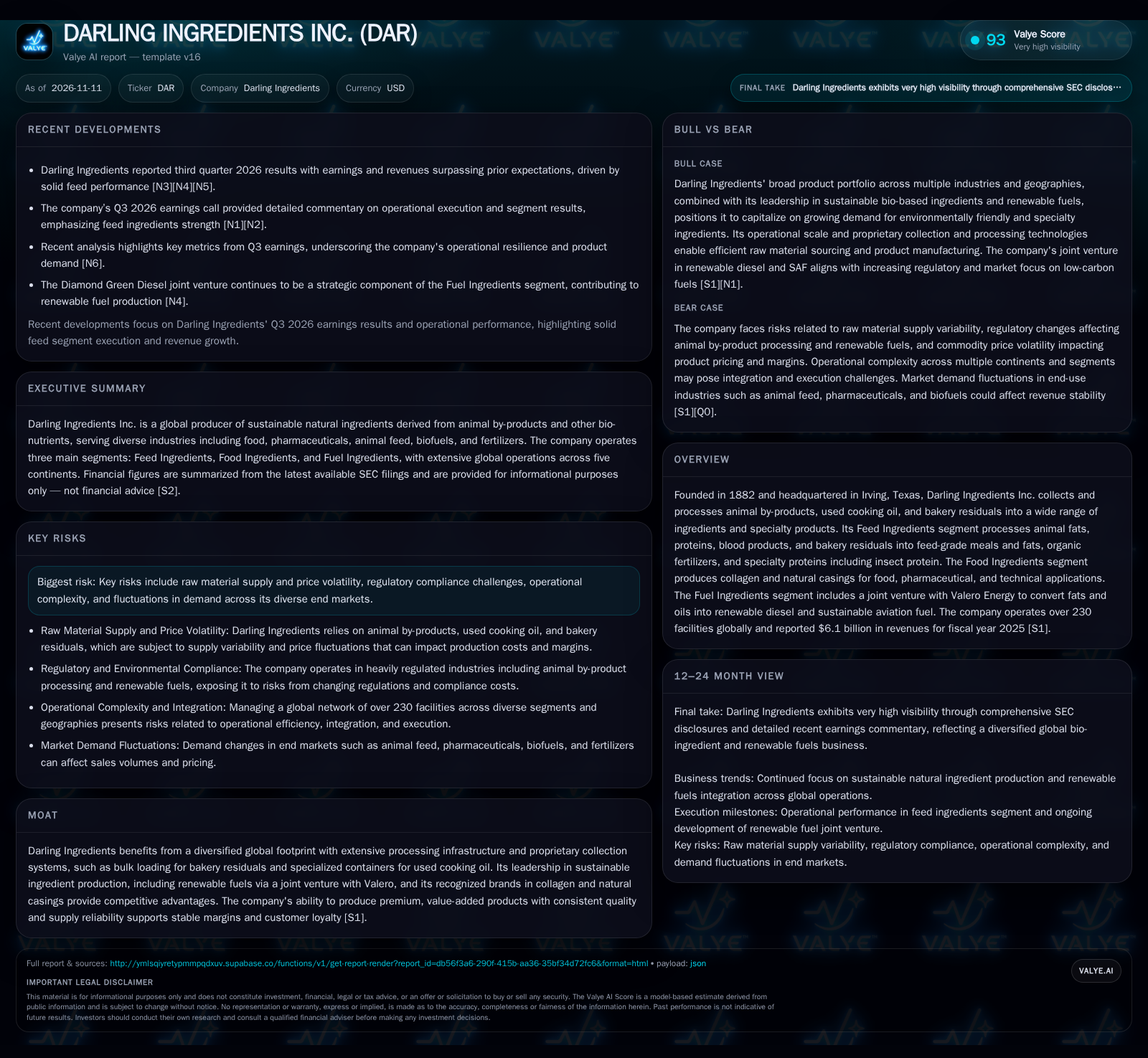
Darling Ingredients’ diversified bio-ingredient platform leverages global scale and proprietary collection networks to serve food, feed, and renewable fuel markets. Solid feed segment execution and the strategic Diamond Green Diesel joint venture are driving current outperformance, but questions remain around raw material volatility, regulatory risk, and the economic durability of its renewable energy ambitions.
Darling Ingredients delivered a robust Q3 2026, propelled by strong feed segment results and operational discipline. Its global network and vertically integrated business underpin a defensible position in sustainable ingredients, but exposure to commodity cycles, regulatory shifts, and execution risks in renewable fuels remain material counterforces. The company’s future rests on its ability to balance raw material sourcing, margin stability, and the scaling of high-value fuel ventures.
Darling Ingredients Inc. stands at the intersection of sustainable ingredient production and renewable energy integration. Its Q3 2026 performance—driven by feed segment strength and disciplined operations—demonstrates the company’s ability to navigate volatile markets and complex supply chains. Yet, as Darling deepens its commitment to renewable fuels through its Diamond Green Diesel joint venture, the interplay between commodity sourcing, regulatory change, and global execution risk will define its future value creation. Investors must weigh the durability of Darling’s operational edge against the structural uncertainties inherent in its sprawling, multi-segment platform.
Recent Feed Segment Outperformance and Fuel Platform Expansion
Darling Ingredients reported Q3 2026 earnings and revenues that surpassed expectations, with the feed ingredients segment highlighted as the primary driver of outperformance [N3] [N4] [N5]. For fiscal 2025, the Feed Ingredients segment contributed 65% of total revenue, underscoring its centrality to the business model [S1]. The company’s Diamond Green Diesel joint venture continues to be a strategic pillar within the Fuel Ingredients segment, converting animal fats and recycled feedstocks into renewable diesel and sustainable aviation fuel [S1] [N4]. As of the end of Q3 2026, Darling reported net income of $266.986 million, basic EPS of $1.70, cash and equivalents of $121.7 million, and a current ratio of 1.42 [S2]. These facts collectively emphasize the company’s current operational momentum, ongoing commitment to renewable fuels, and the importance of feed ingredient execution to overall financial health.
How Darling Turns Waste Streams into Profitable Ingredients
Darling Ingredients’ core economics hinge on transforming low- or negative-cost waste streams—animal by-products, used cooking oil, and bakery residuals—into higher-value products for feed, food, and fuel markets. The company’s vertically integrated collection network, with over 230 facilities globally, allows it to secure feedstock at scale, often with collection fees or low acquisition costs. This model creates a cost advantage over peers reliant on market-priced raw materials.
Revenue generation splits across three segments: Feed Ingredients (bulk protein meals, fats, fertilizers, insect protein), Food Ingredients (collagen, natural casings), and Fuel Ingredients (renewable diesel/SAF via the Diamond Green Diesel JV and biogas). Feed and food products are typically sold under contract or to recurring industrial buyers, while fuel segment economics are more exposed to commodity cycles and policy incentives.
Fixed costs are high given the global asset base, but incremental processing of additional waste streams can provide operating leverage. The mix between value-added food/collagen products (with relatively stable margins) and fuel/energy products (with volatile margins) is a critical driver of long-term profitability. Capital needs are ongoing, particularly for plant upgrades and fuel capacity expansions, but the company’s cash generation from feed and food segments has historically helped fund growth initiatives.
Defensible Scale, But Margin Pressures and Substitution Risks Loom
Darling’s competitive position is anchored by its proprietary global collection and processing infrastructure, which creates significant barriers to entry for new players and enables reliable, large-scale feedstock aggregation. The company’s recognized brands in collagen (Rousselot, Gelnex), natural casings (CTH), and animal feed ingredients (Sonac, FASA) bolster customer loyalty and pricing power in niche markets [S1]. Its leadership in renewable diesel production through Diamond Green Diesel provides exposure to fast-growing low-carbon fuels, but also ties a portion of future growth to regulatory support and feedstock availability.
However, the business faces persistent counterforces: commodity processors, rendering cooperatives, and integrated agribusinesses are potential competitors, especially in North America and Europe. Substitution risk is present, as synthetic or plant-based proteins and alternative biofuel feedstocks could erode demand or compress margins over time. Regulatory changes—particularly in waste-derived fuel incentives or animal by-product handling—could shift the economics for both feed and fuel segments. The breadth of Darling’s platform is a strength, but also a source of complexity when managing cost, quality, and compliance across diverse markets.
If Darling Achieves Synchronized Growth in Feed, Collagen, and Renewable Fuels
In a favorable scenario, Darling leverages its collection infrastructure and processing scale to capture growing demand for sustainable ingredients and low-carbon fuels. Continued outperformance in feed (driven by robust protein meal and fertilizer demand) and stable, premium-margin collagen sales underpin strong cash flow. The Diamond Green Diesel joint venture benefits from supportive regulatory policies (e.g., renewable diesel blending mandates, SAF credits) and stable feedstock sourcing, allowing for profitable capacity expansion.
This scenario would be confirmed by sustained growth in feed and food segment revenues, visible margin improvement in the fuel segment, and expanding contribution from new products such as insect protein and biogas. Evidence would include above-peer volume growth, new long-term offtake agreements for renewable fuels or specialty ingredients, and further capacity investments in high-value segments. Falsification would occur if regulatory tailwinds weaken, feedstock costs spike, or if feed and collagen volumes stagnate despite broader market growth.
Balancing Margin Stability with Fuel Volatility in a Diversified Platform
The most plausible medium-term trajectory for Darling is continued revenue dominance from feed ingredients, with moderate growth in food and fuel segments. Feed margins remain resilient, supported by efficient raw material sourcing and steady demand from animal nutrition and pet food markets. Collagen and casings contribute stable, premium margins, but face only incremental growth due to mature end markets and rising competition from plant-based alternatives.
The fuel segment, anchored by the Diamond Green Diesel JV, experiences margin and volume volatility tied to policy shifts and feedstock price swings. However, the segment continues to provide growth optionality and helps diversify the earnings base. The base case would be confirmed by relatively steady segmental revenue mix, modest incremental margin expansion in core feed and food categories, and periodic but not transformative fuel segment gains. This scenario would be challenged if raw material costs rise sharply, regulatory incentives weaken, or if execution missteps erode the cost advantage in collection and processing.
When Raw Material Volatility and Regulatory Shifts Hit the Bottom Line
In an adverse scenario, Darling faces a confluence of rising raw material costs (animal by-products, used cooking oil), reduced availability, and tightening environmental regulations that increase compliance costs or restrict feedstock flows. Commodity price swings compress margins across feed, food, and especially fuel segments, while regulatory headwinds (e.g., removal of renewable fuel credits or shifts in animal by-product handling rules) undermine the economics of the Diamond Green Diesel JV.
Operational complexity—managing over 230 facilities across five continents—amplifies integration and execution risk, leading to cost overruns, downtime, or quality issues. If end-market demand for animal protein or collagen softens, or if plant-based and synthetic alternatives gain rapid share, revenue and margin stability could erode. Confirmation of this scenario would come from declining segment margins, negative volume trends, or regulatory changes that directly impact revenue visibility. Falsification would require evidence of raw material price stability, regulatory clarity, and sustained demand for core ingredients.
Milestones and Metrics That Will Validate or Challenge Darling’s Diversification Thesis
Quarterly and annual trends in segment-level margins—especially for Feed Ingredients and Fuel Ingredients—would help determine the durability of Darling’s competitive advantage.
Volume growth or contraction in collected raw materials (animal by-products, used cooking oil, bakery residuals) would provide insight into sourcing resilience and operational leverage if disclosed.
Updates on regulatory developments affecting renewable diesel, SAF incentives, or animal by-product processing standards will shape the risk/reward for the fuel and feed segments.
Capacity expansions, utilization rates, or operational bottlenecks at major processing facilities (particularly Diamond Green Diesel JV plants) would help test scalability and execution.
Market share changes in core product categories (e.g., collagen, protein meals) would indicate competitive positioning and pricing power if disclosed.
The pace of new product commercialization—such as insect protein or advanced bio-phosphates—could signal the company’s ability to innovate and diversify revenue.
Trends in working capital needs and capital expenditure requirements, relative to cash generation, would clarify the sustainability of Darling’s growth model.
Customer contract renewals, new long-term offtake agreements, or supply chain disruptions in major regions would provide early warning of potential demand or execution challenges if disclosed.
Disclaimer: This is research-only, informational analysis and not investment advice. It may include AI-generated interpretation and general industry context. Always verify important details using primary sources.

Comments