
Cartesian Growth Corp III: SPAC Ambition Meets Solid-State Battery Execution Risk
With a disciplined private equity pedigree and strong pre-combination liquidity, Cartesian Growth Corp III aims to merge with Factorial Energy, an early-stage solid-state battery developer. The deal’s long-term value hinges on Factorial’s ability to overcome formidable technical, manufacturing, and commercialization hurdles in a fiercely competitive EV battery landscape.
Cartesian Growth Corp III, a well-capitalized SPAC backed by experienced private equity leadership, targets Factorial Energy for its initial business combination.
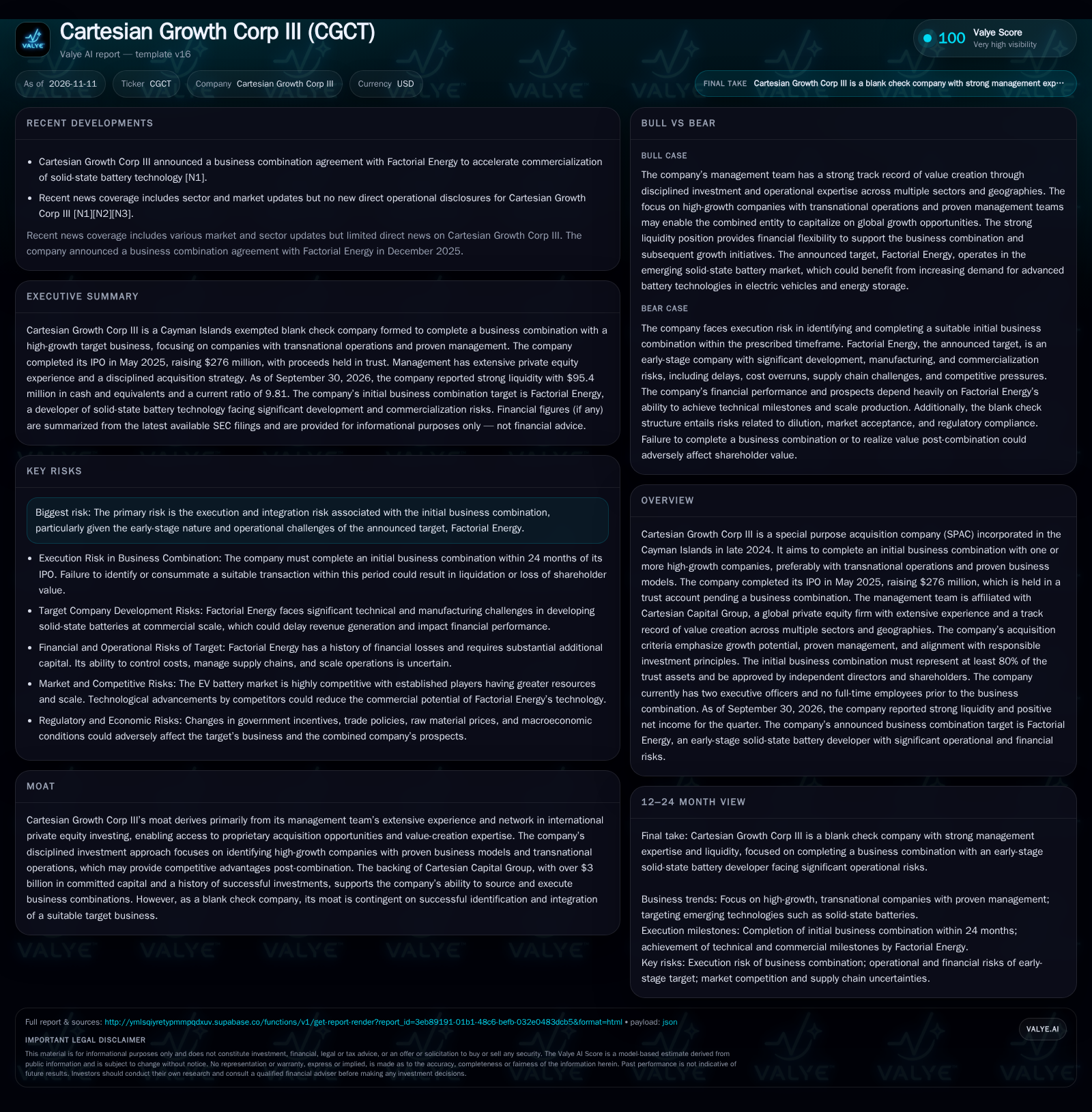
Cartesian Growth Corp III sits at the intersection of private equity discipline and SPAC opportunism, with $276 million raised and a reported current ratio as of late 2026. Its choice of Factorial Energy—a developer of next-generation solid-state batteries—as its business combination target promises exposure to a potentially transformative EV technology. However, the path from laboratory innovation to profitable commercial production is fraught with uncertainty, and the investment case now depends on Factorial’s ability to achieve technical milestones, scale manufacturing, and win customers in a challenging and capital-intensive market.[S2]
IPO Proceeds, Target Selection, and the Shift from Financial Strength to Execution Risk
Cartesian Growth Corp III completed its IPO in May 2025, raising $276 million, and as of September 30, 2026, reported $95.4 million in cash and equivalents, with a current ratio of 9.81 and a cash ratio of 9.18, signaling strong pre-combination liquidity.[S2] The company’s announced target, Factorial Energy, is an early-stage solid-state battery developer with a history of financial losses and significant capital requirements. While Cartesian’s management brings extensive private equity experience, the thesis has transitioned from the SPAC’s financial position and sponsor credentials to the operational and technological execution of the target. The business combination must be completed within 24 months of the IPO, creating a hard deadline for both deal closure and shareholder approval.
How Value Could Be Created in a Solid-State Battery Rollout
The economic logic of the deal will ultimately depend on Factorial Energy’s ability to transition from R&D to scalable, cost-effective commercial production of solid-state batteries. In the battery sector, gross margins are shaped by material costs (notably lithium and other inputs), manufacturing yields, and scale efficiencies. Fixed costs are high due to capital expenditure for plant and equipment, while variable costs are sensitive to raw material price swings and process yields. If Factorial can achieve technical breakthroughs—such as higher energy density and safety at competitive costs—there is potential for premium pricing, especially in automotive and high-performance segments. However, absent near-term revenue and with ongoing R&D and scale-up expenses, Factorial is likely to incur substantial losses and cash outflows before achieving break-even. Ongoing capital needs for R&D, plant buildout, and supply chain development are material, and the timing and magnitude of future cash flows remain highly uncertain.[S2]
For Cartesian Growth Corp III, the economics of the SPAC structure mean most IPO proceeds are held in trust until a deal is approved, and sponsor returns are heavily tied to post-combination equity appreciation. If the business combination closes and Factorial’s commercialization succeeds, substantial upside could accrue; if execution falters, sponsor promote and public shareholders face dilution and downside.
Can Factorial Carve Out an Edge in a Crowded Battery Innovation Race?
Factorial Energy operates in an intensely competitive environment, with established lithium-ion battery manufacturers, well-funded solid-state startups, and automotive OEMs all racing to commercialize next-generation battery technology. Major battery suppliers have deep relationships with automakers and scale advantages, while new entrants must prove technical and cost parity—or superiority—to displace incumbents. Intellectual property, proprietary manufacturing processes, and customer collaborations could serve as sources of differentiation, but the sector is marked by rapid innovation and aggressive capital deployment.
Switching costs for automotive OEMs are substantial due to qualification cycles and integration challenges, but actual customer stickiness will depend on Factorial’s ability to meet performance, safety, and cost benchmarks. The competitive threat from alternative battery chemistries, as well as potential regulatory changes or shifts in EV adoption rates, add further uncertainty. Factorial’s path to a durable competitive position will require not just technical success but also the ability to scale manufacturing and secure long-term supply agreements.
What a Breakout Success Would Look Like—and What Could Prove It
If Factorial Energy achieves technical milestones—demonstrating reliable, high-energy-density solid-state batteries at competitive cost—and scales manufacturing to meet automotive OEM requirements, it could rapidly attract high-value contracts and partnerships. In this scenario, the combined company could ride the wave of EV adoption, command premium pricing, and potentially secure a first-mover advantage with major carmakers. Operating leverage would improve as fixed costs are absorbed over higher volume, and the company could transition to positive cash flow ahead of initial projections.
Evidence supporting this scenario would include: announced multi-year supply agreements with leading OEMs, successful pilot production runs with high yields, cost per kWh metrics approaching or beating incumbent lithium-ion technology, and regulatory or safety certifications enabling market entry. Disclosure of backlog, customer adoption rates, and progress toward commercial-scale manufacturing would further validate the thesis.
Commercialization Delays, Gradual Scale-Up, and Ongoing Capital Needs
The most plausible near-term path is that Factorial Energy continues to advance its technology but encounters delays in scaling manufacturing and converting pilot results into commercial contracts. R&D and plant ramp-up expenses may outpace early revenue, requiring additional capital infusions before the business turns cash flow positive. Customer adoption could proceed incrementally, with automakers demanding extensive validation and reliability testing before committing to large-scale supply agreements.
Evidence for this scenario would be ongoing net losses, periodic capital raises or debt financings, and disclosures about technical bottlenecks or extended timelines for commercial production. Updates on customer pilot programs, supply chain partnerships, and incremental technical milestones would help confirm a measured, but not breakout, commercialization trajectory.
If Technical Hurdles or Cost Overruns Derail the Investment Thesis
A more adverse scenario would see Factorial Energy unable to overcome technical or manufacturing bottlenecks—prolonging the R&D phase, driving up costs, and eroding customer confidence. In this outcome, the company could miss delivery deadlines, become reliant on costly third-party components, or face reputational damage if pilot programs fail to meet performance or safety standards. Prolonged negative cash flow without commercial traction would force further dilutive financings or, in the worst case, jeopardize the combined company’s ability to continue as a going concern.
Evidence supporting this scenario would include: repeated delays in technical milestones, disclosure of cost overruns or unfavorable supply contracts, lack of customer traction, or withdrawal of OEM partners from pilot programs. Negative developments in the competitive landscape—such as a rival achieving technical or cost leadership—would further pressure the thesis.
Milestones and Metrics That Will Make or Break the Cartesian–Factorial Story
Progress toward closing the business combination with Factorial Energy within the SPAC’s 24-month deadline.
Disclosure of customer contracts, pilot programs, or supply agreements—especially with major automotive OEMs.
Updates on manufacturing scale-up: facility buildout, pilot production yields, and cost per kWh achieved (if disclosed).
Capital raise announcements, burn rate trends, and revised projections for cash runway or additional funding needs.
Evidence of technical milestones achieved: energy density, cycle life, safety certifications, and regulatory approvals.
Management turnover or changes in key technical personnel at Factorial Energy.
Competitive landscape developments—such as rival solid-state battery companies announcing commercial partnerships or technical breakthroughs.
Material changes in raw material input costs or supply chain disruptions that impact Factorial’s economics.
Disclaimer: This is research-only, informational analysis and not investment advice. It may include AI-generated interpretation and general industry context. Always verify important details using primary sources.

Comments