
Narragansett Bancorp: Limited Disclosure, Positive Earnings, and the Challenge of Incomplete Transparency
Narragansett Bancorp, Inc.
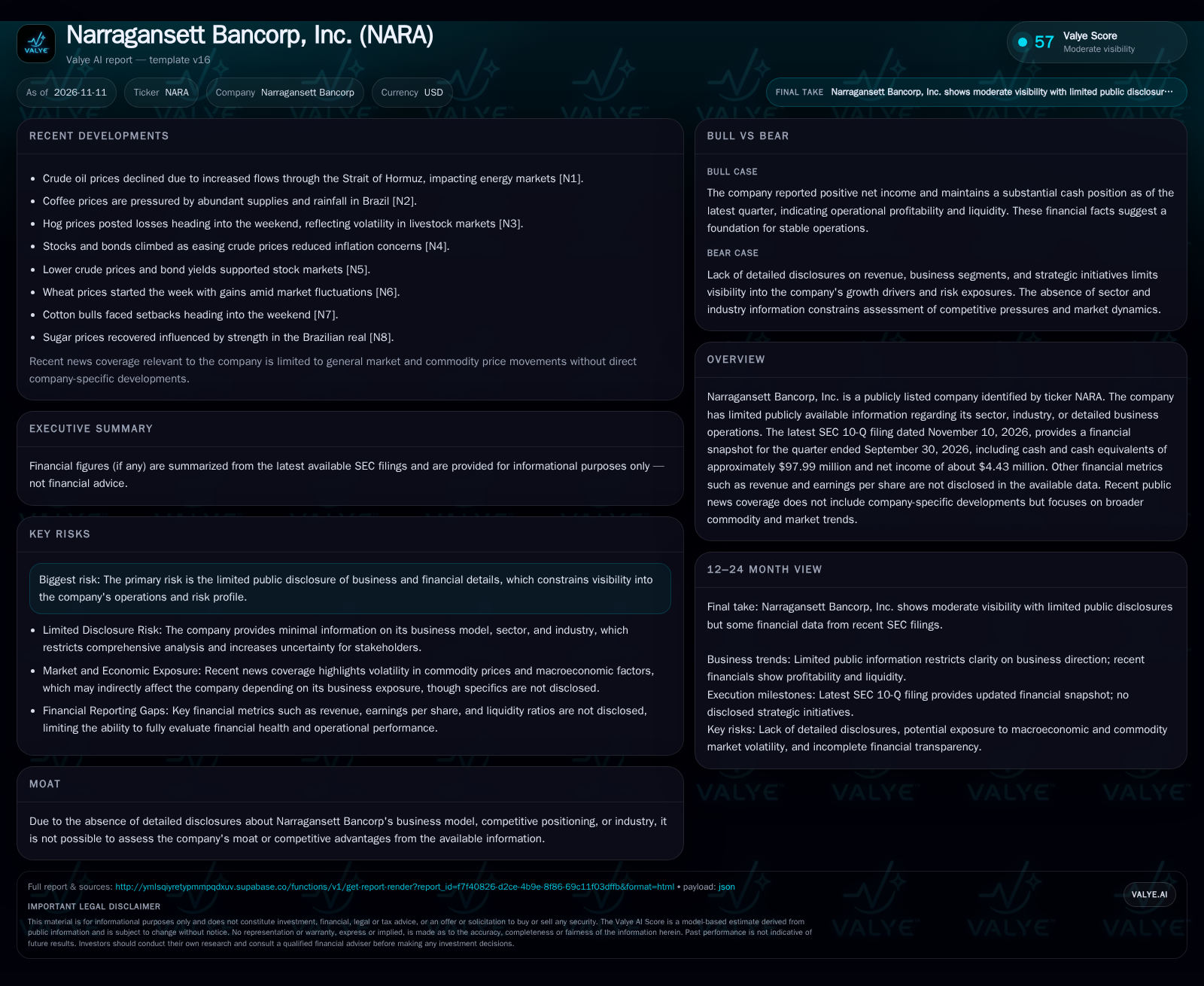
Narragansett Bancorp’s latest SEC filing reveals net income of $4.43 million and cash holdings of nearly $98 million as of September 30, 2026. However, the company provides minimal business, revenue, or segment information, leaving the core drivers of profitability and future risks opaque. Investors face a challenge in assessing the sustainability and sources of earnings given the limited transparency.
Narragansett Bancorp, Inc. presents a paradox for investors: recent SEC filings show positive net income and a substantial cash balance, but the company has released almost no information about its underlying business, revenue streams, or industry context. This absence of disclosure means that while the company appears profitable and liquid as of the latest quarter, stakeholders have little insight into what drives these results, what risks may be lurking, or how sustainable the current trajectory is. The challenge for any analysis is to interpret these financial signals in a vacuum, relying on scenario analysis and general banking or financial holding company logic to frame plausible pathways forward.
Earnings and Liquidity in the Absence of Transparency
Narragansett Bancorp reported net income of $4.43 million for the quarter ended September 30, 2026, and held $97.99 million in cash and cash equivalents at that date [S1]. These figures suggest that the company is operating profitably and maintains a significant liquidity reserve. However, the lack of disclosed revenue, segment breakdowns, or business model details prevents a clear understanding of how these results were achieved or what portion of earnings may be recurring versus one-time in nature. No additional operational or strategic milestones are reported, and there is no evidence of recent company-specific news or developments.
How Profits Might Be Generated: Scenarios for Revenue and Cost Structure
Without direct disclosure of Narragansett Bancorp's business model, one can only speculate on the mechanics behind its profitability. If the company operates as a traditional bank holding company or community bank—a plausible scenario given its name—it may derive revenue from net interest income (the spread between interest earned on loans and interest paid on deposits), service fees, and potentially investment or trading activities. In such models, fixed costs include branch operations, compliance, and technology, while variable costs are tied to transaction volumes and credit provisioning. High cash balances could indicate a conservative liquidity posture, readiness for loan origination, or limited recent lending activity.
The positive net income suggests either a favorable interest-rate environment, effective cost management, or non-recurring gains (such as asset sales or securities gains). However, without revenue, margin, or loan/deposit data, it is impossible to assess the underlying operating leverage, cost structure, or capital requirements. A critical unknown is whether the current profitability is sustainable or the result of unusual, non-recurring items.
In addition to traditional banking revenue streams, the company's profitability could also stem from alternative financial services such as wealth management, insurance underwriting, or advisory fees, which typically have different margin profiles and risk characteristics. If such diversified revenue lines exist, they might contribute to earnings stability or volatility depending on market conditions and client retention. Furthermore, the cost structure in these segments often involves higher fixed costs related to specialized personnel and compliance, which could affect operating leverage differently than lending-focused activities. Understanding whether Narragansett Bancorp benefits from such diversification would materially influence assessments of earnings resilience and growth potential.
Competitive Dynamics: Opaque Market Positioning and Substitution Risks
The lack of sector and industry disclosure leaves Narragansett Bancorp’s competitive landscape undefined. If it is a regional bank or thrift, competition would typically come from other community banks, credit unions, and digital financial services platforms. Factors such as interest rate competition, digital transformation, and regulatory compliance would shape the company’s ability to maintain margins and attract deposits or lending business.
In the absence of disclosed information on loan portfolios, geographic footprint, or customer segments, it is unclear whether the company possesses any durable advantages such as brand loyalty, low-cost deposit base, or technology integration. Conversely, it may be vulnerable to digital disruptors or broader industry pressures such as margin compression, regulatory changes, or credit cycle deterioration.
Another critical dimension in evaluating competitive positioning is the company’s technology infrastructure and digital capabilities. If Narragansett Bancorp has invested in robust digital platforms, it could mitigate risks from fintech disruptors and enhance customer acquisition and retention at lower marginal costs. Conversely, lagging technology adoption might expose the company to substitution risks and margin pressure. Additionally, regulatory compliance costs and the ability to efficiently navigate evolving banking regulations would impact competitive dynamics, particularly for smaller institutions. The company’s scale relative to peers also matters; smaller banks often face higher per-unit costs and limited product offerings, which could constrain growth and profitability if not offset by niche market focus or superior service.
Profitability Is Sustained by Core Operations and Prudent Management
A favorable trajectory for Narragansett Bancorp would involve the current net income reflecting core, recurring operating profits from banking or financial services activities. If management is conservative, the high cash and liquidity levels could signal a well-capitalized institution positioned to weather macroeconomic volatility or to opportunistically deploy capital for growth (e.g., local lending, acquisitions, or digital investments).
Evidence that would confirm this scenario includes future disclosures of stable or growing net interest income, consistent fee revenue, and low credit losses. Additional proof would be regular dividend payments, prudent loan growth, and regulatory filings showing strong capital ratios. If future filings reveal stable earnings despite changing economic conditions, it would further suggest that the business is resilient and operationally sound.
Limited Visibility Persists, Earnings Volatility Remains a Possibility
The most plausible near-term scenario is continued limited public disclosure, with periodic net income figures but little accompanying detail. In this case, investors may see fluctuations in reported profitability driven by factors that remain opaque—such as non-recurring gains, shifts in asset mix, or market-driven valuation changes. The absence of segment or revenue detail means that the sustainability and quality of earnings will remain in question.
Confirmation of this scenario would be continued sparse filings with minimal business context, and potentially volatile quarterly net income. If future filings continue to omit revenue, margin, or asset quality data, it will be difficult to determine whether the company has a stable, recurring earnings base or is exposed to unpredictable swings in investment or market activity.
Hidden Risks Emerge: One-Time Gains or Adverse Exposures Drive Earnings Reversal
The greatest risk for Narragansett Bancorp is that current profitability is driven by non-recurring events—such as asset sales, securities gains, or temporary market factors—and that underlying core operations are weak or exposed to adverse trends. If the company is under-reserved for credit losses, faces deteriorating loan performance, or is exposed to volatile asset classes, future quarters could reveal sharp earnings declines or even losses.
This scenario would be confirmed by future filings disclosing significant write-downs, loan losses, or large swings in net income. If the company is forced to raise capital, cut dividends, or disclose material weaknesses in internal controls, it would further validate concerns about hidden risks. Without regular, transparent business updates, investors may be caught off guard by negative surprises.
Signals That Would Clarify Narragansett Bancorp’s True Business Trajectory
Disclosure of revenue, net interest income, and fee income would clarify the company’s core operating model and the sustainability of earnings.
Detailed segment or business line reporting—if provided—would help assess diversification, growth drivers, and risk concentration.
Trends in loan quality, non-performing assets, and credit loss provisions (if disclosed) would reveal exposure to credit cycles and underlying asset risk.
Capital adequacy and regulatory ratios would provide insight into the company’s risk absorption capacity and financial resilience.
Evidence of recurring dividends or share buybacks would suggest confidence in future cash flows, though the underlying source of funds would still require scrutiny.
New disclosures regarding strategic initiatives, digital transformation, or M&A activity would provide clues about management’s growth ambitions and risk appetite.
A useful metric would be disclosure of the loan-to-deposit ratio or other balance-sheet efficiency measures to gauge operational leverage and liquidity management.
Disclaimer: This is research-only, informational analysis and not investment advice. It may include AI-generated interpretation and general industry context. Always verify important details using primary sources.

Comments