
Phoenix Energy One: Leveraged Growth, Operational Expansion, and the Challenge of Capital Discipline
Phoenix Energy One, LLC has rapidly scaled its oil and gas asset base and production footprint since 2019, leveraging a three-pronged strategy of direct drilling, mineral/royalty acquisitions, and non-operated interests. While revenue and EBITDA have soared, the company’s high leverage and ongoing capital needs underscore the delicate balance between aggressive expansion and potential financial flexibility in a volatile commodity environment.
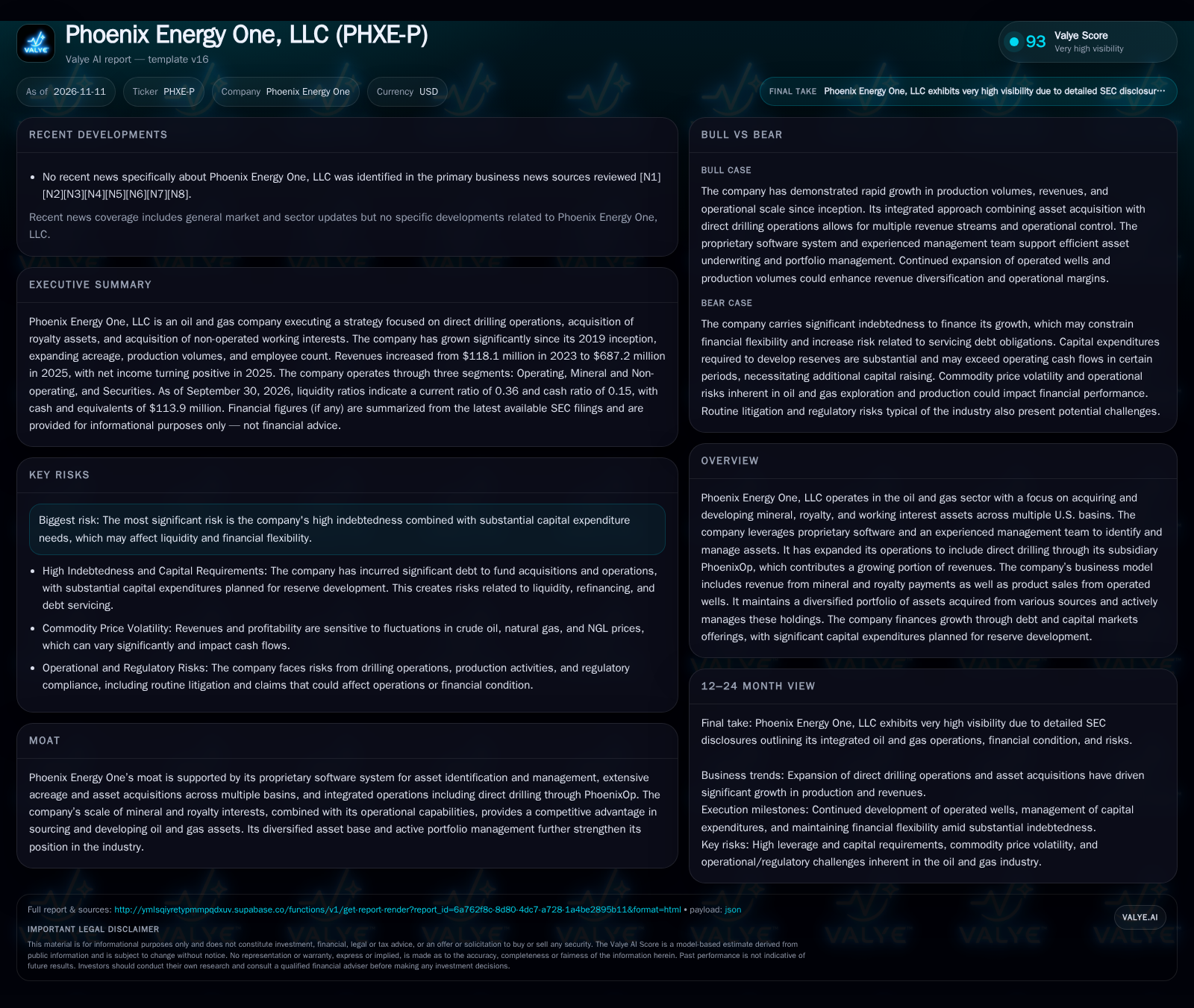
Phoenix Energy One’s revenue has grown nearly sixfold from 2023 to 2025, driven by aggressive asset acquisition and drilling, with operated production now the majority of revenues. The business’s future hinges on its ability to generate sustainable free cash flow from its growing asset base while managing leverage and exposure to commodity price swings. [S1] [S2]
Phoenix Energy One, LLC has rapidly emerged as an ambitious oil and gas operator, transitioning from royalty and mineral acquisitions to direct drilling across multiple U.S. basins. The company’s aggressive asset accumulation and operational expansion have fueled a transformation in both scale and revenue mix, but this growth has come at the cost of substantial leverage and ongoing capital demands. As Phoenix Energy One advances its drilling footprint and seeks to unlock value from its vast acreage, its ability to balance capital discipline, operational efficiency, and exposure to commodity cycles will define its long-term trajectory. [S1] [S2]
Rapid Asset Growth Meets Capital Constraints: The 2026 Snapshot
Phoenix Energy One has delivered extraordinary top-line growth, with revenue expanding from $118.1 million in 2023 to $687.2 million in 2025. This has been powered by a strategic shift toward direct drilling, evidenced by the company drilling 116 gross (105.7 net) producing wells between mid-2023 and the end of 2025. By the end of 2025, operated production accounted for over 63% of total revenues, reflecting the company’s pivot from primarily royalty and non-operated interests toward operating wells in the Williston, Powder River, and Denver-Julesburg basins. [S1]
This expansion has been fueled by significant leverage: as of December 31, 2025, Phoenix Energy One carried $1.53 billion in debt. Liquidity as of September 30, 2026 was tight, with $113.9 million in cash and a current ratio of just 0.36. The company continues to anticipate substantial capital expenditure needs through 2028 to develop its proved and probable reserves. The result is a business that has scaled rapidly but faces a persistent need for external capital to sustain its drilling program and manage debt service. [S1] [S2]
How the Model Works: Revenue Streams, Cost Structure, and Leverage
Phoenix Energy One generates revenue from three primary streams: (1) product sales from operated wells, (2) mineral and royalty payments from third-party E&P operators on acquired interests, and (3) capital markets activities via its Securities segment. The economics of operated wells are typically higher-margin but expose the company to full-cycle development costs, including drilling, completion, lease operating expenses, and production taxes. In contrast, royalty interests generate revenue with minimal direct operating costs but offer less control over production timing and development.
The company’s pivot toward operated production has increased both revenue and EBITDA—$403.6 million in 2025 versus $65.9 million in 2023—but also raised fixed costs, capital intensity, and exposure to commodity price volatility. Operating leverage is high: as production volumes and prices rise, incremental revenue can drive disproportionate gains in EBITDA and cash flow. However, the flip side is that downturns can quickly pressure margins and liquidity due to high baseline costs and interest expense.
Given the capital intensity of drilling and the company’s plans for further reserve development through 2028, Phoenix Energy One’s funding model is heavily reliant on debt and potentially future capital markets activity. The need to balance reinvestment in drilling with debt service and working capital is a central economic challenge.
Asset Scale, Technology, and Vertical Integration: Assessing the Strategic Edge
Phoenix Energy One’s competitive positioning rests on three pillars: its large and diversified acreage/mineral portfolio, proprietary software for asset identification and management, and vertical integration via direct drilling operations. The company’s footprint—over 4.4 million gross acres and 562,318 net royalty acres as of year-end 2025—provides significant optionality to allocate capital to the most attractive basins and drilling targets. [S1]
The development of specialized software may confer an edge in sourcing underappreciated assets and efficiently underwriting acquisitions, potentially lowering acquisition costs and improving returns. Vertical integration, especially the move to direct operation through PhoenixOp and Firebird Services, allows the company to capture a larger share of the value chain and control development pace, but also increases execution risk and exposure to cost overruns.
The competitive landscape includes traditional E&P operators in the Williston, Powder River, Permian, Uinta, and Denver-Julesburg basins, as well as mineral/royalty aggregators and private equity-backed consolidators. Success in this environment will depend on maintaining cost discipline, technological edge in asset selection, and the ability to access capital efficiently.
Unlocking Asset Value: When Operational Scale and Commodity Tailwinds Align
The bull case for Phoenix Energy One is that its aggressive acreage accumulation and shift to operated drilling unlock substantial value as production volumes ramp and commodity prices remain favorable. With over 100 net operated wells in production and a vast inventory of undeveloped reserves, the company could achieve significant operating leverage if it executes drilling programs on time and on budget.
A favorable causal chain would see strong well performance and cost control drive cash flow generation, enabling the company to fund capital expenditures internally and begin to deleverage. Sustained oil and gas prices above the company’s planning assumptions would amplify this effect, turning the current asset and debt base into a platform for compounding returns. Confirmation would come from consistent positive free cash flow, declining debt-to-EBITDA, and robust reserve replacement ratios. Falsification would occur if production growth stalls, costs escalate, or commodity prices fall below break-even levels despite operational execution.
Balancing Growth and Leverage in a Volatile Market Environment
The most plausible mid-term scenario is that Phoenix Energy One continues to grow production and revenues, but faces a persistent need to raise capital externally to fund drilling and debt service. Commodity prices likely fluctuate within a moderate band, supporting positive EBITDA but not sufficient free cash flow to materially reduce leverage. The company juggles drilling cadence, asset sales (if any), and refinancing to manage liquidity while gradually increasing operated well count.
This scenario would be confirmed by steady, but not accelerating, production growth, ongoing capital raises, and relatively stable leverage metrics. It would be falsified by either a sharp, sustained commodity price rally (enabling faster deleveraging and self-funded growth) or a severe downturn that forces a retrenchment in drilling activity or distressed asset sales.
When Leverage and Capital Intensity Collide with Commodity Downturns
The bear case centers on the risk that Phoenix Energy One’s high debt load and ongoing capital requirements become unsustainable in the face of falling oil and gas prices or operational setbacks.
A negative spiral could develop if lenders tighten terms or market appetite for new debt/equity dries up, particularly if operating costs rise or well performance disappoints. Confirmation would come from negative free cash flow, rising net debt, and an inability to maintain or grow production. Falsification would require evidence of disciplined capital allocation, operational outperformance, or a commodity price recovery that stabilizes financial metrics.
Milestones That Will Define Phoenix Energy One’s Next Chapters
Quarterly free cash flow generation (if disclosed) versus capital expenditures and debt service obligations—tracking ability to self-fund growth.
Production volumes and operating margins from operated wells, with particular focus on well performance relative to type curves and cost assumptions.
Net debt to EBITDA and interest coverage ratios—indicators of leverage sustainability and potential financial flexibility.
Reserve replacement and drilling inventory metrics, especially in core Williston, Powder River, and DJ basins.
Commodity price sensitivities and realized pricing differentials compared to benchmark indices.
Capital raising activity, including timing, terms, and mix of debt versus equity.
Any asset sales, joint ventures, or portfolio optimization efforts that could shift the company’s risk/reward profile.
Disclosure of litigation, regulatory, or operational setbacks that could materially impact financial results.
Disclaimer: This is research-only, informational analysis and not investment advice. It may include AI-generated interpretation and general industry context. Always verify important details using primary sources.

Comments