
Fold Holdings: Persistent Losses, Bitcoin Treasury Strategy, and the Challenge of Unproven Revenue Leverage
The company's disclosed focus on Bitcoin treasury management and capital access raises questions about its sustainable value proposition and the degree to which crypto exposure can offset or amplify operational volatility.
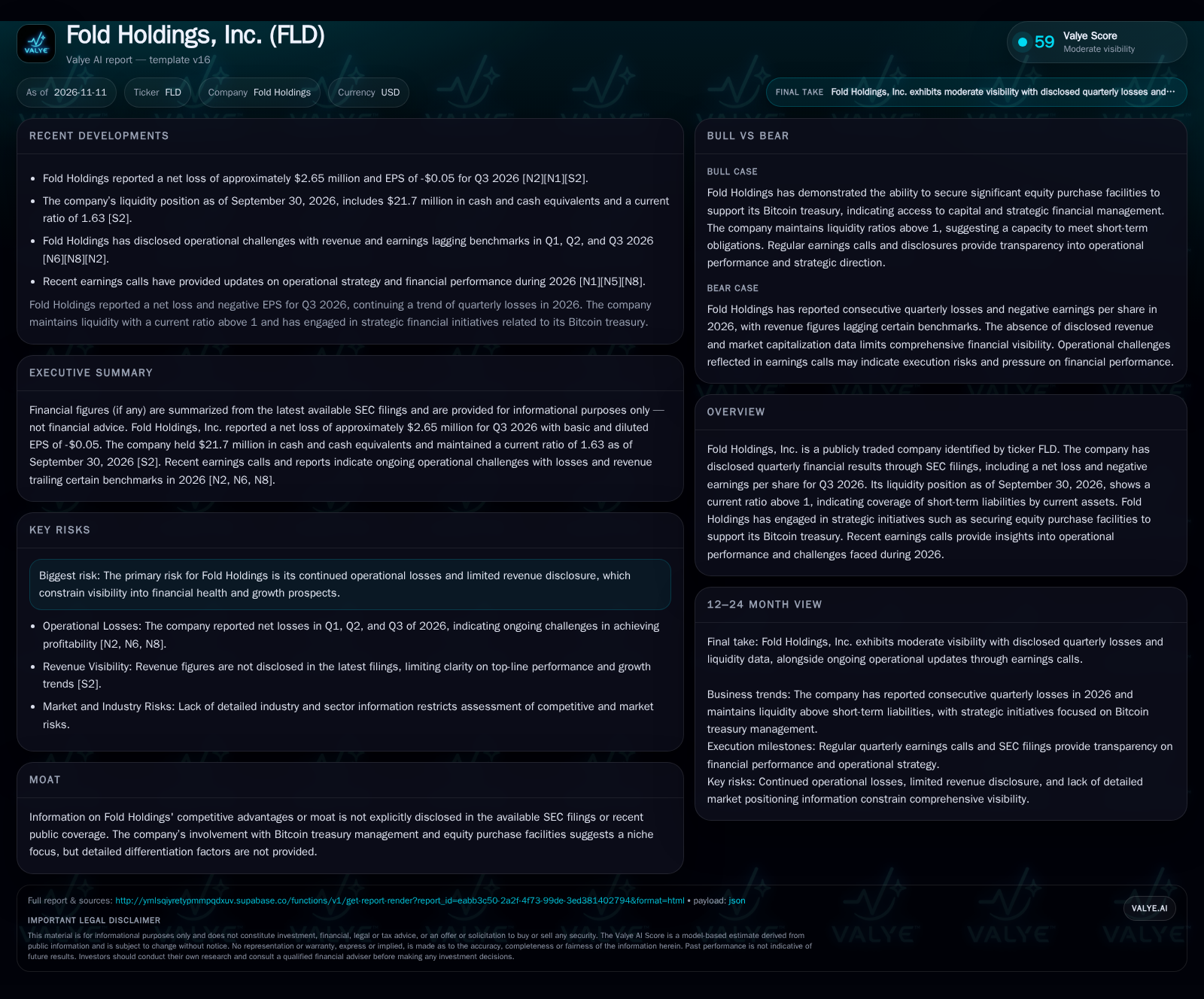
Fold Holdings closed Q3 2026 with a net loss of $2.65 million and negative EPS, maintaining $21.7 million in cash and a current ratio of 1.63 [S2]. Its strategy includes a substantial equity purchase facility for Bitcoin treasury activities, but the commercial impact of this approach remains unclear.
Fold Holdings, Inc. (FLD) enters the final quarter of 2026 with a run of operational losses, reporting a Q3 net loss of $2.65 million and negative earnings per share. The company’s strategic emphasis on Bitcoin treasury management—backed by a $250 million equity purchase facility—may offer financial optionality, but it also introduces volatility and uncertainty around the core value proposition. The question for investors and analysts is not merely whether Fold can survive the next few quarters, but whether its approach can generate sustainable returns or if operational losses will continue to erode shareholder value.
Q3 2026 Losses and Liquidity Coverage Define the Short-Term Picture
Fold Holdings reported a net loss of $2,649,889 for the quarter ended September 30, 2026, with basic and diluted earnings per share of -$0.05 [S2]. This marks the third consecutive quarterly loss in 2026, with revenue and earnings trailing expectations throughout the year [N2] [N6] [N8]. As of the end of Q3, the company held $21.7 million in cash and cash equivalents and reported liquidity-ratio trends of 1.63, suggesting that current assets can cover immediate liabilities [S2]. However, there is no detailed revenue disclosure in the latest filings, limiting insight into the sources or sustainability of cash generation. Recent earnings calls have focused on operational strategy and financial performance, emphasizing both the ongoing challenges and the company's efforts to reposition itself [N1] [N5] [N8].
Unpacking Fold’s Business Model: Revenue Ambiguity and Crypto-Driven Leverage
The absence of disclosed revenue figures in recent filings makes it challenging to pin down Fold Holdings’ core earning mechanics [S2]. Traditionally, a company with a focus on Bitcoin treasury management might generate returns through appreciation of digital assets, transaction facilitation, or related advisory and platform services. However, without clear breakdowns, it remains uncertain whether Fold’s top line is driven by active trading, asset appreciation, service fees, or a blend of these activities.
A $250 million equity purchase facility to enhance its Bitcoin treasury, as previously disclosed, implies a capital-intensive approach that may amplify both upside and downside volatility depending on the performance of crypto markets. This strategy could allow the company to benefit from positive Bitcoin price movements, but exposes it to significant mark-to-market and liquidity risks if the market turns.
Operating leverage in such a model is highly variable: if digital asset prices surge, reported earnings could improve quickly without a proportional increase in operating costs. Conversely, if Bitcoin prices fall or remain stagnant, losses could deepen, especially if fixed costs are not offset by recurring, non-volatile revenue streams. The lack of detailed cost structure and gross margin data means it is unclear how sensitive Fold’s bottom line is to swings in crypto valuation versus its baseline operating expenses.
Where Does Fold Fit? Niche Crypto Exposure Amid Unclear Differentiation
Fold’s public focus on Bitcoin treasury management sets it apart from traditional financial services firms but puts it in a loosely defined cohort of crypto-treasury operators and digital asset holding companies. In this space, competitive advantage could stem from proprietary technology, market access, regulatory positioning, or the ability to attract and retain capital at scale. However, the available disclosures do not establish clear differentiation, such as unique platform capabilities, customer relationships, or defensible network effects.
The company’s access to a sizable equity purchase facility may offer some advantage in scaling Bitcoin holdings relative to smaller peers, but this is a double-edged sword: while it allows for opportunistic accumulation during market dips, it also increases exposure to adverse market conditions. Larger, more diversified digital asset firms or established fintechs with integrated crypto offerings may be able to absorb volatility more effectively or cross-sell to a broader customer base.
A further complication is the regulatory environment, which remains fluid for crypto-treasury strategies. Firms with robust compliance and risk management infrastructure may gain a reputational edge, but there is no evidence in the current filings or public statements to suggest Fold has established such a moat.
A Crypto Market Rally and Strategic Execution Could Transform the Trajectory
If Bitcoin and broader crypto asset prices experience a sustained rally, Fold Holdings could see material mark-to-market gains on its treasury, potentially reversing quarterly losses and bolstering shareholder equity. The equity purchase facility would enable rapid scaling of digital asset positions, magnifying gains in a bullish environment. If the company successfully develops ancillary revenue streams—such as transaction fees, platform subscriptions, or advisory services—this could provide more stable top-line growth and lessen reliance on asset price appreciation.
Confirmation of this scenario would come from disclosed revenue growth tied to Bitcoin-related activities, improved gross margins, and a shift to positive operating income. Evidence of growing customer adoption, new product launches, or strategic partnerships in the crypto ecosystem would further support the case for sustainable upside. Conversely, muted or declining revenue, persistent losses despite a favorable crypto environment, or failure to diversify income sources would falsify this scenario.
Operational Losses Persist While Crypto Exposure Adds Volatility but Not Stability
The most plausible outcome, given current disclosures, is that Fold Holdings continues to report operational losses into 2027, with results highly sensitive to crypto market swings. Liquidity remains sufficient for near-term obligations, but without material improvement in revenue generation or cost discipline, the company may struggle to achieve profitability. Crypto exposure introduces upside optionality but also exposes shareholders to potential downside shocks.
This scenario would be confirmed by continued net losses, little to no revenue growth, and earnings that fluctuate in tandem with Bitcoin prices rather than operational milestones. If the company fails to articulate a clear path to recurring or diversified revenues, or if operational updates remain focused on financial engineering rather than business development, this would further support the base case.
Sustained Losses and Crypto Market Weakness Force Dilution or Strategic Retrenchment
Should Bitcoin prices stagnate or decline, Fold’s treasury strategy could exacerbate operating losses, erode shareholder equity, and force the company to seek additional external funding under adverse terms. If fixed costs remain high relative to revenues—and if new income streams fail to materialize—the company may face pressure to dilute existing shareholders through equity issuance or to divest core assets. Regulatory headwinds or tightening capital markets could further constrain strategic flexibility.
Persistent lack of revenue visibility, missed operational milestones, or adverse regulatory developments would further validate this scenario.
What Will Test Fold’s Crypto-Treasury Thesis in the Next Year?
Any disclosure of revenue composition—specifically, the proportion derived from Bitcoin-related activities versus other potential streams—would help clarify the business model’s durability.
Quarterly updates on cash and equivalents, including details on crypto holdings versus fiat, would illuminate liquidity risk and asset allocation.
Reported gross margins or operating leverage metrics, if disclosed, would help gauge the sensitivity of bottom-line performance to crypto market movements.
Evidence of successful deployment of the $250 million equity purchase facility—such as timing, pricing, and realized gains or losses—would test the effectiveness of Fold’s treasury strategy.
Announcements of new product lines, partnerships, or customer acquisition metrics would signal efforts to diversify and stabilize revenue.
Any regulatory disclosures, investigations, or compliance milestones relevant to crypto holdings or treasury activities would materially impact the risk profile.
Quarterly earnings calls and SEC filings that provide forward guidance or revised strategic priorities would offer clues about management’s confidence and evolving execution plan.
A useful metric would be customer churn or retention rates, if the company operates a platform or recurring revenue business; such data would help test the stickiness of any non-treasury offerings.
Disclaimer: This is research-only, informational analysis and not investment advice. It may include AI-generated interpretation and general industry context. Always verify important details using primary sources.

Comments