
Redwood Trust’s C-Corp Pivot: Tax Asset Gambit, Activist Pressure, and the Rebuilding of Mortgage Capital Platforms
Redwood Trust’s plan to transition from REIT to taxable C-corporation status in 2027 is a high-stakes strategic shift aimed at unlocking tax asset value and operational flexibility. Success hinges on the company’s ability to protect net operating losses, adapt its capital structure, and navigate activist pressures—all while repositioning in a changing mortgage finance landscape.
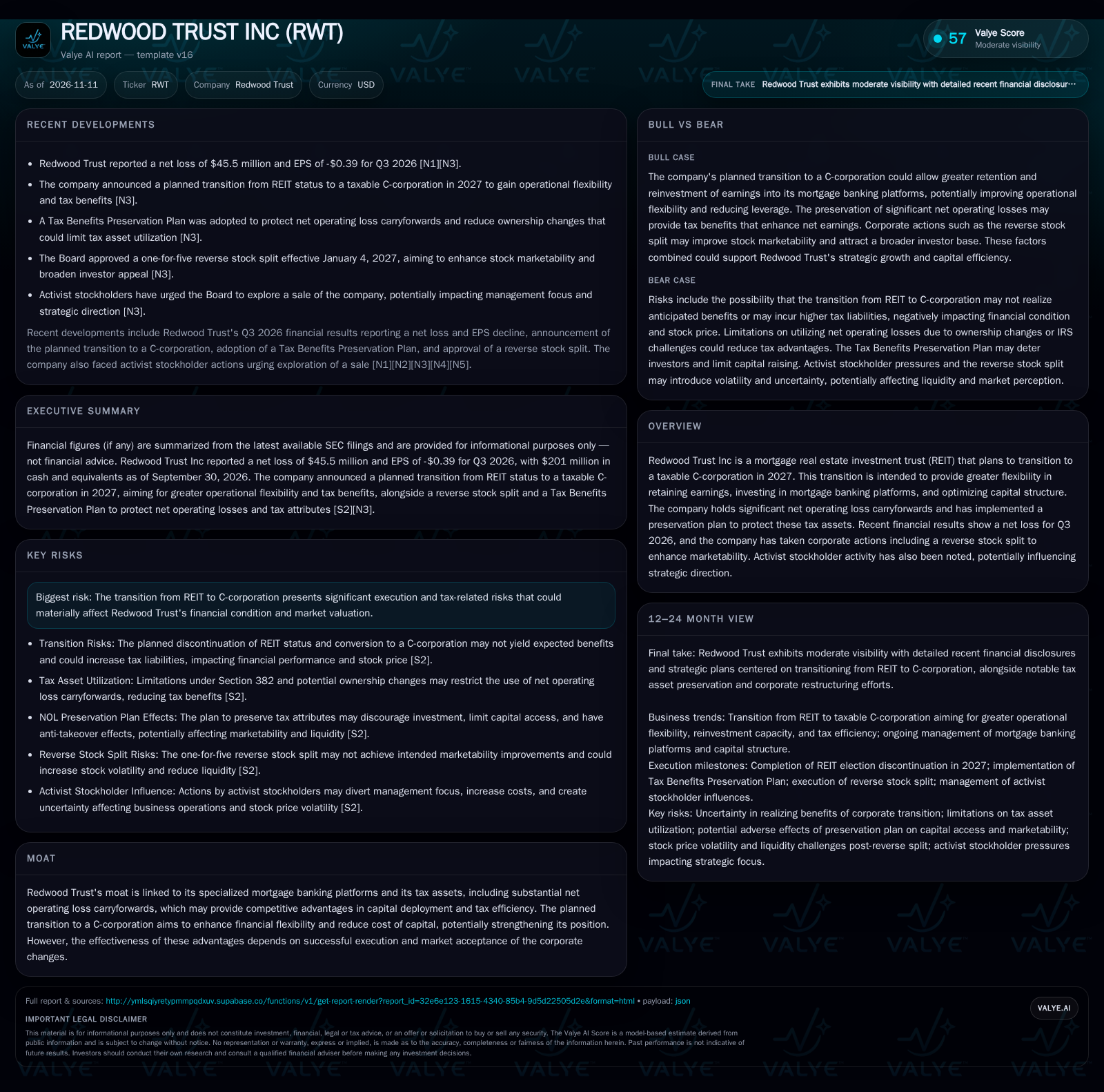
Redwood Trust’s announced move from REIT to C-corporation status in 2027 is designed to enable greater earnings retention and investment flexibility, leveraging substantial net operating loss carryforwards. The company has adopted a Tax Benefits Preservation Plan to protect these tax assets, but activist shareholders are pressing for a potential sale, injecting uncertainty into the transition. The effectiveness of the strategy will depend on execution, market acceptance, and the evolving economics of mortgage banking platforms. [N3]
Redwood Trust stands at a pivotal inflection point as it prepares to abandon its REIT status in favor of becoming a taxable C-corporation in 2027—a move explicitly aimed at unlocking operational flexibility and maximizing the value of its substantial net operating loss carryforwards. This transition, underpinned by a Tax Benefits Preservation Plan, comes amid activist investor agitation for a sale and broader uncertainty about the future of mortgage finance platforms. The ultimate outcome will depend not only on Redwood’s execution but also on its ability to protect tax assets, maintain investor confidence, and adapt to the evolving economics and competitive landscape of mortgage capital markets. [N3]
Strategic Shift: From REIT to C-Corp and the Tax Asset Imperative
Redwood Trust has publicly announced its intention to transition from a mortgage REIT to a taxable C-corporation in 2027. This move is designed to provide the company with greater flexibility to retain earnings—rather than being required to distribute them as dividends—and to reinvest in its mortgage banking platforms. The company holds significant net operating loss (NOL) carryforwards, which could be leveraged to shelter future taxable income, potentially enhancing after-tax earnings. To protect these valuable tax assets, Redwood has implemented a Tax Benefits Preservation Plan aimed at limiting ownership change events that could trigger IRS restrictions under Section 382. At the same time, activist shareholders have urged the Board to explore a sale of the company, introducing further uncertainty around management’s strategic direction and the potential for near-term disruption or a change in control. [N3]
Earnings Retention, Tax Shields, and Mortgage Banking Platform Economics
Redwood’s business model has historically relied on generating net interest income and fee income from mortgage banking activities, with required high payout ratios as a REIT limiting internal capital formation. The C-corp transition—if completed—may allow Redwood to retain and reinvest a greater share of its earnings, reallocating capital into higher-return mortgage banking and servicing platforms. The company’s substantial NOL carryforwards represent a potential tax shield, meaning future taxable income could be offset, reducing effective tax rates and boosting post-tax profitability for a period.
However, the economics of mortgage banking are inherently cyclical and sensitive to interest rate volatility, credit risk, and origination volumes. Operating leverage is high: fixed costs tied to platform infrastructure can create significant upside in periods of rising loan volumes but can also amplify downside when origination slows. The capital intensity of mortgage banking varies based on the mix of on-balance-sheet lending, loan sales, and servicing rights retention; a shift toward fee-based, capital-light activities may reduce risk, but would also typically compress margins. The flexibility gained from C-corp status could enable Redwood to optimize its capital stack—potentially reducing leverage or investing in technology and distribution—but the actual value creation will depend on management’s allocation discipline and the competitive returns available in a crowded mortgage finance market.
Mortgage Platform Differentiation and the Tax Asset Edge
Redwood Trust’s competitive position is built on its specialized mortgage banking platforms and its stockpile of tax attributes. The planned C-corp transition and NOL preservation strategy could, in theory, confer a cost advantage versus peers that do not have similar tax shields, allowing Redwood to reinvest more aggressively or price more competitively for a time. However, these advantages are contingent on successful execution and IRS compliance—ownership changes or regulatory challenges could erode the value of the NOLs.
The mortgage banking sector is highly competitive, with pressure from both traditional banks and non-bank mortgage originators. Technology-driven platforms, access to low-cost funding, and the ability to scale origination and servicing operations are key competitive levers. Redwood’s ability to differentiate via platform efficiency, product innovation, or servicing depth will determine whether tax advantages translate into durable outperformance. Meanwhile, activist shareholder activity could create both a catalyst for strategic change and a distraction for management, depending on how it is handled.
Unlocking Value: Tax Shields, Reinvestment, and Platform Scale
In a favorable scenario, Redwood Trust successfully completes its transition to C-corp status, retaining earnings and deploying them into scalable, higher-return mortgage banking and servicing businesses. The company preserves the full value of its NOLs, using them to offset taxable income and enhance net earnings over several years. Freed from REIT payout requirements, Redwood is able to invest in technology, expand distribution, and optimize its capital structure, leading to improved operating efficiency and competitive positioning.
This scenario would be supported by evidence of rising retained earnings, reinvestment into mortgage banking platforms, and growing fee-based income. Confirmation would come from disclosures showing full NOL utilization, increasing post-tax profitability, and platform market share gains without a meaningful increase in leverage. A resolution of activist pressures—either through constructive engagement or a strategic transaction at a premium—would further validate the thesis.
Execution, Tax Constraints, and Competitive Realities Shape Outcomes
The most plausible outcome is that Redwood transitions to C-corp status and retains some incremental earnings, but faces partial constraints in utilizing its NOLs due to Section 382 limitations or minor ownership changes. Operational flexibility improves, but the company remains subject to cyclical mortgage origination trends and competitive pricing pressure. The Tax Benefits Preservation Plan may succeed in protecting tax assets, but could also dampen investor interest or limit the pool of potential capital providers, offsetting some benefits.
Activist shareholder influence continues to create strategic noise but does not result in a near-term sale. Redwood’s platform investments produce modest efficiency gains, but the company’s returns on equity remain bounded by industry-wide margins and the gradual amortization of its tax shield. Evidence supporting this scenario would include incremental improvements in platform economics, partial NOL consumption, stable but not outsized growth in retained earnings, and ongoing—but non-disruptive—activist engagement.
Tax Asset Erosion, Activist Distraction, and Platform Underperformance
In an adverse scenario, Redwood’s efforts to protect its NOLs fail—due to an unexpected ownership change, regulatory challenge, or IRS ruling—substantially reducing or eliminating the anticipated tax benefits. The C-corp transition does not deliver operational or capital efficiency gains, and the company struggles to generate sufficient taxable income to use the NOLs before expiration.
The Tax Benefits Preservation Plan acts as a deterrent to new investors or potential acquirers, limiting access to capital and depressing the stock’s marketability. Activist pressures escalate, diverting management focus and increasing costs, while platform investments fail to deliver competitive differentiation. Mortgage origination volumes remain pressured by macro factors, and Redwood’s earnings and valuation deteriorate. Confirmation would come from updates disclosing impaired NOL utilization, rising operating expenses, stalled platform growth, or a failed strategic review.
Milestones That Will Define Redwood Trust’s Strategic Transformation
Progress toward completion of the REIT-to-C-corporation conversion in 2027, including regulatory approvals and any amendments to the transition timeline.
Quarterly disclosures of NOL carryforwards, utilization rates, and any Section 382 limitations imposed by ownership changes or IRS rulings.
Earnings retention and reinvestment rates post-transition, as reflected in balance sheet growth and capital allocation to mortgage banking or technology platforms.
Fee-based income and platform operating margins, if disclosed, to gauge the effectiveness of reinvestment and platform scaling strategies.
Impact of the Tax Benefits Preservation Plan on shareholder base stability, new investor participation, and any anti-takeover effects.
Updates on activist shareholder activity, Board responses, and any announced strategic alternatives, including potential sale processes or major governance changes.
Trends in mortgage origination volumes, market share, and competitive positioning of Redwood’s core mortgage banking platforms relative to industry benchmarks.
Liquidity and capital access metrics, particularly if the preservation plan or reverse stock split affects the company’s ability to raise funds or maintain trading liquidity.
Disclaimer: This is research-only, informational analysis and not investment advice. It may include AI-generated interpretation and general industry context. Always verify important details using primary sources.

Comments