
Somnigroup After Mattress Firm and Leggett & Platt: Integration Depth, Margin Structure, and Bedding Industry Barriers
Somnigroup’s twin acquisitions of Mattress Firm and Leggett & Platt have transformed its scale, vertical integration, and competitive posture. Yet, the company’s Q3 2026 record performance was tempered by segment disruptions and soft demand, raising questions about the durability of margin gains and the complexity of integrating new assets in a cyclical, highly competitive global bedding landscape.
Somnigroup International reported record Q3 2026 results, but also experienced segment-specific disruptions and softening demand. The integration of Mattress Firm and Leggett & Platt significantly expands Somnigroup’s retail footprint and vertically integrates key supply chain components, with the potential to drive operational efficiencies and product innovation. However, these advances come with execution risk and heightened exposure to global economic, supply chain, and competitive pressures. The company’s omni-channel and brand-focused strategy is robust, but the next phase will test its ability to realize acquisition synergies, defend margins, and adapt to evolving consumer and industry cycles.
Somnigroup International Inc. stands at a critical juncture in the bedding industry, having recently completed two transformative acquisitions: Mattress Firm, which solidifies its direct-to-consumer retail dominance, and Leggett & Platt, which brings key component manufacturing in-house. While Q3 2026 results showcased record performance, underlying challenges—including disruptions in the Dreams segment and signs of softer demand—indicate that the company’s expanded scale and integration efforts must now translate into sustainable margin improvement and operational resilience. The next phase for Somnigroup will test the realization of acquisition synergies and the ability to navigate a cyclical, globally competitive market.
Record Results, but Segment Strains and Integration Risk Loom
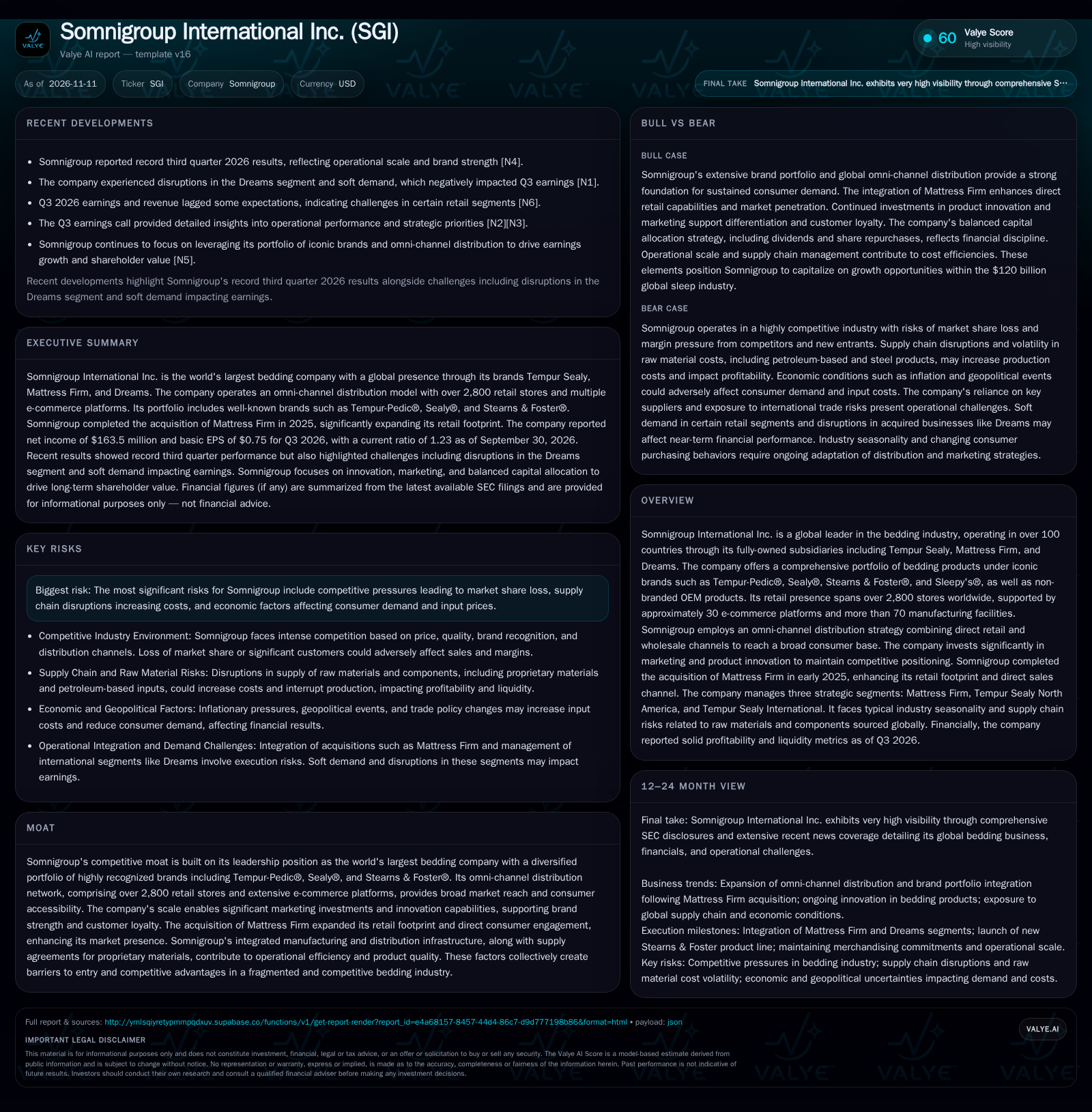
Somnigroup reported record third quarter 2026 results, underscoring the scale and brand power achieved through recent acquisitions and ongoing investment in marketing and innovation [N4]. However, these headline numbers were offset by disruptions in the Dreams segment and soft demand, which contributed to Q3 earnings and revenue coming in below some analyst expectations [N1] [N6]. [S2]
The company completed its acquisition of Mattress Firm in early 2025, adding over 2,100 retail locations, and the acquisition of Leggett & Platt in August 2026, vertically integrating a major supplier of bedding components and machinery [S2]. These moves have redefined Somnigroup's operational footprint, but also raise the stakes for successful integration and realization of supply chain and product innovation synergies.
How Vertical Integration and Omni-Channel Scale Could Shift Margin Structure
Somnigroup now operates along the entire bedding value chain: designing, manufacturing, distributing, and retailing mattresses, foundations, adjustable bases, and bedding accessories. The addition of Leggett & Platt’s engineered components business brings innersprings, specialty foam, and adjustable mechanisms under Somnigroup’s direct control, potentially reducing supplier dependency and input cost volatility for core product lines [S2].
The Mattress Firm acquisition shifts a larger portion of sales to direct-to-consumer retail, where companies typically enjoy higher average selling prices and greater pricing control but also assume higher fixed costs (store leases, labor). This move may increase the company’s operating leverage, with incremental sales driving higher margins if fixed costs are well managed. However, retail also brings exposure to local demand shocks and requires sustained marketing and merchandising investment.
On the wholesale side, Somnigroup continues to sell branded and OEM products to independent retailers and licensees, balancing volume with margin trade-offs. The company also derives royalty income from licensing its brands and technology, which provides a high-margin, low-capital revenue stream.
The combined manufacturing and retail footprint (over 70 manufacturing facilities and 2,800+ stores) creates opportunities for logistics optimization and product customization, but integration costs, supply chain complexity, and the need for ongoing capital investment are likely to rise in the near term.
Barriers to Entry and the Realities of Industry Fragmentation
Somnigroup’s competitive advantages derive from its globally recognized brands (Tempur-Pedic, Sealy, Stearns & Foster), broad omni-channel reach, and now, greater vertical integration. The company’s scale enables significant marketing spend and rapid rollout of product innovations, supporting brand loyalty and consumer mindshare.
However, the bedding industry remains highly fragmented, with regional manufacturers, direct-to-consumer startups, and large retail chains all competing on price, quality, and distribution access. While Somnigroup’s integration of Mattress Firm and Leggett & Platt increases its control over the value chain, it also exposes the company to risks from both upstream (raw material pricing, supply chain disruptions) and downstream (consumer demand swings, retail execution) pressures.
Substitutes in the form of low-cost imported mattresses, online-only brands, and private-label offerings at mass retailers are persistent threats. Somnigroup’s moat relies on the ability to sustain product differentiation, defend premium pricing, and keep cost structures competitive even as the industry cycles through demand shocks and promotional wars.
If Integration Delivers: Margin Expansion and Innovation Flywheel
The most favorable scenario is that Somnigroup successfully integrates Mattress Firm and Leggett & Platt, realizing procurement savings, production efficiencies, and faster product innovation across its global portfolio. By controlling key input components, the company could mitigate raw material price swings and improve gross margins, especially for premium brands.
Direct retail scale may allow for more personalized consumer engagement and upselling, supporting higher average order values and repeat purchases. If the company leverages its data and marketing capabilities to optimize inventory and pricing, it could further enhance profitability.
Evidence confirming this scenario would include: sustained gross and operating margin expansion in subsequent quarters; visible reduction in cost of goods sold as a percentage of sales; successful launch and uptake of new, differentiated product lines (such as the new Stearns & Foster line); and consistent market share gains in both North America and international markets.
Operational Complexity Tempers Margin Gains Despite Scale
A more likely outcome is that Somnigroup maintains industry-leading scale and profitability, but integration costs and cyclical headwinds offset some efficiency gains. While the acquisitions provide new levers for cost control and product development, the company must navigate seasonality, supply chain complexity, and varying consumer trends across geographies.
Margins may improve modestly as synergies are gradually realized, but operating expenses related to integration, store operations, and marketing remain elevated. Demand in certain segments (e.g., Dreams or international markets) could lag due to local economic or competitive pressures.
Confirmation of this scenario would be reflected in steady, but not dramatic, year-over-year margin improvement; stable or slightly increasing same-store sales growth; and ongoing, but uneven, performance across business units. Evidence against this case would include either a sharp decline in profitability (suggesting integration failure or demand collapse) or rapid, sustained margin expansion (indicating superior execution).
Integration Stumbles and Demand Shocks Undermine Scale Advantage
In an adverse scenario, execution missteps in integrating Mattress Firm and Leggett & Platt could lead to operational disruptions, loss of key personnel, or customer confusion. If supply chain synergies are not realized, or if raw material costs spike without offsetting pricing power, margins could compress sharply.
Simultaneously, a downturn in consumer demand—due to macroeconomic shocks, inflation, or increased online competition—could erode sales volumes, particularly in the high-fixed-cost retail channel. Inventory buildups or discounting could further pressure profitability.
Evidence for this scenario would include: declining gross and operating margins; negative same-store sales trends; missed synergy targets; and increasing write-downs or restructuring charges related to the acquired businesses.
Milestones and Data Points That Will Test Somnigroup’s Integration Thesis
Gross margin and operating margin trends by segment—especially for Mattress Firm and the newly acquired Leggett & Platt business—would help gauge synergy realization and cost control.
Same-store sales growth (if disclosed) for Mattress Firm and Dreams will indicate the health of the direct retail channel and the success of merchandising and marketing strategies.
Supply chain and production cost metrics, such as cost of goods sold as a percentage of revenue, will reveal the effectiveness of vertical integration and procurement strategies.
Inventory turnover rates and days sales outstanding (if disclosed) would help assess operational efficiency and demand-planning effectiveness post-integration.
Capital expenditure levels and timing, particularly for manufacturing upgrades and store remodels, could signal management’s confidence in integration progress and growth initiatives.
Royalty and licensing revenue trends, especially from international joint ventures, will shed light on the scalability and resilience of the asset-light portion of the business.
Any disclosure on realized versus targeted acquisition synergies, including cost savings and revenue enhancements, would be a direct test of the integration thesis.
Quarterly updates on liquidity and leverage ratios, especially in light of integration costs and potential macroeconomic headwinds, will inform balance sheet resilience.
Disclaimer: This is research-only, informational analysis and not investment advice. It may include AI-generated interpretation and general industry context. Always verify important details using primary sources.

Comments