
MARA Holdings: Scaling Digital Asset Infrastructure Through Volatility and Strategic Change
MARA Holdings is expanding beyond bitcoin mining into power generation and high-performance computing, but remains exposed to bitcoin price swings, regulatory flux, and capital-intensive growth.
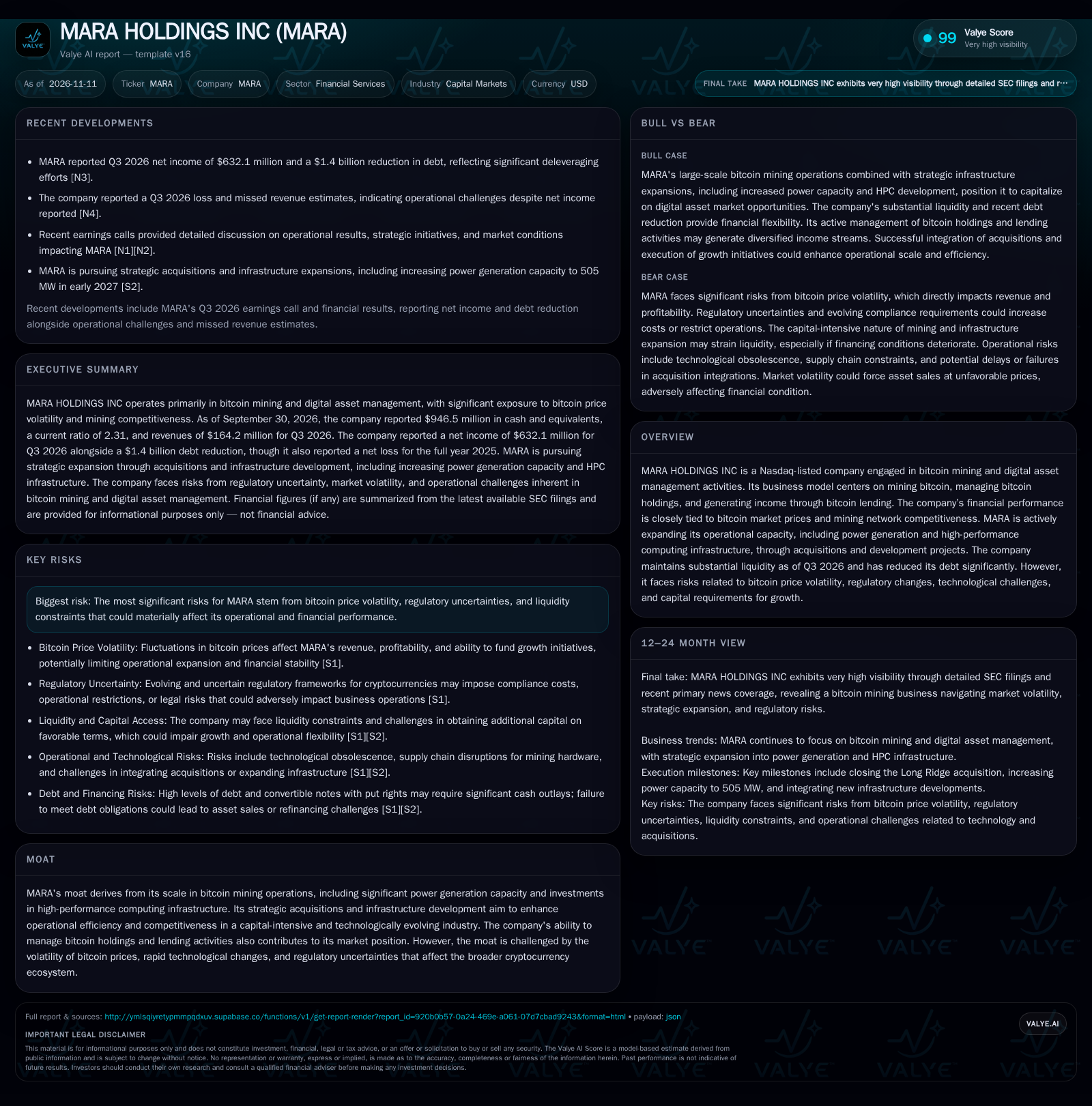
MARA Holdings reported $632.1 million in Q3 2026 net income alongside major debt reduction and continues to build out power and digital infrastructure. While the company holds significant liquidity and is pursuing HPC expansion, its fortunes remain tightly linked to bitcoin prices, mining competitiveness, and evolving regulatory and capital market conditions. Strategic acquisitions and integration will be key to future scale and resilience, but technology, compliance, and funding risks persist. [S2] [N3] [N4]
However, MARA’s business remains acutely exposed to the volatility of bitcoin markets, regulatory crosscurrents, and the capital demands of scaling its infrastructure. As the industry faces rapid technological and policy shifts, MARA’s ability to execute on its expansion plans and manage risk will be central to its long-term value proposition.
Recent Deleveraging Highlights a Key Company Transition
MARA Holdings reported $632.1 million in net income for Q3 2026, coupled with a $1.4 billion reduction in debt, marking a significant deleveraging effort [N3]. [S2] Operationally, MARA continues to focus on bitcoin mining and digital asset management, but is now expanding into power generation and high-performance computing (HPC), including a pending acquisition of Long Ridge that would increase nameplate capacity from 485 MW to 505 MW in early 2027 [S2]. However, Q3 2026 also saw MARA miss revenue estimates and report a loss, underscoring the volatility and operational challenges inherent to the sector [N4]. These developments collectively set the stage for a business balancing expansionary ambitions with the persistent headwinds of digital asset market cycles and regulatory flux.
MARA’s Business Model: Turning Volatility into Both Opportunity and Risk
MARA’s core business economics are defined by its bitcoin mining operations, where revenue is a function of bitcoin’s market price, block rewards, transaction fees, and the company’s proportional share of global mining hashrate. The cost base is heavily influenced by electricity prices, hardware efficiency, and facility scale, with power generation costs and infrastructure investment forming the bulk of fixed and semi-variable expenses. As MARA expands its power generation capacity and pursues HPC initiatives, the opportunity exists to diversify income streams—potentially offering hosting, computational services, or digital asset lending. However, these expansions are capital intensive and require both upfront investment (e.g., the Long Ridge acquisition with $785 million in bridge financing [S2]) and ongoing operational expenditure. While mining margins can be highly attractive during bitcoin bull cycles, they compress sharply when prices fall or global hashrate rises. The company’s large bitcoin holdings introduce further P&L volatility, as mark-to-market gains and losses flow through the income statement, and lending activities expose MARA to credit and counterparty risks. Operating leverage is substantial—both on the upside during digital asset rallies and on the downside if pricing, regulation, or technology trends shift unfavorably.
Assessing MARA’s Position: Scale, Power, and Platform Ambitions in a Competitive Market
MARA seeks differentiation through scale in mining operations, proprietary power generation, and early moves into high-performance computing infrastructure. The ability to secure and operate at industrial-scale energy capacity (485 MW, targeting 505 MW [S2]) may yield lower per-unit electricity costs and some insulation from grid volatility—key for sustaining margins in competitive mining cycles. Strategic acquisitions like Long Ridge could further cement this advantage if integration is successful. However, the sector remains crowded, with other public and private miners, energy conglomerates, and technology infrastructure players all vying for similar scale and efficiency gains. The rapid pace of mining hardware innovation and potential for new, more efficient ASICs or alternative consensus mechanisms pose ongoing threats of technological obsolescence. MARA’s venture into digital asset lending and HPC could open new markets, but also pits it against specialized crypto lenders and established data center operators. Regulatory uncertainty—spanning environmental policy, digital asset governance, and financial compliance—remains a universal headwind, with the potential to reshape the competitive landscape overnight.
Potential for Operating Leverage if Bitcoin Prices Rally and Integration Advances
A sustained rally in bitcoin prices—coupled with successful scaling of mining and HPC infrastructure—could drive outsized earnings growth for MARA. If power generation expansions lower effective mining costs per bitcoin, and the Long Ridge acquisition closes on favorable terms, MARA may emerge as a low-cost operator with the ability to monetize both proprietary mining and third-party computational workloads. Additional upside could come from prudent management of bitcoin reserves (selling into strength or leveraging for lending income) and the development of new, high-margin digital asset management products. Confirmation of this scenario would be visible in rising revenues and margins outpacing bitcoin price appreciation, successful completion and integration of infrastructure projects, and evidence of new income streams from HPC or lending. Falsification would come from persistent integration delays, cost overruns, or underutilization of new capacity, as well as bitcoin price stagnation or decline.
Managing Cyclical Volatility with a Stronger Balance Sheet and Targeted Growth
The most plausible near-term trajectory for MARA involves continued sensitivity to bitcoin price cycles, with operational performance oscillating accordingly. Incremental increases in power generation and infrastructure integration are likely, but may be accompanied by execution risks and regulatory hurdles. Revenue and profitability will fluctuate based on bitcoin market dynamics and the company’s ability to optimize its energy mix and mining efficiency. The base case assumes neither a sustained bitcoin bull nor bear market, but rather ongoing volatility—testing MARA’s operational flexibility and risk management. Confirmation would come from stable or improving operating margins, incremental capacity additions, and manageable capital outflows. Falsification would involve a rapid deterioration in liquidity, major regulatory setbacks, or unanticipated technology disruptions.
Risks from Bitcoin Price Drops or Regulatory Changes Could Prompt Asset Sales and Retrenchment
In an adverse scenario, a sharp decline in bitcoin prices—potentially combined with rising global hashrate and regulatory clampdowns—would compress mining margins, potentially rendering some operations unprofitable. If such conditions persist, MARA could be forced to liquidate bitcoin holdings at unfavorable prices, defer or abandon infrastructure projects, and prioritize cash preservation over expansion. The company’s outstanding convertible notes with 2027 put rights could trigger substantial cash outflows at an inopportune time, amplifying liquidity stress [S1]. Further downside could stem from failed integration of acquisitions, technological obsolescence, or supply chain disruptions affecting mining hardware. Evidence of this scenario would include negative operating cash flow, emergency asset sales, project delays or cancellations, and a rapid erosion of balance sheet strength.
Company Milestones and External Events That May Alter MARA’s Strategic Direction
Progress toward closing and integrating the Long Ridge acquisition, including clarity on final financing terms and operational ramp-up.
Quarterly trends in bitcoin mining output, realized price per mined bitcoin, and total network hashrate—especially if disclosed.
Operating margin evolution relative to bitcoin price movements, as a test of cost and efficiency gains.
Updates on regulatory developments affecting digital asset mining, power generation, and digital asset lending in MARA’s primary jurisdictions.
Utilization rates and revenue contribution from new high-performance computing infrastructure, if broken out.
Changes in the company’s bitcoin holdings policy—especially large-scale sales, loans, or hedging strategies.
Status and exercise rates of the 2027 put rights on convertible notes, as a potential future liquidity event.
Evidence of cost discipline in capex and opex during expansion, including any disclosed budget overruns or schedule slips.
Disclaimer: This is research-only, informational analysis and not investment advice. It may include AI-generated interpretation and general industry context. Always verify important details using primary sources.

Comments