
Amplify Energy Refocuses on Core Assets After Debt Elimination, but Commodity Volatility and Liquidity Remain Central Risks
Following major divestitures and a move to debt-free status, Amplify Energy is now highly concentrated in the Bairoil and Beta fields. While special royalty relief and streamlined operations may bolster near-term cash flow, the company’s exposure to commodity swings, customer concentration, and below-par liquidity ratios keep its outlook finely balanced.
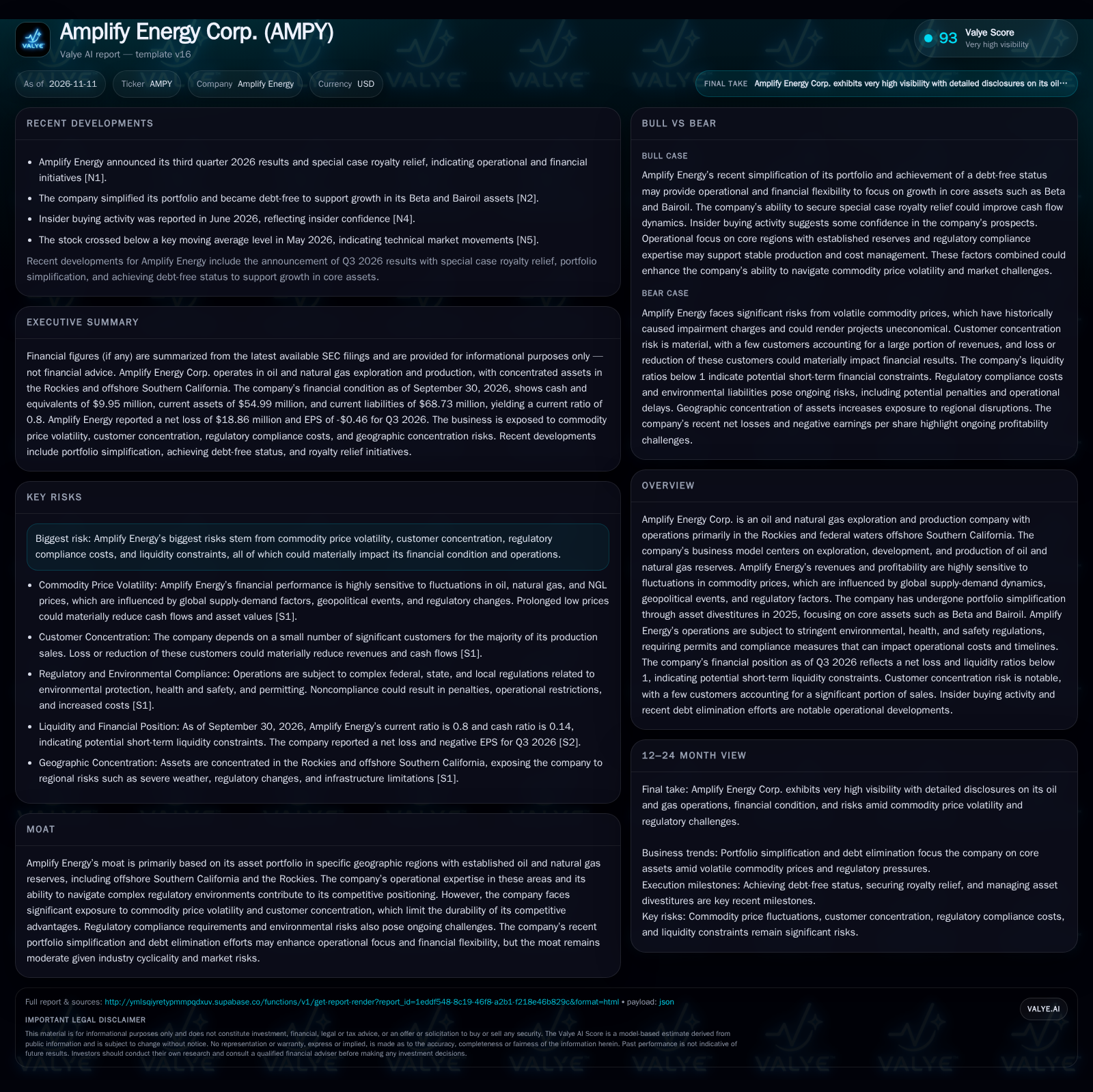
Amplify Energy has exited non-core assets, eliminated debt, and secured royalty relief for its key Beta offshore properties, leaving it highly focused but also acutely exposed to commodity price volatility and a handful of customers. [S1] [S2] [N1] [N2]
Amplify Energy Corp. has undergone a radical transformation over the past year, divesting non-core assets and eliminating debt to concentrate on its Bairoil (Rockies) and Beta (offshore Southern California) properties. This strategic refocus, paired with recent royalty relief for its Beta leases, is designed to streamline operations and shore up cash flow. The next phase hinges on translating operational focus and regulatory wins into improved financial resilience.
Recent Asset Sales and Debt Elimination Reshape the Playing Field
Amplify Energy’s operational landscape has changed significantly following a series of divestitures in 2025, which included its non-operated Eagle Ford, East Texas/North Louisiana, and Oklahoma assets. The company’s portfolio is now concentrated in just two core regions: Bairoil in the Rockies and Beta offshore Southern California. This streamlining was paired with achieving a debt-free status by Q3 2026, a notable milestone for any E&P business in a volatile commodity environment. [S1] [S2] [N2]
A further development is the approval of special case royalty relief for the Beta properties, effective November 1, 2026, which could improve near-term cash flow dynamics for these offshore assets. [N1] [S2]
How Amplify’s Leaner Portfolio Could Alter Cost Structure and Cash Flow
The company’s business model is now tightly focused on extracting value from mature oil and NGL reservoirs in Bairoil and Beta. With the asset base narrowed, fixed costs related to administration and compliance can potentially be spread over more production per asset, but the loss of scale from divested properties may also mean higher unit costs if production volumes do not offset overhead.
Revenue is driven almost entirely by realized prices for oil and gas, which are highly volatile and outside the company’s control. While royalty relief for the Beta properties will reduce government take and could improve margins, cash generation remains fundamentally tied to commodity cycles.
The cited source reports dividend-related activity; that disclosure alone does not establish dividend-policy continuity, management confidence, or a material constraint on capital flexibility. The company’s below-par current and cash ratios suggest that, absent a sustained improvement in commodity prices or further cost reductions, external financing or asset sales could again become necessary if liquidity tightens.
A critical consideration in Amplify's leaner portfolio is the balance between fixed and variable costs under fluctuating production volumes. While concentrating on fewer assets may yield administrative efficiencies, the company must contend with the diminishing returns typical of mature fields, where incremental production gains often require disproportionately higher investment. This dynamic could erode margin improvements from royalty relief unless operational enhancements or enhanced recovery techniques are implemented effectively. Additionally, the company’s ability to optimize capital allocation between maintenance and potential development projects will be pivotal in sustaining production levels and managing unit costs over time.
Niche Position in Mature Basins—But Competitive Advantages Are Modest
Amplify’s advantages stem primarily from established operating expertise in the Bairoil and Beta fields, where regulatory navigation and operational know-how can deter less experienced entrants. The company is the operator of record for 100% of its proved reserves, ensuring control over production timing and cost decisions. [S2]
However, these are mature, legacy assets, and the company faces ongoing production decline pressures that require continuous investment just to maintain output. The asset concentration increases exposure to regional regulatory shifts, weather events, and infrastructure constraints. In the broader market, Amplify competes with both public and private E&Ps focused on similar mature plays, as well as larger integrated players with greater financial resilience and portfolio diversity.
Customer concentration risk is acute, with a small number of buyers accounting for the majority of sales. This limits pricing power and increases vulnerability if a major customer were to reduce or cease purchases. Regulatory compliance and environmental liabilities are also persistent competitive headwinds, especially for offshore operations.
Amplify's competitive position is further nuanced by the regulatory environment governing its core assets. Compliance costs and environmental standards, particularly for offshore operations, can fluctuate with policy shifts, impacting operational flexibility and cost structures. The company's established presence and operator control may provide some insulation against abrupt regulatory changes, but persistent environmental liabilities could constrain capital deployment or necessitate increased provisions. Moreover, the limited geographic diversification heightens exposure to localized operational risks, such as weather disruptions or infrastructure bottlenecks, which competitors with broader portfolios might better absorb.
Royalty Relief and Focused Operations Set the Stage for a Cash Flow Turnaround
The most optimistic scenario for Amplify hinges on the recent special case royalty relief for the Beta offshore assets, which could significantly lower the government take on production and improve netbacks. If oil and gas prices remain stable or improve, the company’s now-simplified portfolio could generate sufficient free cash flow to rebuild liquidity, fund maintenance capex, and potentially return to profitability.
Operational focus on two core regions may drive efficiency gains and cost reductions, especially if management can leverage economies of scale in procurement and field operations.Insider transaction activity was reported in the cited source; this activity does not by itself establish insider confidence. [N4]
Confirmation of this scenario would come from a reversal of recent net losses, improved operating cash flow in subsequent quarters, and a reported liquidity-ratio trends above 1. Additional evidence would include stable or growing production volumes, continued cost discipline, and the ability to self-fund operations without recourse to external financing.
Navigating Commodity Swings as a Lean, Regionally Concentrated Operator
The most probable outcome is that Amplify operates as a tightly focused, debt-free E&P exposed to the full volatility of the oil and gas markets. The company’s financial results will likely oscillate with commodity cycles, and near-term liquidity will remain tight unless prices improve or costs are further reduced.
Royalty relief may cushion some downside for the Beta asset, but with a small customer base and legacy asset profile, Amplify’s earnings are unlikely to show consistent positive momentum without external catalysts. The company will need to carefully manage capital spending, regulatory compliance, and customer relationships to avoid further impairments or liquidity crunches.
Evidence for this scenario would be continued quarter-to-quarter earnings volatility, slow improvement (or stagnation) in liquidity ratios, and no major change in production volumes or customer mix.
In this scenario, Amplify’s operational resilience will depend heavily on its capacity to adapt to commodity price cycles through disciplined cost management and strategic capital deployment. Additionally, maintaining strong relationships with its concentrated customer base will be essential to securing stable revenue streams, although pricing power remains limited. The interplay between market volatility and operational execution will likely define Amplify’s financial trajectory, underscoring the importance of transparent communication with stakeholders regarding risk management and contingency planning.
Liquidity Squeeze and Customer Loss Could Trigger Strategic Crisis
The company’s reliance on a handful of customers amplifies the impact of any lost contracts or payment delays.
A negative development—such as a major regulatory penalty, a production disruption in Bairoil or Beta, or a customer defection—could force Amplify to seek emergency financing or undertake further asset sales, potentially on unfavorable terms. The company’s concentrated asset base leaves little room for geographic diversification, and mature fields may not offer sufficient upside to attract new capital in a crisis.
Confirmation of this scenario would be a further deterioration in the current ratio, sequential production declines, new impairment charges, or announcements of asset sales or capital raises under stressed conditions.
What Will Prove Whether Amplify’s Streamlined Model Can Deliver Resilience
Quarterly cash flow from operations and free cash flow—sustained improvement would signal that royalty relief and cost focus are translating to financial health.
Production volumes from the Bairoil and Beta fields—stability or growth would indicate operational control despite mature asset status.
Current and cash ratios—movement above 1 would suggest improved liquidity and reduced short-term risk.
Customer concentration metrics—if disclosed, a reduction in reliance on top buyers would lower revenue vulnerability.
Operating expense per barrel—continued cost discipline is necessary to offset commodity price volatility.
Any new regulatory actions or environmental liabilities—these could materially impact costs or operational continuity.
Capital expenditure levels and funding sources—evidence of self-funded capex versus reliance on external capital or asset sales.
Insider transactions and management commentary—ongoing insider buying or clear strategic communication could reinforce internal confidence in the turnaround.
Disclaimer: This is research-only, informational analysis and not investment advice. It may include AI-generated interpretation and general industry context. Always verify important details using primary sources.

Comments