
MYOMO’s Record Revenue Amid Persistent Losses: Can Medical Device Scale Deliver Profitability?
MYOMO, INC. The critical question is whether operational leverage and market adoption in a regulated, competitive rehabilitation device sector can shift the company’s economics.
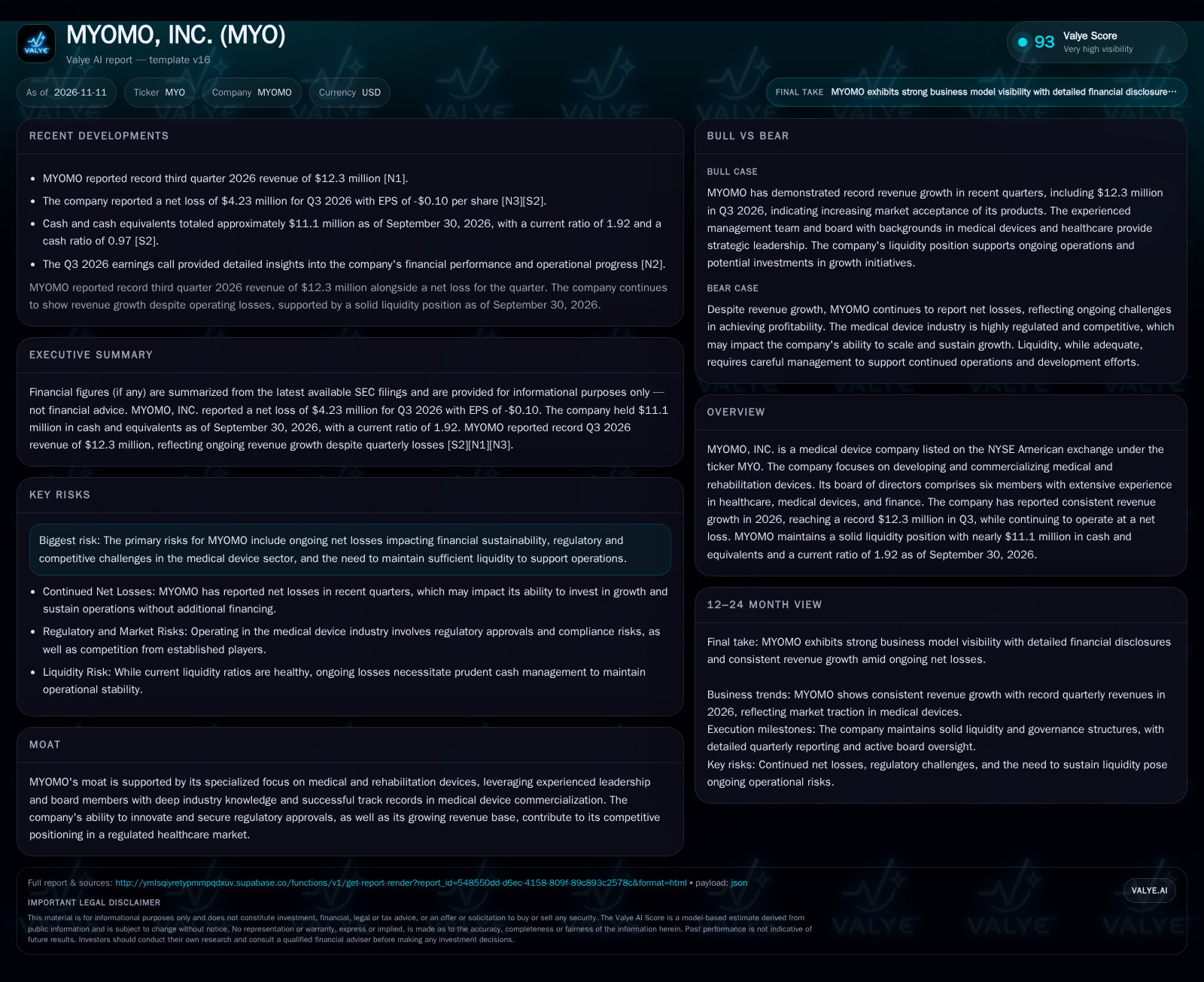
MYOMO reported record Q3 2026 revenue of $12.3 million, extending a revenue growth trend, yet posted a net loss of $4.2 million for the quarter. Cash and equivalents stood at $11.1 million with a current ratio of 1.92 as of September 30, 2026. The company operates in the medical device sector, focusing on rehabilitation products, and faces the dual challenge of scaling adoption while reaching profitability in a highly regulated, competitive environment. [S2] [N1] [N3]
MYOMO, INC., a publicly traded medical device company, enters Q4 2026 marked by a dual narrative: accelerating revenue growth and persistent net losses. The company’s record $12.3 million in third-quarter revenue signals growing demand for its rehabilitation devices, yet a quarterly net loss of $4.2 million and ongoing negative EPS highlight the continued struggle to translate market traction into profitability. With $11.1 million in cash and a current ratio of 1.92, MYOMO maintains a buffer for near-term operations, but its long-term trajectory hinges on whether its business model can achieve scale-driven margin improvements in a tightly regulated and competitive sector. [S2] [N1] [N3]
Recent Financial Performance Frames the Strategic Challenge
MYOMO reported record third quarter 2026 revenue of $12.3 million, extending a pattern of revenue growth across multiple recent quarters. Despite this top-line momentum, the company posted a net loss of $4.2 million for Q3 2026, with EPS at -$0.10 per share. As of September 30, 2026, MYOMO held $11.1 million in cash and equivalents and reported a current ratio of 1.92, providing a degree of operational liquidity but not a surplus. These data points are material because they illustrate both increasing commercial traction in the rehabilitation medical device market and an unresolved profitability gap. [S2] [N1] [N3]
How MYOMO’s Model Could Unlock Operating Leverage
MYOMO’s core business generates revenue by developing and commercializing rehabilitation medical devices, likely targeting patients with neuromuscular conditions who require assistance regaining arm and hand function. Revenue growth suggests increasing device adoption, but the persistent net losses point to a cost structure where fixed expenses—such as R&D, regulatory compliance, sales infrastructure, and clinical support—outpace current gross profit. In the medical device sector, achieving sustainable profitability typically requires either high unit volumes or premium pricing supported by reimbursement and clinical differentiation.
Fixed costs dominate early-stage medical device companies, especially those investing in clinical trials, regulatory submissions, and physician training. Variable costs per device (manufacturing, distribution) may be moderate, but until fixed costs are covered, each additional sale only incrementally improves the bottom line. If MYOMO can drive greater utilization per sales dollar—either through higher average selling prices, increased reimbursement, or broader adoption—the company could achieve meaningful operating leverage. Conversely, persistent customer acquisition costs and complex reimbursement processes can keep margins suppressed unless scale is reached.
The tipping point for MYOMO’s model will be whether product adoption accelerates fast enough to outpace burn and drive margin expansion.
In addition to scaling unit volumes, MYOMO’s path to operating leverage may depend on optimizing its product mix and enhancing service offerings that command higher margins. For example, bundled solutions that integrate hardware with software-driven therapy management or remote monitoring could increase customer lifetime value and create recurring revenue streams. This shift from a purely transactional device sale to a more comprehensive care model might improve predictability of cash flows and reduce sensitivity to single-unit sales fluctuations. However, such a transition requires upfront investment in technology development and customer education, which could temporarily pressure margins before benefits materialize.
Positioning in a Regulated and Crowded Rehabilitation Market
MYOMO operates within a heavily regulated medical device landscape, competing with both established device manufacturers and emerging technology entrants targeting neuromuscular rehabilitation. Its competitive positioning may hinge on clinical efficacy, regulatory clearances, and the ability to secure insurance reimbursement—key barriers to entry in this field. Experienced leadership with medical device backgrounds could support navigation of these hurdles, but entrenched incumbents often possess deeper distribution networks and established relationships with payors and providers.
Substitution risk exists from both traditional rehabilitation therapies and newer digital or robotic assistive technologies. MYOMO’s differentiation likely depends on device performance, patient outcomes, and integration into clinical care pathways. If the company can demonstrate superior functional improvement or patient adherence, it could justify premium pricing or drive broader reimbursement coverage. However, without evidence of durable switching costs or network effects, customer retention may remain vulnerable to competitive advances or reimbursement policy changes.
MYOMO’s competitive positioning also depends on its ability to demonstrate compelling clinical outcomes through robust data, which can influence physician adoption and payer decisions. In a crowded rehabilitation market, evidence of superior functional recovery, reduced therapy duration, or improved patient satisfaction can differentiate the product and justify higher reimbursement rates. However, generating such clinical evidence is resource-intensive and time-consuming, requiring well-designed trials and post-market studies. The company’s capacity to efficiently generate and communicate this evidence to key stakeholders will be pivotal in sustaining competitive advantage and mitigating substitution risks from emerging technologies.
Moreover, the company’s distribution and service model plays a significant role in competitive dynamics. Rehabilitation devices often require ongoing technical support, training, and customization to fit individual patient needs, which can increase switching costs and foster customer loyalty. If MYOMO can build a scalable yet personalized service infrastructure, it may enhance retention and reduce churn. However, expanding such services entails incremental operating expenses, which must be balanced against the incremental revenue and margin benefits. The interplay between service quality, cost structure, and customer satisfaction will be a key determinant of long-term competitive resilience.
What Would It Take for MYOMO to Achieve Sustainable Profitability?
A favorable trajectory for MYOMO would involve continued double-digit revenue growth, driven by expanding adoption of its rehabilitation devices—potentially through new clinical indications, broader payor coverage, or successful partnerships with rehabilitation centers. If the company demonstrates improved gross margins (e.g., through manufacturing efficiencies or higher average selling prices), and SG&A growth moderates relative to revenue, operating leverage could tilt the business toward profitability.
Evidence confirming this scenario would include: sequential gross margin expansion; positive free cash flow or narrowing net losses even as revenue rises; announcements of major reimbursement wins or large-scale provider partnerships; and commercial launches in new geographies or patient populations. A falsification would be flat or declining revenue despite increased spending, or margin erosion due to pricing pressure or higher-than-expected customer acquisition costs.
Most Likely Outcome: Gradual Revenue Growth with Ongoing Margin Pressure
The most plausible path for MYOMO is continued revenue growth—supported by steady market adoption and incremental geographic or clinical expansion—offset by persistent operating losses as fixed costs remain high relative to scale. The company could see improving gross margins as manufacturing volumes rise, but SG&A and R&D expenses may continue to absorb much of the incremental revenue, especially if commercial expansion and regulatory requirements drive ongoing investment.
Confirmation of this scenario would come from consistent single- or low double-digit quarterly revenue growth, with net losses narrowing only modestly. Falsification would occur if revenue growth stalls or reverses, or if net losses unexpectedly widen due to cost overruns or reimbursement setbacks.
When Revenue Momentum Isn’t Enough: Risks to Financial Sustainability
MYOMO’s downside risk centers on the possibility that revenue growth plateaus or slows before scale economies and reimbursement wins can drive profitability. Adverse developments could include regulatory setbacks, delayed payor coverage, or increased competitive pressure leading to price erosion or lost market share. In this scenario, fixed costs remain high while incremental revenue fails to offset operating expenses, accelerating cash burn.
Falsification would require a clear inflection in gross or operating margins, or a major strategic partnership that resets the company’s cost or revenue structure.
Testing the MYOMO Thesis: What Should Investors Track Next?
Quarterly revenue growth rates and absolute revenue figures: Sustained top-line expansion is essential to the operating leverage narrative. [N1] [N3]
Gross margin progression, if disclosed: Improvement here would signal manufacturing scale or pricing power.
Net loss and cash burn trajectory: Monitoring whether net losses narrow as revenue scales, and how quickly cash reserves are depleted. [S2]
Updates on reimbursement coverage: Announcements of new payor agreements or expanded insurance coverage would support broader adoption.
Commercial partnerships or distribution agreements: New alliances with rehabilitation centers or health systems could accelerate volume.
Regulatory milestones: Approvals for new indications or devices would indicate pipeline progress and market expansion potential.
SG&A and R&D expense trends: Whether these costs are flattening relative to revenue growth.
Liquidity events: Any new financing, credit arrangements, or cost-cutting initiatives would indicate management’s assessment of financial runway.
Disclaimer: This is research-only, informational analysis and not investment advice. It may include AI-generated interpretation and general industry context. Always verify important details using primary sources.

Comments