
Rocket Lab in 2026: Scaling Beyond Small Launches While Managing Neutron’s Technical Hurdles
Rocket Lab’s operational momentum in small satellite launches contrasts with technical delays in its Neutron medium-lift vehicle.
Rocket Lab has demonstrated high launch cadence and reported liquidity position, but faces near-term uncertainty as Neutron’s development encounters technical delays. The company’s integrated approach to launch and spacecraft manufacturing positions it for expanded market reach if it can resolve engineering challenges and capture demand for larger constellation deployments.
Rocket Lab stands at a pivotal juncture in 2026: it has firmly established itself as a reliable provider of small satellite launches, with its Electron rocket delivering frequent, successful missions and supporting a growing roster of commercial and government customers.
Where Rocket Lab Stands: Launch Cadence, Technical Delays, and Financial Cushion
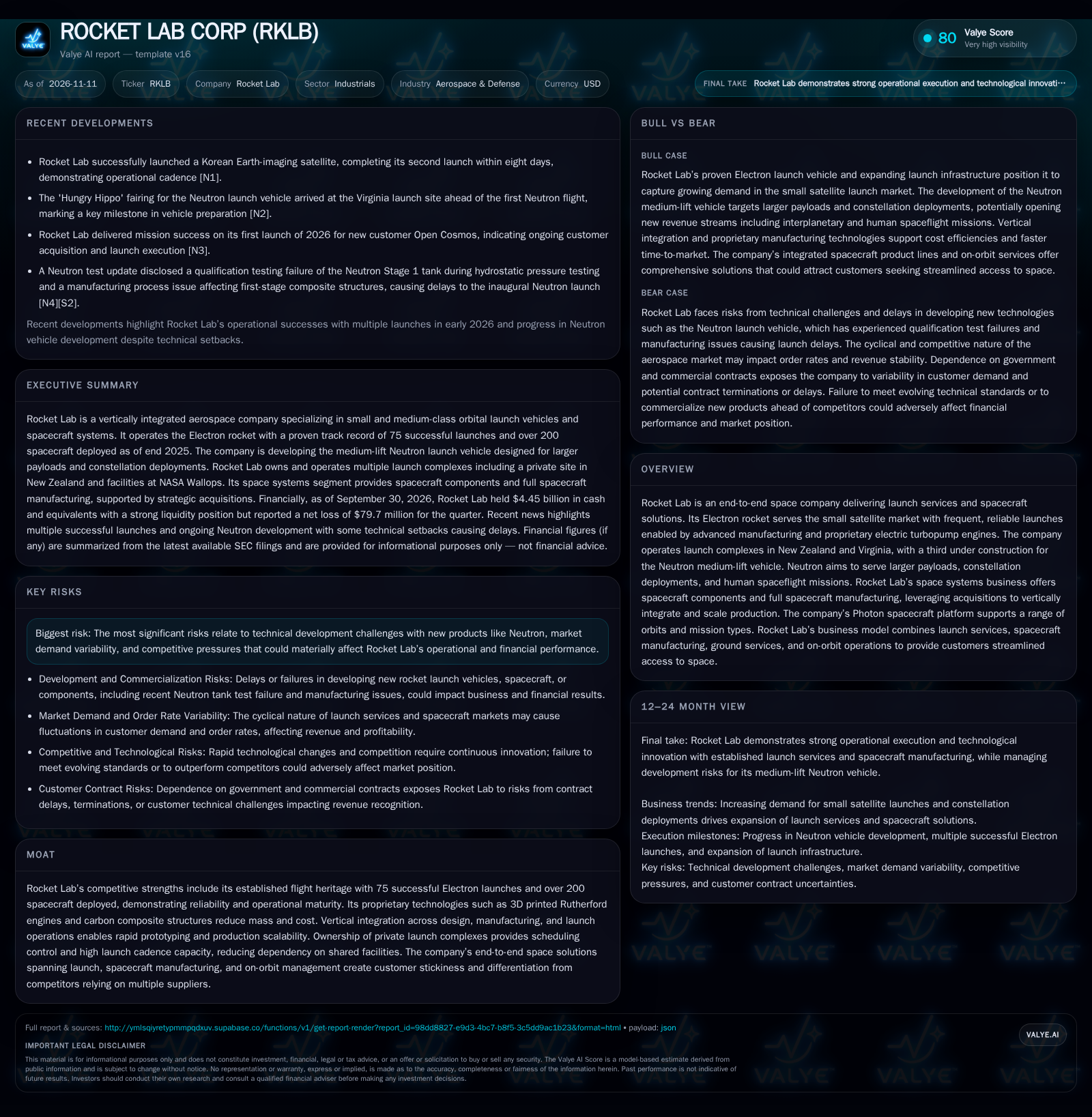
Rocket Lab has maintained a strong cadence in the small satellite launch market, achieving 75 successful Electron missions and deploying over 200 spacecraft as of December 31, 2025 [S1]. This operational reliability is further underscored by back-to-back launches within eight days in early 2026 [N1]. However, the company’s medium-lift Neutron rocket has encountered significant technical hurdles: a qualification testing failure of the Stage 1 tank and manufacturing process issues affecting composite structures have delayed its inaugural flight [N4] [S2]. Financially, Rocket Lab reported $4.45 billion in cash and equivalents and a current ratio of 8.55 as of September 30, 2026, but continued to operate at a net loss, with a $79.7 million deficit for the quarter [S2]. These facts collectively frame a company with proven small-launch execution, reported liquidity position, but near-term uncertainty regarding its next growth phase.
How Rocket Lab’s Economics Could Shift with Neutron and Vertical Integration
Rocket Lab’s revenue model currently combines fee-for-service launch contracts, sales of spacecraft components, and integrated mission solutions. The Electron rocket targets small satellite operators, a segment characterized by relatively high launch frequency but lower payload mass and, therefore, smaller contract values per launch. The company’s strategy of vertical integration—from manufacturing engines and components in-house to operating private launch complexes—enables a degree of cost control and schedule flexibility that may not be accessible to less integrated competitors.
If Neutron achieves operational status, Rocket Lab’s economic profile could change materially. Medium-lift launches command higher ticket prices, particularly for constellation deployments and interplanetary missions. However, these missions typically require greater up-front capital investment, longer sales cycles, and higher technical risk. The introduction of reusable first-stage technology, if successful, could improve gross margins by amortizing vehicle costs over multiple flights, though this benefit depends on achieving high reliability and launch cadence.
[S2] The business remains exposed to fixed infrastructure and personnel costs, meaning that launch cadence and utilization rates are key drivers of operating leverage.
Competitive Advantages and the Challenge of Entering the Medium-Lift Arena
Rocket Lab’s established track record with Electron provides credibility and customer trust in the small launch segment. Its proprietary technologies—such as the Rutherford electric turbopump engine and advanced composite structures—support cost and performance differentiation. Vertical integration, supported by strategic acquisitions (Sinclair Interplanetary, SolAero, GEOST, etc.), enables end-to-end mission delivery, reducing reliance on third-party suppliers and potentially increasing customer stickiness.
However, the medium-lift market targeted by Neutron is structurally different from the small launch sector. It is characterized by higher barriers to entry, more entrenched incumbents, and greater sensitivity to technical reliability and price-per-kilogram metrics. Rocket Lab will face competition from established players in the medium-lift market—both traditional aerospace primes and newer entrants with reusable technology. Customer switching costs may be lower at this scale, especially for constellation operators who prize reliability, schedule assurance, and regulatory track records. While Rocket Lab’s private launch infrastructure is an asset, market share gains in medium-lift will require not just technical achievement but also demonstrated reliability and cost competitiveness.
If Neutron Delivers: Expanding Revenue Streams and Customer Base
The most favorable outcome for Rocket Lab is successful qualification and operational deployment of Neutron within the next 12–24 months. This would allow the company to compete for high-value constellation deployments, rideshare missions, and potentially interplanetary or human spaceflight contracts. Neutron’s reusability, if proven in practice, could enable Rocket Lab to offer lower-priced launches while maintaining or improving margins—expanding its addressable market beyond what Electron can serve.
Evidence that would confirm this scenario includes: the resolution of current manufacturing and qualification issues, successful test flights, and the signing of multi-launch contracts with large satellite operators or government agencies. Early demonstration of Neutron’s reliability and reusability would likely catalyze order momentum and validate the company’s move up the value chain. Additional upside could come from cross-selling integrated spacecraft solutions bundled with launch services, leveraging Rocket Lab’s vertical integration.
Steady Electron Operations While Neutron Faces a Protracted Ramp
The most plausible near-term path is that Rocket Lab continues to execute reliably with Electron, sustaining its position in the small launch market and generating incremental growth from spacecraft systems and component sales. Neutron’s development likely continues but encounters further delays or staged rollouts, with initial operational flights occurring later than originally projected.
In this scenario, Rocket Lab’s financial performance remains weighed down by R&D and capital expenditures related to Neutron, offset by modestly growing revenues from its established businesses. Confirmation would come from continued high-frequency Electron launches, stable or improving backlog in space systems, and incremental (but not transformative) progress updates on Neutron’s test milestones. Falsification would be indicated by a decline in Electron launch cadence, loss of key customers, or further material setbacks in Neutron’s development timeline.
Prolonged Technical Setbacks Erode Growth Prospects and Margin Structure
A negative scenario would see persistent technical and manufacturing issues with Neutron resulting in extended delays or the need for costly redesigns, eroding customer confidence and reducing Rocket Lab’s ability to win medium-lift contracts. In this environment, Electron’s small launch market may also face pricing pressure or demand softness, either from macroeconomic headwinds or competitive encroachment by new entrants and rideshare offerings from larger launch providers.
Financially, this could translate to a sustained period of operating losses, with fixed costs from underutilized infrastructure and ongoing R&D outlays. Evidence for this scenario would include repeated Neutron test failures, contract cancellations or delays, growing cash burn, and a reduction in announced launch backlog. The risk of strategic retrenchment or capital raising could rise if losses persist and revenue growth stalls.
Milestones and Metrics Shaping Rocket Lab’s Next Chapter
Resolution and public disclosure of the Neutron Stage 1 tank qualification issues and composite manufacturing process, including updated launch timelines.
Frequency and reliability of Electron launches, especially maintaining or increasing cadence compared to prior years.
Announcement and value of new customer contracts for Neutron, particularly with constellation or government customers—if disclosed.
Progress on Neutron’s reusability demonstrations, such as successful booster recovery or refurbishment, if and when disclosed.
Revenue mix evolution between launch services and spacecraft systems/components, which would help test scaling of integrated offerings.
Quarterly cash burn rate and changes in net loss, as indicators of capital efficiency and financial runway.
Updates on competitive launches or pricing changes in the small and medium-lift segments, which could signal shifting market dynamics.
Disclaimer: This is research-only, informational analysis and not investment advice. It may include AI-generated interpretation and general industry context. Always verify important details using primary sources.

Comments