
Attovia Therapeutics: Clinical Progress, Financial Position, and the Critical Journey Toward Itch Relief
The company’s prospects hinge on translating early clinical promise into regulatory approval and eventual market adoption in a competitive dermatology landscape.
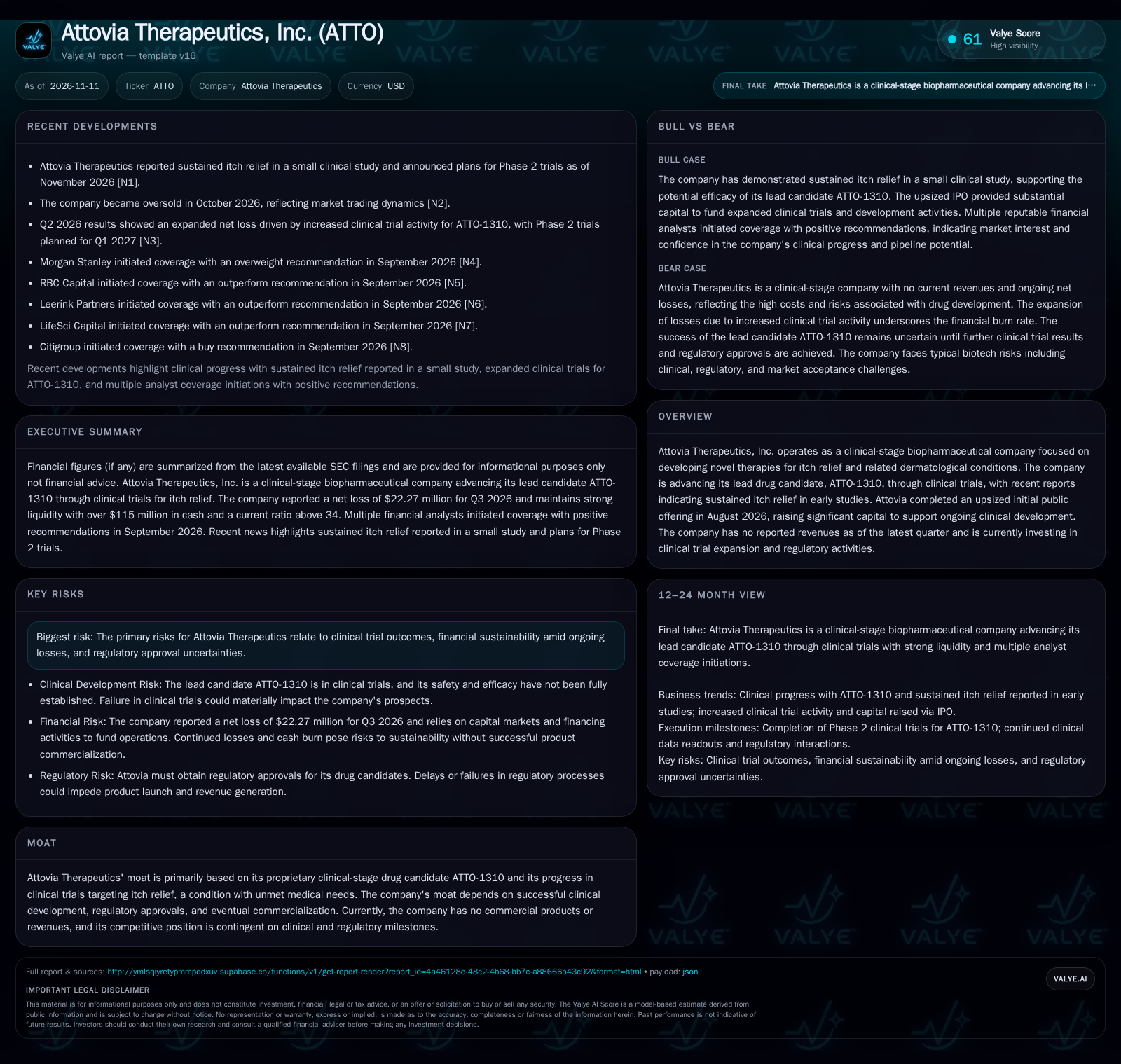
Attovia Therapeutics is a clinical-stage biotech focused on itch relief, with its lead candidate ATTO-1310 advancing toward Phase 2 trials. The company has no revenue but reported over $115 million in cash as of September 2026, following a $289 million IPO. Sustained early clinical results and multiple positive analyst initiations underscore market optimism, but Attovia faces the classic risks of clinical development, regulatory hurdles, and the challenge of commercializing in a crowded field. [S1] [N1] [N4] [N5] [N6] [N7] [N8]
Attovia Therapeutics stands at a pivotal point as a clinical-stage biotech aiming to address unmet needs in itch relief and dermatological conditions. With its lead candidate, ATTO-1310, demonstrating sustained efficacy in early studies and a reported cash position following an upsized IPO, Attovia has caught the attention of major financial analysts. Yet, the company is still pre-revenue, operating with significant net losses, and faces the familiar but formidable risks of clinical development and regulatory approval. The next phase will test whether Attovia can convert scientific promise into a defensible commercial foothold.
Recent Clinical Findings, IPO Capital, and Analyst Perspectives Frame the Outlook
As of November 2026, Attovia Therapeutics reported sustained itch relief in a small clinical study for its lead candidate, ATTO-1310, and announced plans to move into Phase 2 trials. This early clinical signal, while from a limited cohort, suggests potential differentiation in a field with substantial unmet need for chronic pruritus treatments. The company completed an upsized IPO in August 2026, raising approximately $289 million by selling 17 million shares at $17 per share. As of September 30, 2026, Attovia reported $115.37 million in cash and cash equivalents, with a current ratio of 34.66 and a cash ratio of 9.88. The company reported cash and liquidity metrics for the period; these figures do not by themselves establish operating runway, investment capacity, financial flexibility, or financing capacity. Multiple prominent analysts—including Morgan Stanley, RBC Capital, Leerink Partners, LifeSci Capital, and Citigroup—initiated coverage with overweight, outperform, or buy recommendations in September 2026, reflecting market optimism about Attovia’s pipeline potential. [S1] [N1] [N4] [N5] [N6] [N7] [N8]
Attovia’s Approach to Turning Innovation into Financial Success
Attovia’s business model is currently centered on R&D, with no product revenue as of the latest reported quarter. The company’s primary economic engine would be the successful clinical development, regulatory approval, and commercialization of ATTO-1310 and, later, additional pipeline assets. In dermatology, especially for chronic pruritus, pricing power is typically influenced by clinical efficacy, safety profile, and payer willingness to reimburse for novel therapies. If ATTO-1310 demonstrates clear superiority or a novel mechanism compared to existing treatments, Attovia could potentially command premium pricing, especially in rare or refractory patient subgroups. However, launching a new biologic therapy usually requires substantial commercial investment (sales force, medical education, payer negotiation), often before scale economies are reached.
The capital-intensive nature of clinical development is reflected in Attovia’s Q3 2026 net loss of $22.27 million and accumulated deficit of $172.6 million. If Phase 2 and beyond require larger, multi-center studies or if regulatory feedback necessitates additional endpoints or safety monitoring, burn rates could accelerate. Attovia’s fixed costs are high at this stage, but variable costs may rise sharply with trial expansion. Should ATTO-1310 reach commercialization, operating leverage could improve dramatically as fixed R&D costs are amortized over product revenues, but only if market uptake is robust and the company can avoid significant post-marketing study obligations or pricing pressures.
Positioning Amid a Dense Dermatology Pipeline and Established Competitors
Attovia’s competitive landscape is defined by both established pharmaceutical incumbents and a growing cohort of biotech innovators targeting pruritic diseases and atopic dermatitis. Several large companies already market therapies for chronic itch—such as monoclonal antibodies targeting IL-4, IL-13, or other inflammatory pathways. Attovia’s proposition rests on its proprietary ATTOBODY platform, which aims to generate next-generation biotherapeutics with potentially improved efficacy or differentiated mechanisms.
The main threats include clinical setbacks, faster-moving competitors, and the risk that ATTO-1310’s benefit-risk profile does not surpass current standards of care. Switching costs for prescribers are moderate in dermatology, often driven by payer coverage and physician familiarity. However, if Attovia can demonstrate substantial efficacy in patient populations underserved by current drugs or offer a novel modality with fewer side effects, it could carve out a defensible niche. Intellectual property protection, speed to pivotal data, and successful navigation of regulatory hurdles will be critical in establishing a durable competitive advantage.
Potential for Breakthrough Efficacy to Accelerate Growth in Targeted Areas
In a favorable scenario, ATTO-1310’s Phase 2 trials confirm the early signals of sustained itch relief, with statistically and clinically meaningful improvements over placebo and current therapies. If the safety profile remains clean and efficacy is robust across multiple pruritic disease subgroups, Attovia could rapidly progress to pivotal trials. Strong Phase 2 data would likely draw interest from strategic partners or acquirers, potentially accelerating late-stage development and commercial infrastructure build-out.
This scenario would be confirmed by positive top-line Phase 2 results, regulatory fast-track designations, and evidence of partnering discussions or non-dilutive funding. A rapid uptick in analyst target prices, increased institutional ownership, and pre-commercialization hiring would also support this outcome. Falsification would occur if Phase 2 fails to replicate early efficacy, reveals safety concerns, or if competing therapies capture the target market segment before Attovia.
Advancing Clinical Goals with Uncertain Market Adoption
The most plausible path for Attovia is one of steady clinical progress with ATTO-1310, but with the typical delays and uncertainties that accompany novel biologics. Phase 2 trials may show incremental, rather than transformative, benefit—sufficient to justify further development but not to disrupt the standard of care.
Analyst sentiment remains positive but cautious, and the company’s valuation reflects both pipeline promise and execution risk. Falsification would occur if persistent clinical setbacks, regulatory delays, or a deteriorating cash position force Attovia to halt or scale back development.
Risks from Clinical Challenges, Cash Flow, and Competitive Pressures
A negative scenario unfolds if ATTO-1310 fails to meet efficacy endpoints in Phase 2 or exhibits unexpected safety issues, undermining confidence in the broader ATTOBODY platform. Rapid cash burn, compounded by the need for additional or expanded studies, could erode Attovia’s liquidity before alternative pipeline candidates reach value inflection points. Meanwhile, competitors with similar or superior data could secure regulatory approval or payer coverage first, reducing Attovia’s potential market share even if eventual approval is achieved.
This outcome would be confirmed by negative or inconclusive clinical data, a sharp drop in analyst recommendations or price targets, and public disclosures of cost-cutting or pipeline reprioritization. Difficulty raising additional capital on favorable terms or the need for strategic alternatives (such as asset sales or out-licensing) would further validate the downside case.
Key Milestones and External Influences Impacting Attovia’s Future
Top-line results from ATTO-1310’s Phase 2 trials—both efficacy and safety outcomes—will be the most immediate value inflection point.
Updates on enrollment pace, trial design, and any regulatory feedback for ATTO-1310 would help test the thesis.
Progression of pipeline candidates ATTO-2306 and ATTO-1091 into clinical trials, including any IND clearances or early human data.
Any announced partnerships, licensing deals, or strategic collaborations that could provide non-dilutive funding or commercial leverage.
Publicly disclosed payer or KOL (key opinion leader) feedback on the clinical need and potential adoption curve for new pruritus treatments.
Competitive trial readouts from other companies in the pruritus and atopic dermatitis space that may shift market expectations or raise the clinical bar.
Disclaimer: This is research-only, informational analysis and not investment advice. It may include AI-generated interpretation and general industry context. Always verify important details using primary sources.

Comments