
Ferguson Enterprises in 2026: Scale, Fragmented Competition, and the Economics of Distribution Dominance
Ferguson Enterprises stands as the largest value-added distributor for water and air professionals in North America, leveraging an differentiated footprint and breadth of offerings. While robust Q3 2026 financials highlight its operational scale, the company’s future will be shaped by its ability to sustain margin discipline in a fragmented landscape, manage commodity volatility, and deepen value-added service penetration.
Ferguson’s Q3 2026 results confirm its dominance in North American construction distribution, driven by a vast branch network, supplier diversity, and balanced end-market exposure. While scale and value-added services offer insulation from smaller rivals, persistent market fragmentation and commodity price swings remain structural challenges. Execution on automation, service innovation, and acquisition integration will be central to sustaining growth and margin resilience over the next cycle. [S2] [N1]
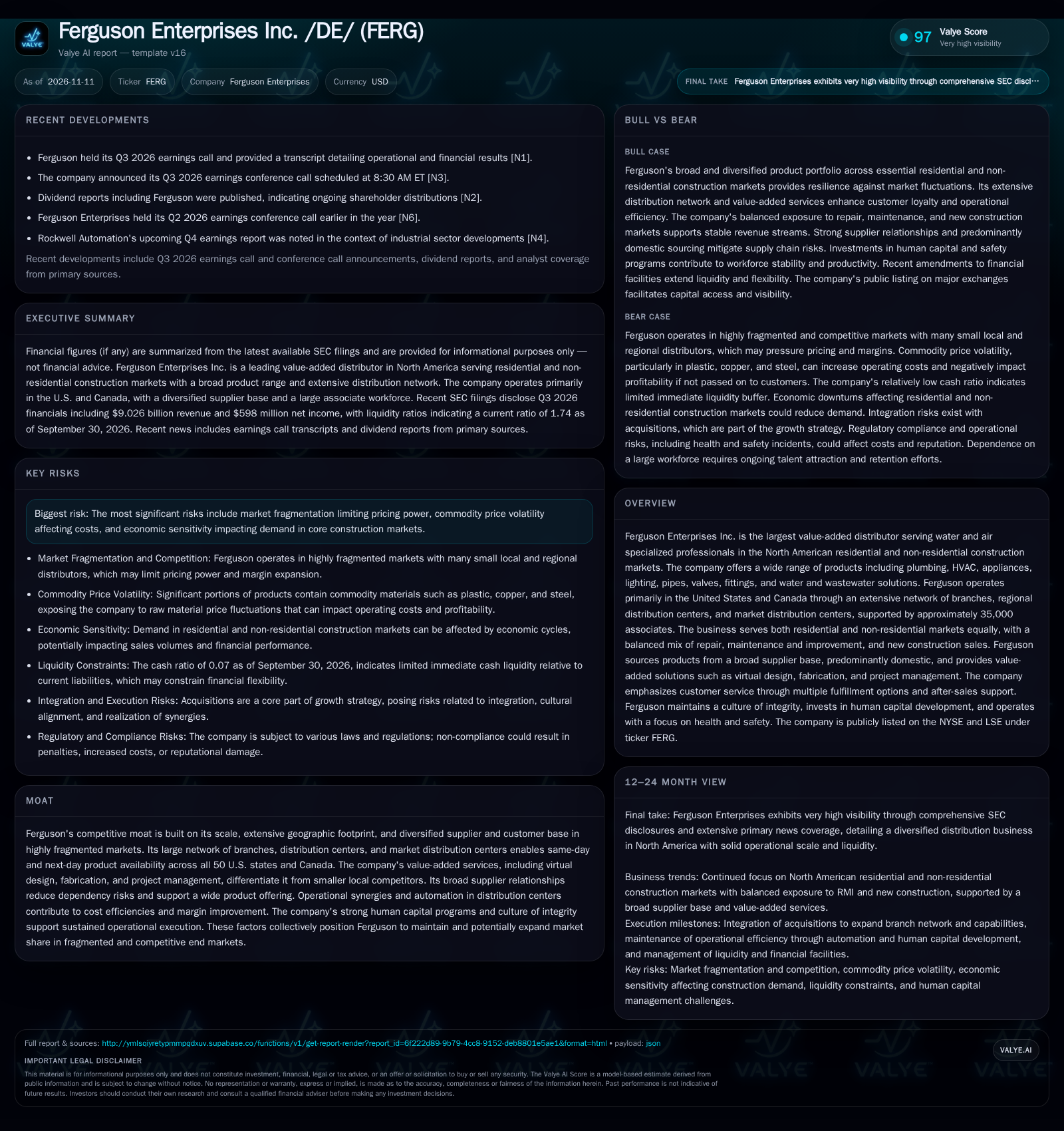
Ferguson Enterprises, North America’s leading distributor for water and air construction professionals, continues to set the pace in a $340 billion industry defined by fragmentation and operational complexity. Q3 2026 financials highlight the company’s scale, with $9.026 billion in revenue and $598 million in net income, but the real story lies in its ability to translate a sprawling distribution footprint and diversified product portfolio into defensible margins. With no single customer or supplier concentration, and a business split between repair/improvement and new construction, Ferguson’s resilience is apparent. Yet, the competitive landscape remains crowded, and commodity price swings are a constant headwind. The next phase for Ferguson will hinge on how well it can leverage automation, deepen value-added services, and execute acquisitions to offset intrinsic industry pressures. [S2] [N1]
Recent Results and Strategic Position: Ferguson’s Q3 2026 Snapshot
Ferguson reported $9.026 billion in revenue and $598 million in net income for Q3 2026, reflecting both scale and profitability in a complex market environment. The company’s U.S. segment drove 95% of revenue, reinforcing its core geographic focus. Recent amendments to its receivables facility extended the termination date to November 2029, suggesting a proactive approach to maintaining liquidity flexibility. These factors collectively indicate a business with high operational throughput, broad customer and supplier diversification, and a focus on balance-sheet stability, even as near-term cash reported liquidity position. [S2] [N1]
How Ferguson’s Distribution Model Drives Profits—and Where the Leverage Lies
Ferguson’s core economics are anchored in being a value-added distributor rather than a pure-play commodity wholesaler. Its revenue mix is balanced: approximately two-thirds comes from repair, maintenance, and improvement (RMI), and one-third from new construction, providing some insulation from construction cycle swings. Pricing power is inherently limited by the market’s fragmentation and product commoditization—especially for the 15% of U.S. sales tied to volatile materials like plastic, copper, and steel. In these categories, Ferguson’s gross margin is sensitive to input cost fluctuations and the speed at which it can pass through price changes.
Operating leverage is achieved through scale: 1,519 U.S. branches, 10 regional, and 5 market distribution centers enable high throughput, automation, and logistical efficiencies. Variable costs dominate at the branch level, but investments in automated picking and replenishment systems at distribution centers may offer incremental margin expansion if volumes scale further. The business also benefits from diversified supplier relationships—no single supplier accounts for more than 5% of purchases—reducing the risk of supply disruption or pricing pressure from upstream partners.
Value-added services—such as virtual design, fabrication, pre-assembly, and project management—are higher-margin offerings that could gradually shift Ferguson’s profit mix away from pure product distribution toward service-based economics. However, the extent to which these services can scale across the network and command price premiums is unproven at full market saturation.
Defending Share in a Fragmented, Localized Market: Ferguson’s Real Moat
Ferguson’s preeminent position is defined by its extensive branch and distribution network, which enables same-day/next-day fulfillment and supports a wide product catalog. The market is highly fragmented, with numerous small, local, and regional distributors vying for business—none holding a dominant share. This fragmentation constrains industry pricing power and incentivizes service differentiation, rather than product exclusivity or cost leadership alone.
Ferguson’s scale delivers procurement advantages, operational synergies, and the ability to invest in automation and value-added services that many smaller competitors cannot match. However, the absence of meaningful customer or supplier concentration means that switching costs are low; customers can readily move to local alternatives if service or price falters. Digital platforms and e-commerce are emerging as potential substitutes, but the complexity of project delivery, logistics, and after-sales support still favors incumbents with deep networks.
The real moat lies in the combination of geographic reach, fulfillment speed, and the breadth of value-added solutions. In theory, this enables Ferguson to capture larger and more complex projects, but persistent market fragmentation means that margin expansion remains a constant battle against both local rivals and broader digital disruption.
Unlocking Margin Expansion Through Service Innovation and Automation
A favorable scenario for Ferguson would see the company successfully scaling its value-added services—such as virtual design, fabrication, and project management—across a larger share of its customer base. If these offerings enable Ferguson to capture more of the value chain, this could translate into higher blended gross margins and deeper customer relationships, reducing churn and increasing share-of-wallet.
Further, continued investment in automation at market distribution centers could drive incremental cost savings as throughput rises, expanding operating margins even if product-level pricing remains constrained. Successful integration of acquisitions that bring new capabilities or geographic coverage could accelerate this effect.
Evidence that would confirm this scenario includes sustained gross margin improvement (if disclosed), increased revenue or share from value-added services, and positive commentary on operating leverage or cost efficiency gains in future earnings calls. Accelerating adoption of digital tools by customers—if Ferguson can lead rather than lag in this transition—would also bolster the upside case.
Sustaining Share and Margins in a Competitive, Cyclical Industry
The most plausible scenario is one where Ferguson maintains its leading share and operational efficiency, but faces ongoing pressure on gross margins from competitive pricing and commodity cost volatility. The company’s balanced mix between RMI and new construction provides revenue stability, while its broad supplier and customer base limits concentration risk.
Incremental margin improvement may be possible through automation and selective expansion of value-added services, but these are likely to offset rather than fully overcome structural headwinds. Acquisitions will remain a growth lever, but integration risks and dilution of culture or operational focus could temper their impact.
Confirmation of this scenario would come from stable to modestly improving revenue and net income trends, maintenance of current asset and liability ratios, and earnings calls that emphasize operational discipline rather than dramatic transformation. Any disclosed metrics on service attachment rates or automation-driven cost savings would be particularly telling.
Margin Compression and Share Erosion Amid Commodity Shocks or Execution Missteps
In a negative scenario, Ferguson could face pronounced margin compression if commodity prices spike and the company is unable to pass through cost increases rapidly. Simultaneously, if local and digital competitors intensify price competition or erode Ferguson’s value-added service differentiation, customer churn could rise and revenue growth could stall.
Integration challenges from acquisitions—whether cultural misalignment, IT friction, or operational disruption—could also weigh on margins and undermine the benefits of scale. A significant economic downturn impacting both residential and non-residential construction would further reduce volume, amplifying the impact of fixed-cost leverage.
Signs of this scenario would include declining gross and operating margins (if disclosed), flat or negative same-branch sales, rising SG&A as a percent of revenue, or negative commentary around competitive pricing and customer retention in management communications.
What Will Determine Ferguson’s Next Chapter in Distribution Leadership?
Growth in value-added service revenue, or rising service attachment rates, if disclosed, would help test whether Ferguson is truly shifting its profit mix beyond core distribution.
Any change in gross margin or blended margin trends—especially relative to historical commodity price swings—would signal the company’s ability to manage input cost volatility.
Updates on automation and operational efficiency metrics, such as cost savings from automated picking/replenishment, would provide insight into the sustainability of margin improvement.
The pace and success of acquisition integration—measured by branch network expansion or realized synergies—would indicate whether growth through M&A is accretive.
Trends in same-branch sales growth (if disclosed), as a proxy for organic demand and share retention in mature markets.
Shifts in working capital metrics, including inventory turns and receivables management, that could affect liquidity or signal operational stress.
Disclosures on customer or supplier concentration, or any material changes in these metrics, as a leading indicator of risk concentration or relationship loss.
Management commentary on competitive dynamics—particularly the threat from digital platforms and local disruptors—would help assess whether Ferguson’s moat is holding.
Disclaimer: This is research-only, informational analysis and not investment advice. It may include AI-generated interpretation and general industry context. Always verify important details using primary sources.

Comments