
Clearway Energy at a 2026 Inflection: Revenue Trends, Contractual Foundations, and Margin Dynamics
Clearway Energy, Inc. enters late 2026 with year-over-year revenue growth, a diversified renewable and flexible generation portfolio, and a reaffirmed outlook. Yet as Q3 earnings lag consensus, the company’s ability to convert stable top-line trends into sustained margin expansion and navigate regulatory and operational complexities remains central to its medium-term value proposition.
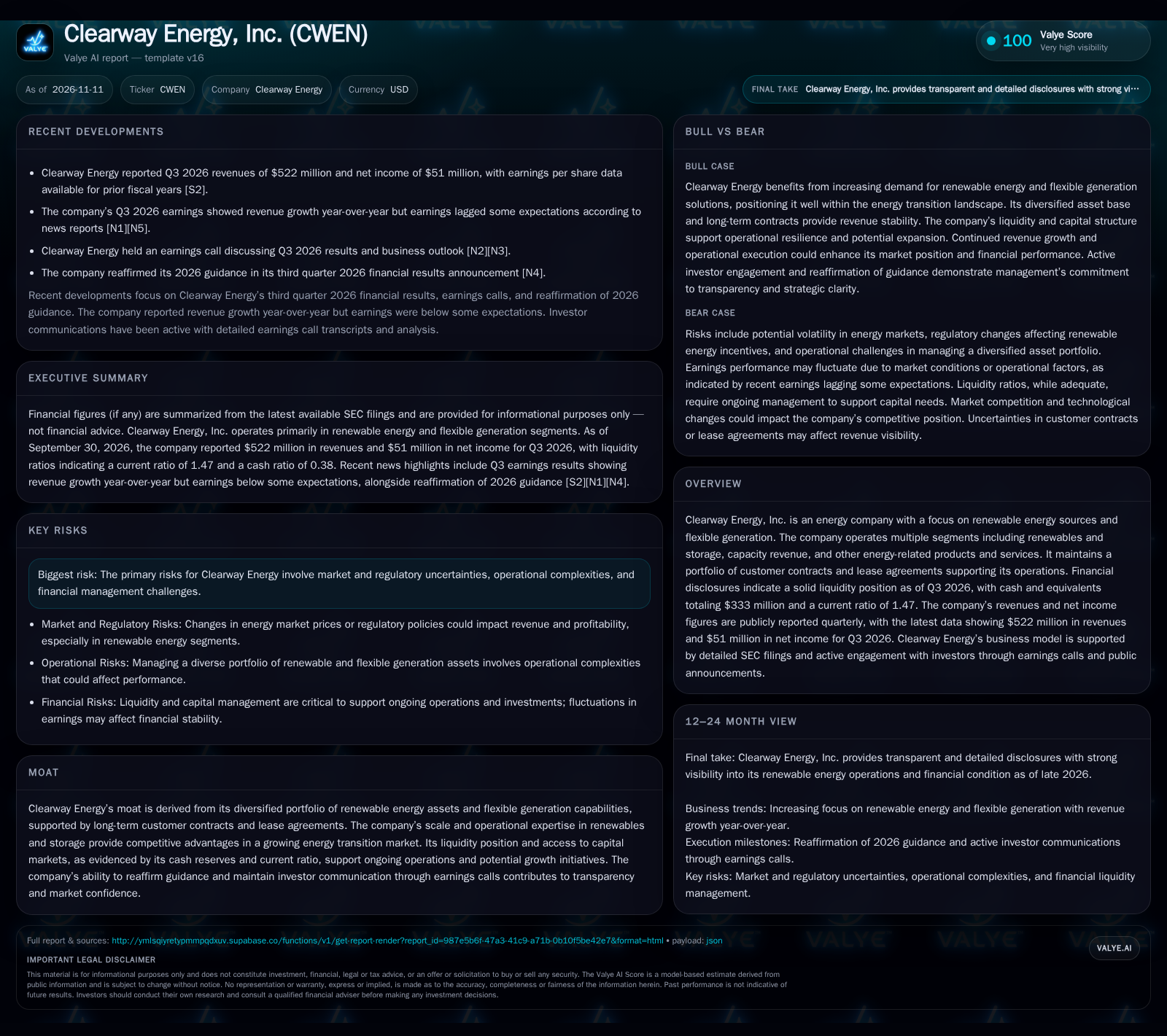
Clearway Energy reported $522 million in Q3 2026 revenue with net income of $51 million, posting year-over-year growth but earnings below some analyst expectations. The durability of Clearway’s long-term contracts and ability to scale renewables and storage will likely determine whether recent momentum translates into lasting shareholder value. [S2] [N1] [N4]
Clearway Energy, Inc. stands at a pivotal moment in late 2026, demonstrating robust revenue growth and operational scale across renewables, storage, and flexible generation. With $522 million in Q3 revenue and $51 million in net income, the company’s reaffirmation of guidance signals management’s confidence in its diversified asset base and contracted revenue streams. Yet, as earnings lag some expectations and sector risks intensify, the core challenge shifts from topline expansion to margin durability, regulatory adaptation, and operational execution—factors that will ultimately shape Clearway’s ability to deliver outsized value in a rapidly evolving energy landscape. [S2] [N1] [N4]
Late 2026 Financial Overview: Revenue Gains Offset by Earnings Pressure
Clearway Energy reported $522 million in revenue and $51 million in net income for the third quarter of 2026, marking a year-over-year revenue increase. Despite this topline momentum, earnings came in below some analyst expectations, as noted in recent news coverage. Management reaffirmed 2026 guidance during the Q3 release, signaling confidence in the operating outlook despite near-term margin pressure. These facts frame a company with stable revenue visibility but pressure to translate that into consistent earnings performance. [S2] [N1] [N4] [N5]
The Impact of Clearway’s Contracted Assets on Cash Flow and Financing
Clearway Energy’s business economics are built around a portfolio of renewable energy and flexible generation assets, underpinned by customer contracts and lease agreements that can provide multi-year revenue visibility and dampen exposure to spot market volatility—if contract terms are sufficiently long and creditworthy. Revenue is derived from electricity sales, capacity payments, and related products and services, with a mix that likely leans toward fixed-price contracts for renewables and more variable pricing in flexible generation or merchant segments. The company’s reported financials suggest a business model with significant fixed costs (depreciation, maintenance, overhead) and moderate operating leverage, meaning incremental revenue growth could yield margin expansion if costs are contained. However, capital intensity remains high: renewables and storage require substantial upfront investment, and ongoing asset management demands disciplined capital allocation. [S2]
The interplay between contract tenure and counterparty creditworthiness critically shapes Clearway’s cash flow predictability and financing capacity. Longer-term contracts with investment-grade counterparties typically reduce revenue volatility and enhance lender confidence, enabling more favorable debt terms. Conversely, a higher proportion of short-duration or merchant-exposed assets increases earnings variability and refinancing risk, potentially elevating the company’s weighted average cost of capital. Additionally, the capital-intensive nature of renewables and storage necessitates disciplined capital allocation to balance growth ambitions with leverage targets. Efficient capital recycling, through asset sales or tax equity structures, can mitigate funding pressures but requires robust market conditions and asset performance to realize value without compromising operational scale.
Contracted Renewables Provide Cushion but Remain Vulnerable to External Risks
Clearway’s competitive stance rests on its diversified portfolio of contracted renewable and flexible generation assets, which can offer some insulation from direct price competition and spot market volatility. The company’s disclosed customer contracts and lease agreements suggest a degree of revenue stability, though the actual duration, renewal rates, and counterparty strength are not disclosed in detail. In the broader context, Clearway contends with utility-scale renewable developers, independent power producers, and infrastructure funds, all seeking to expand in markets where policy support and capital access are pivotal. While the company’s scale and operational expertise in renewables and storage may confer advantages in project execution and financing, these do not guarantee superior returns if power prices fall, regulatory incentives change, or new entrants with lower cost structures emerge. The transition toward storage and flexible generation is also accelerating, and the ability to integrate these assets profitably will likely determine whether Clearway’s moat remains durable or erodes over time.
Clearway’s competitive position also hinges on its ability to optimize asset dispatch and integrate storage with renewables to capture value across multiple market segments. The evolving regulatory landscape incentivizes flexibility and grid services, creating opportunities for companies that can effectively monetize ancillary services, capacity markets, and demand response. However, this requires sophisticated operational capabilities and technology investments, which may strain resources if not managed prudently. Furthermore, the company must navigate the risk that emerging technologies or new entrants with lower cost bases could compress margins, particularly if Clearway’s portfolio lacks sufficient geographic or technological diversification to offset localized market downturns or policy shifts.
Potential for Margin Growth Through Contracted Expansion and Cost Controls
If Clearway successfully executes on project development, maintains high utilization across its renewable and flexible generation assets, and contains operating costs, the company could see operating leverage drive margin expansion. Upside may be augmented if new customer contracts are secured at attractive rates, regulatory incentives for renewables persist or increase, and the company’s storage assets capture a growing share of ancillary service markets. Confirmation of this scenario would include sustained revenue growth above sector averages, upward revisions to earnings guidance, and evidence of expanding operating or net margins—especially if cost per MWh delivered declines over time. Additional signals would be successful refinancing or project-level funding at favorable rates, and public disclosure of long-term contract wins or renewals with strong counterparties.
Revenue Stability Amid Complex Policy Environment and Portfolio Challenges
The most plausible path for Clearway involves continued revenue growth driven by incremental renewable and storage capacity additions and the steady execution of existing contracts. Margins may remain under pressure from rising maintenance costs, inflationary inputs, or less favorable contract renewals, offsetting some benefits of scale. Regulatory policy is likely to remain supportive but could shift at the margin, requiring ongoing adaptation. Confirmation would come from quarterly results that show modest, consistent revenue and net income growth, stable or slightly compressed margins, and capital expenditures in line with prior guidance. Falsification would occur if recurring cost overruns, regulatory setbacks, or contract attrition materially disrupt the company’s ability to deliver on guidance.
Risks of Margin Squeeze Triggered by Regulatory Changes and Market Pressures
In a less favorable scenario, Clearway could face a combination of regulatory rollbacks (e.g., reduced tax credits or stricter permitting), unexpected operational disruptions, or adverse contract renegotiations that erode both revenue and margins. Rising interest rates or tightening capital markets could further challenge refinancing or new project development, while competitive pressures might force the company to accept lower rates on new contracts. Confirmation of this scenario would include a string of quarters with flat or declining revenues, shrinking net income, negative free cash flow, and downward earnings revisions. Additional warning signs would be asset impairments, project delays, or news of customer defaults or contract disputes.
Operational complexity inherent in managing a mixed portfolio of renewables, storage, and flexible generation can amplify downside risks if not effectively controlled. Unplanned outages or underperformance in storage assets, for example, can reduce the company’s ability to meet contractual obligations or capitalize on ancillary service revenues, leading to penalty costs or lost opportunities. Regulatory changes that tighten environmental or grid interconnection standards may increase compliance costs or delay project timelines, further pressuring margins. Additionally, a prolonged period of elevated interest rates could restrict access to affordable capital, forcing the company to defer growth projects or accept dilutive financing terms, thereby constraining long-term value creation.
Factors Influencing the Sustainability of Clearway Energy’s Growth Trajectory
Quarterly trends in operating and net margins—especially if cost per MWh delivered is disclosed—will clarify whether revenue growth translates into sustainable profitability.
Updates on contract duration, renewal rates, and counterparty credit quality would help gauge revenue visibility and risk of attrition.
Capital expenditure and project pipeline disclosures, including timelines for new renewables or storage assets, will indicate growth prospects and capital intensity.
Any changes in regulatory policy affecting renewable incentives, tax credits, or permitting could materially impact project economics and returns.
Refinancing activity, interest expense trends, and access to capital markets are crucial for assessing funding risk, especially if free cash flow is thin.
Disclosures of asset utilization rates and unplanned outages would reveal operational effectiveness and potential reliability issues.
New contract wins, especially at above-market rates or with high-credit counterparties, would support the upside scenario and reinforce the business model.
If disclosed, the mix between fixed-price and merchant revenue streams would help clarify sensitivity to power price fluctuations.
Disclaimer: This is research-only, informational analysis and not investment advice. It may include AI-generated interpretation and general industry context. Always verify important details using primary sources.

Comments