
Occidental Petroleum in 2026: Debt Progress, Profitability, and the Structure of Upstream Value Creation
Strong Q3 2026 results and a major debt milestone highlight Occidental Petroleum’s focus on operational discipline. The company’s economics remain tightly linked to commodity cycles, with capital management and cost control central to future value. Scenario outcomes hinge on oil price resilience, debt trajectory, and the ability to sustain efficient production.
Occidental Petroleum posted robust Q3 2026 revenue and earnings, achieved a $10 billion principal debt milestone, and maintained a positive liquidity profile. The company’s upstream model remains exposed to commodity price swings, but recent results show improved profitability and capital management. The next phase depends on oil price stability, continued cost discipline, and evidence of durable free cash flow.
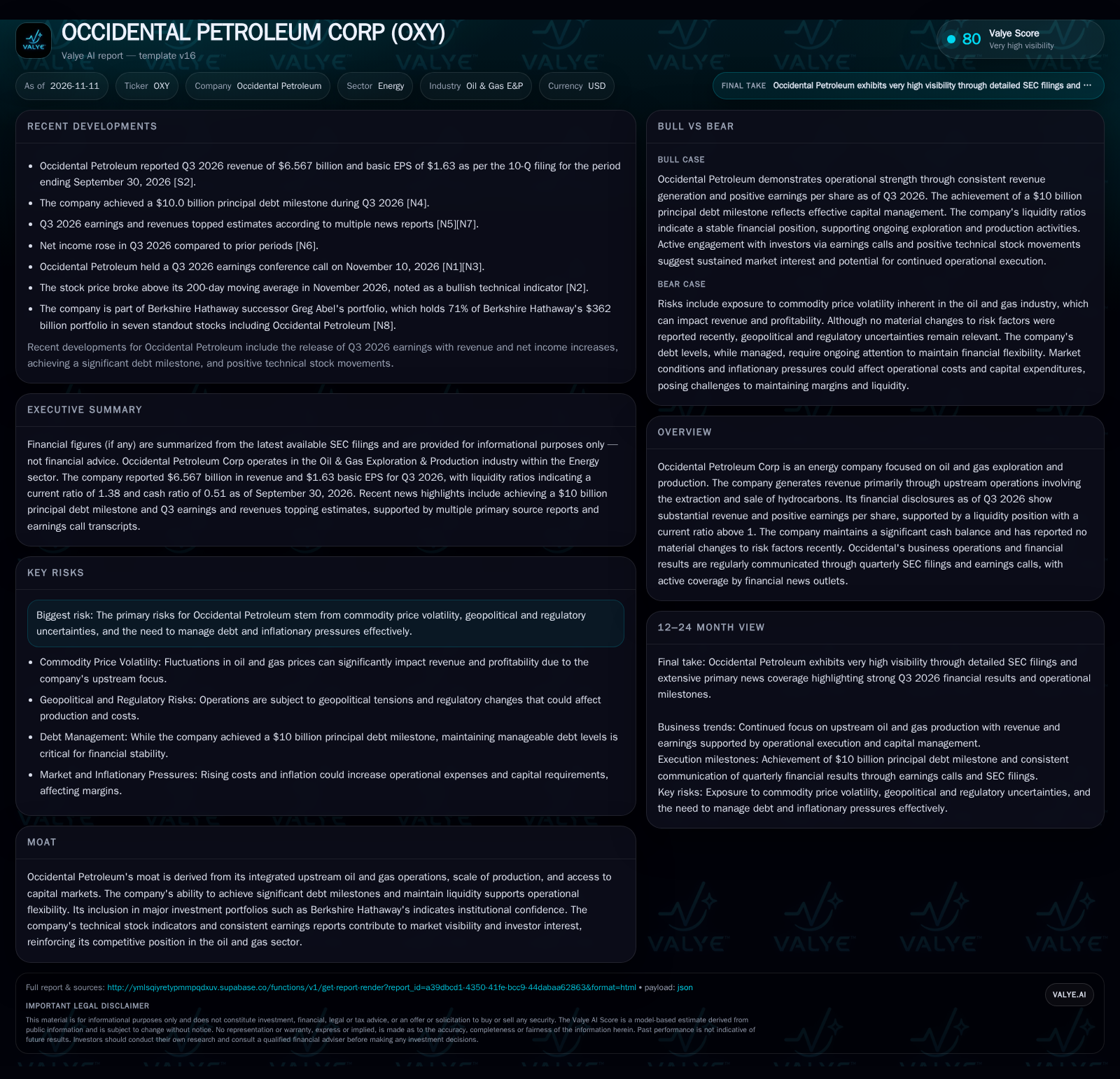
Occidental Petroleum’s third quarter of 2026 marks a period of financial momentum and strategic progress. With $6.567 billion in revenue and a significant reduction in principal debt, the company is demonstrating effective capital stewardship amid ongoing commodity volatility. The next phase will test whether its improved financial position can translate into consistent free cash flow and long-term value creation.
Recent Financial and Strategic Milestones Define Occidental’s Position
Occidental Petroleum reported revenue of $6.567 billion and basic EPS of $1.63 for Q3 2026, with earnings and revenues exceeding analyst estimates [S2] [N5] [N7]. Net income rose compared to prior periods, highlighting improved operational profitability [N6]. The company reached a $10 billion principal debt milestone during the quarter, marking substantial progress in its ongoing deleveraging strategy [N4]. The company reported cash and liquidity metrics for the period; these figures do not by themselves establish operating runway, investment capacity, financial flexibility, or financing capacity. [S2] These developments collectively reflect a period of strong execution and capital discipline, but the durability of these improvements will depend on commodity price trends and future capital allocation decisions.
How Upstream Oil Economics Drive Occidental’s Profit and Risk Profile
Occidental’s core economics are anchored in the upstream extraction and sale of hydrocarbons. Revenue is driven primarily by production volumes and realized prices for oil and gas, while cost structure is dominated by field operating expenses, depletion, and capital expenditures required to sustain or grow reserves. The company’s reported EPS improvement in Q3 2026 suggests that either realized prices improved, operating costs were contained, or production efficiency increased—though the specific driver is not disclosed in the current evidence [S2].
Operating leverage is high: incremental changes in oil prices can significantly affect net income due to the substantial fixed cost base typical of large E&P operators. The Q3 2026 debt milestone indicates active capital management, reducing interest expense and potentially freeing up more cash for reinvestment or shareholder returns over time [N4]. However, sustaining production requires ongoing capital outlays, and the unit-of-production depreciation method links cost recognition directly to output, meaning that declines in production or reserves can quickly impair profitability.
Variable costs such as lease operating expenses and production taxes fluctuate with output, while exploration and development spending can be deferred but not eliminated without risking long-term decline. These dynamics create a business model that can generate strong free cash flow in favorable commodity environments, but remains vulnerable to sharp price corrections or cost inflation.
Scale, Capital Access, and Market Perception: Occidental’s Place in a Crowded Field
Occidental Petroleum competes with global integrated oil majors, large independent E&Ps, and national oil companies. Its competitive position is underpinned by production scale, efficient capital allocation, and access to public capital markets. The achievement of a $10 billion debt milestone and inclusion in the Berkshire Hathaway successor portfolio signal institutional confidence and visibility, which can translate into lower funding costs and a more robust opportunity set for mergers, acquisitions, or organic investment [N4] [N8].
However, the structural advantages of scale are counterbalanced by the industry’s commodity risk and the lack of durable pricing power—E&P operators are price takers, not price setters, and must constantly compete for capital, acreage, and technical talent. Technology adoption (for instance, enhanced oil recovery or digital field management) and disciplined cost control can differentiate performance, but sustainable competitive advantages are difficult to defend absent resource or cost structure superiority.
Substitutes for oil and gas—ranging from renewables to electrification and energy efficiency—are a long-term headwind, though the near-term impact is mitigated by persistent global demand for hydrocarbons and the slow pace of energy transition in many regions.
If Oil Prices Stay High and Capital Discipline Holds, Free Cash Flow Could Inflect
The most favorable scenario for Occidental is one in which global oil and gas prices remain elevated or rise further, allowing the company to translate operational efficiency and reduced debt service into substantial free cash flow. Continued cost containment, stable or growing production, and limited capital intensity would allow more cash to be directed toward debt reduction, share repurchases, or dividends.
Evidence that would confirm this scenario includes: sustained or increasing free cash flow generation (if disclosed), further reduction in net debt, expansion of shareholder return programs, and public guidance pointing to stable capital spending requirements despite robust output. Additionally, positive surprises in reserve replacement or efficiency metrics would reinforce the thesis that Occidental can outperform through the cycle.
This scenario would be challenged if oil prices weaken, cost inflation accelerates, or capital expenditures are required to sustain production at higher-than-expected levels.
Production Efficiency and Prudent Capital Management Anchor Forward Expectations
The most plausible path for Occidental is continued focus on operational execution, cautious capital allocation, and incremental debt reduction in a moderately volatile commodity environment. In this scenario, the company maintains production at or near current levels, manages costs to preserve margins, and prioritizes balance sheet strength over aggressive expansion.
Supporting evidence would include stable quarterly revenues and EPS, modest but steady reductions in debt, and management commentary emphasizing capital discipline and risk management.
Risks to this scenario include unexpected declines in commodity prices, regulatory or geopolitical disruptions, or operational setbacks that drive up costs or reduce output.
Commodity Volatility or Cost Overruns Could Reignite Financial Strain
A downside scenario would be triggered by a material decline in oil and gas prices, which would compress revenue, erode margins, and threaten the sustainability of recent profitability gains. Cost overruns, operational incidents, or regulatory changes could compound the problem by forcing higher expenditures or impairing assets.
In this environment, Occidental’s fixed cost base would magnify the impact of lost revenue, and the need to sustain production could pressure the balance sheet despite recent deleveraging. Evidence confirming this scenario would include declining free cash flow (if disclosed), rising net debt, unfavorable revisions to reserve estimates, or guidance indicating higher projected costs or reduced output.
A return to net losses or the need to tap credit lines or divest assets to fund operations would further confirm a deteriorating outlook.
What Will Determine Occidental’s Value Creation in the Next Phase?
Quarterly production volumes and realized oil and gas prices, to assess the sensitivity of revenue and earnings to commodity cycles.
Net debt and interest expense trajectory, to evaluate whether recent deleveraging continues and potential financial flexibility improves.
Free cash flow generation and allocation (if disclosed), to test whether operational gains are translating into distributable value.
Capital expenditure levels and guidance, to determine whether maintenance or growth spending is required to sustain production.
Reserve replacement ratios and asset impairments, as signals of long-term asset quality and value preservation.
Management commentary on cost inflation, regulatory risk, and capital allocation priorities in future earnings calls.
Progress on shareholder return initiatives, such as dividends or share buybacks, if publicly announced or disclosed.
Disclaimer: This is research-only, informational analysis and not investment advice. It may include AI-generated interpretation and general industry context. Always verify important details using primary sources.

Comments