
Bank7 Corp. in Late 2026: Integration Challenges, Capital Actions, and the Economics of Regional Banking Expansion
Bank7’s recent earnings dip and acquisition of Century Financial Services spotlight both the volatility and strategic ambition behind its growth model. As the bank navigates operational integration, capital management, and ongoing cybersecurity oversight, its ability to maintain earnings stability and defend its regional franchise will be tested.
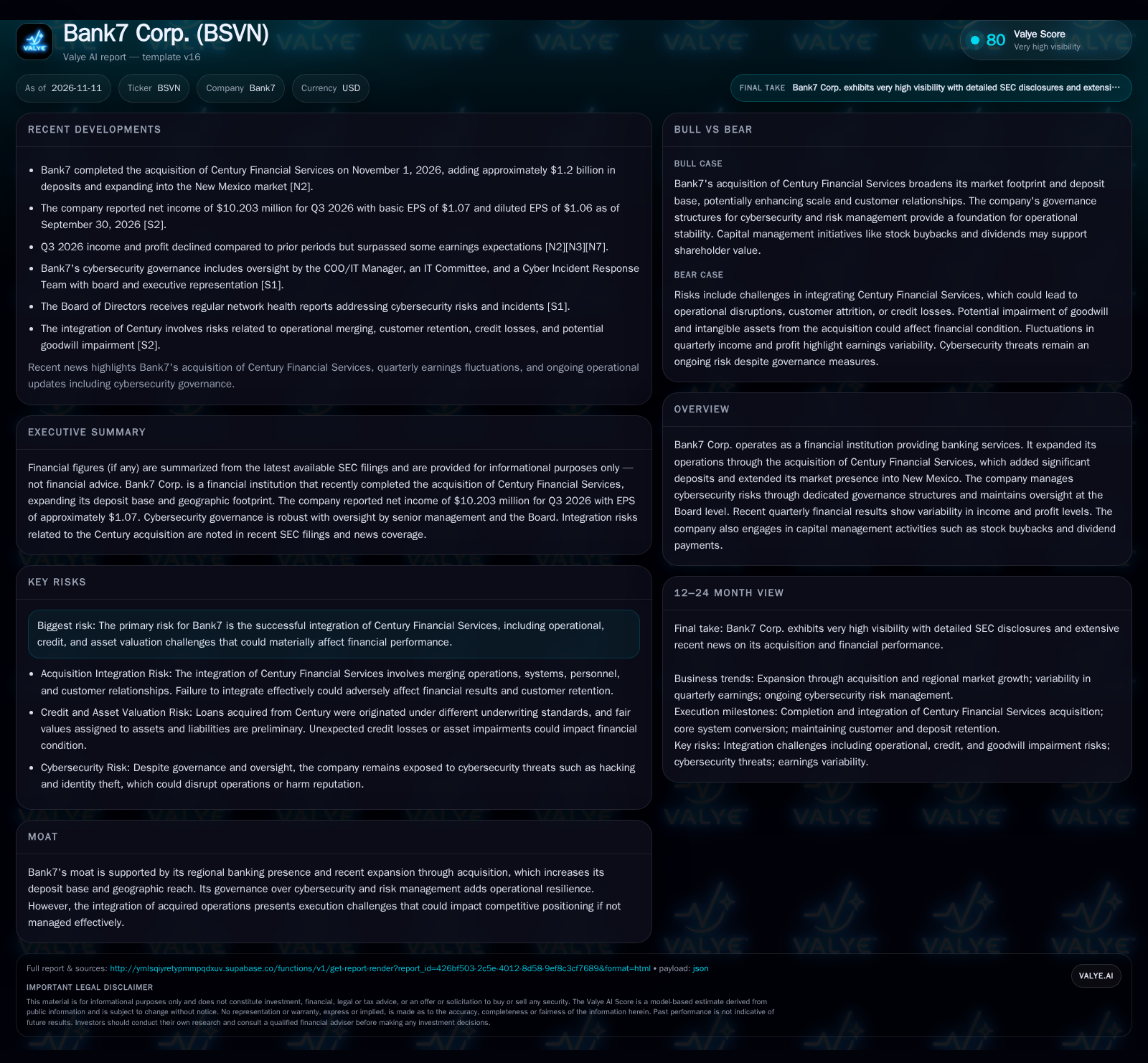
Bank7 reported Q3 2026 net income of $10.2M, with earnings down vs. prior periods but above some estimates. The ongoing integration of Century Financial Services exposes the bank to operational and credit risks, while capital management continues via buybacks and dividends. Cybersecurity oversight is robust, but execution on acquisition synergies and risk management will shape future performance. [S2] [N2] [N3] [N7]
Bank7 Corp. stands at a strategic juncture as of Q3 2026, balancing the promise and pitfalls of regional banking expansion. Its recent acquisition of Century Financial Services is a calculated bet on scale and geographic reach, but it also introduces material integration and credit risks. Meanwhile, despite a quarter of declining earnings, Bank7 continues to return capital to shareholders and invest in cybersecurity oversight. The central question is whether the bank can convert its expanded footprint into sustainable profitability while managing the complex risks that come with growth.
Recent Results and Strategic Moves Define the Current Landscape
Bank7 reported net income of $10.203 million in Q3 2026, with basic EPS of $1.07 and diluted EPS of $1.06. This represents a decline in income and profit compared to previous quarters, although the results exceeded some analyst expectations. The company is in the midst of integrating Century Financial Services, a process introducing operational, credit, and goodwill impairment risks. The cited source reports dividend-related activity; that disclosure alone does not establish dividend-policy continuity, management confidence, or a material constraint on capital flexibility. The Board maintains direct oversight of cybersecurity, with a dedicated governance framework and regular risk reporting. These factors collectively set the stage for both opportunity and risk as the bank grows its regional presence. [S2] [N2] [N3] [N7]
How Scale, Risk, and Capital Allocation Shape Bank7’s Profit Model
Bank7’s core economics hinge on net interest margin (NIM), fee income, and credit performance—typical of regional banks. Revenue is primarily generated through the spread between interest earned on loans and interest paid on deposits, with additional contribution from fees and service charges. The integration of Century Financial Services could increase both the loan book and deposit base, expanding revenue potential but also raising the stakes for credit quality and operational expense control.
Variable costs are dominated by funding costs (deposits and wholesale borrowing) and credit losses, while fixed costs include personnel, technology, and compliance. The acquisition introduces potential operating leverage if synergies are realized and duplicative costs are eliminated. However, if integration proves more complex, fixed costs could rise without a commensurate increase in revenue. Capital management via buybacks and dividends provides a lever for shareholder returns, but also requires careful balancing against regulatory capital requirements and the need to absorb potential credit shocks.
The economics of regional bank M&A often depend on successful cross-selling, customer retention, and the ability to realize scale efficiencies. If Bank7 can standardize systems and processes post-acquisition, it may achieve cost savings and margin expansion. Conversely, integration missteps could lead to higher noninterest expense, customer attrition, or unexpected credit losses.
Defending Regional Territory Amid Acquisitions and Digital Threats
Bank7 operates in a competitive landscape defined by other regional banks, community banks, and increasingly, digital-first financial services providers. Its moat rests on local relationships, expanded footprint via acquisition, and a reputation for governance and risk management. The addition of Century Financial Services broadens both market reach and deposit base, but also exposes the bank to new regional competitors and integration risks.
Switching frictions in banking tend to be moderate: while established customer relationships and local service matter, digital offerings and aggressive pricing from fintechs and larger banks can lure away customers, especially if service disruptions or product mismatches occur post-integration. Bank7’s ability to defend its position will depend on maintaining service continuity, managing credit quality, and leveraging its governance strengths. The bank’s robust cybersecurity oversight may help mitigate reputational and operational threats, but it will not eliminate the risk of customer flight if integration falters or digital offerings lag.
Unlocking Acquisition Synergies and Margin Expansion
The favorable scenario unfolds if Bank7 executes a smooth integration of Century Financial Services, retaining acquired customers and realizing cost synergies. If operational systems are unified without major disruptions, and personnel redundancies are addressed efficiently, the bank could lower its expense base relative to a larger revenue pool. Successful cross-selling could boost noninterest income, while a stable or improving credit environment would support net interest margin expansion.
Confirmation of this scenario would come from sequential improvements in efficiency ratio, stable or rising deposit and loan balances, and evidence of expense reduction without a spike in nonperforming assets. A positive surprise in fee income or rapid digital adoption post-integration would further support the bullish view. Conversely, early signs of customer attrition or a jump in credit losses would falsify this thesis.
Balancing Growth with Integration Complexity and Earnings Volatility
The most plausible outcome is that Bank7 experiences a period of uneven earnings as it works through the Century integration. Some operational disruptions and elevated expenses are likely in the near term, with gradual realization of cost benefits and revenue synergies over several quarters. Credit costs may trend modestly higher as loan portfolios are merged and underwriting standards are harmonized.
In this scenario, the bank continues its capital management activities but at a measured pace, preserving flexibility for unexpected credit or integration issues. Quarterly earnings may remain volatile, reflecting both integration costs and the potential for modest credit shocks. Evidence for this scenario would be a mixed trend in quarterly profit, stable but not accelerating deposit growth, and incremental reduction in operating expenses as integration milestones are achieved. A sudden spike in noninterest expense or a marked decline in loan quality would challenge the base case.
Integration Fallout and Credit Deterioration Undermine Profitability
The adverse scenario develops if Bank7 struggles to integrate Century Financial Services, resulting in operational mishaps, customer attrition, and rising credit losses. Problems could arise from incompatible IT systems, cultural clashes, or loss of key personnel, leading to service disruptions and a loss of market share. If acquired loan portfolios exhibit higher-than-expected delinquencies or charge-offs, earnings could deteriorate rapidly.
This scenario would be confirmed by a sustained rise in nonperforming assets, sharp increases in noninterest expense, or a reversal in deposit and loan growth. Regulatory scrutiny could intensify if risk metrics worsen, and the bank could be forced to curtail capital returns or raise additional capital, intensifying pressure on shareholder value. Falsification would require evidence of stable integration metrics, consistent customer retention, and credit performance in line with historical averages.
What Will Determine Whether Bank7 Converts Scale into Sustainable Value?
Integration expense trends: Watch for quarterly disclosures on costs directly related to the Century integration. Persistent or escalating integration expenses would signal execution risk.
Deposit and loan growth post-acquisition: Sustained growth would indicate successful customer retention and cross-selling; stagnation or decline could point to attrition.
Nonperforming asset ratios: A useful metric would be the proportion of loans classified as nonperforming before and after the acquisition.
Efficiency ratio progression: Improvements would suggest successful realization of cost synergies, while deterioration could indicate integration challenges.
Quarterly net interest margin (NIM): Stability or expansion would confirm effective asset-liability management amid the integration.
Updates on cybersecurity incidents or regulatory findings: Any reported breach or regulatory criticism would be material given the centrality of governance to the thesis.
Executive and board commentary on integration milestones: If disclosed, this qualitative feedback would help test whether integration is on track or facing setbacks.
Disclaimer: This is research-only, informational analysis and not investment advice. It may include AI-generated interpretation and general industry context. Always verify important details using primary sources.

Comments