
Ethan Allen’s Retail Footprint, Cost Pressures, and Leadership Uncertainty: Navigating Margin Headwinds in a Shifting Home Furnishings Landscape
Ethan Allen Interiors’ network of 141 retail design centers faces persistent margin risk from raw material, transportation, and real estate pressures, while leadership succession and contested governance inject strategic uncertainty. The company’s ability to preserve profitability hinges on cost pass-through, operational efficiency, and the outcome of ongoing management transitions.
Ethan Allen’s latest results highlight a business with significant exposure to cost inflation and commercial real estate risk, buffered by a large retail footprint and a history of operational adjustments. With CEO succession nearing and boardroom tensions evident, the company’s future path will likely be shaped by its success in managing input costs, optimizing its store base, and navigating leadership change. [S1] [S2] [N1] [N2] [N3] [N4]
Ethan Allen Interiors stands at a crossroads as its extensive retail network contends with mounting input and occupancy costs, while leadership transition and boardroom disputes create uncertainty around strategic direction. The company’s ability to sustain profitability and brand relevance will depend on its capacity to adjust pricing, streamline operations, and adapt its store base in response to inflation, real estate volatility, and evolving consumer preferences. The coming quarters will test whether Ethan Allen’s legacy strengths can counteract structural headwinds in the home furnishings market, or if margin pressure and governance challenges will force deeper change.
Recent Results Spotlight Margin Headwinds and Governance Flux
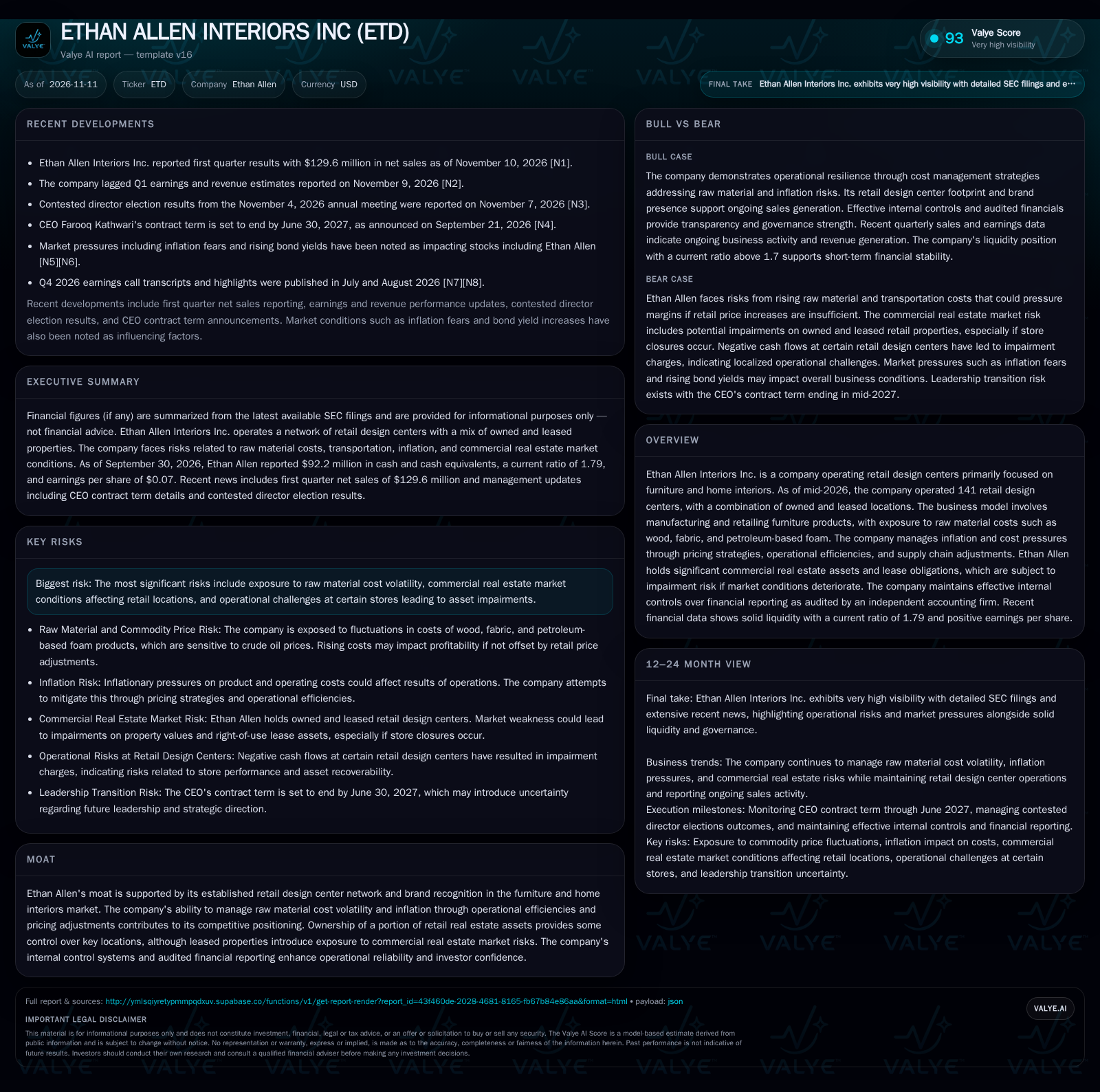
Ethan Allen reported first quarter net sales of $129.6 million as of November 10, 2026, but both earnings and revenue fell short of some analyst expectations, pointing to ongoing challenges in maintaining margin amid persistent cost inflation. The company operates 141 retail design centers, split between 48 owned and 93 leased locations, with significant commercial real estate exposure—right-of-use lease assets were valued at $107.7 million as of June 30, 2026. Impairment charges of $0.4 million were recognized for two underperforming centers, reflecting localized operational stress and asset recoverability concerns. Meanwhile, governance risk has increased: the company reported contested director election results at its November 2026 annual meeting, and CEO Farooq Kathwari’s contract is set to expire by June 2027, introducing strategic uncertainty at the top. [S1] [S2] [N1] [N2] [N3] [N4]
Cost Structure, Price Pass-Through, and the Economics of a Dual-Owned Retail Network
Ethan Allen’s business model is predicated on manufacturing and selling furniture and home interior products through its own branded retail design centers. The company’s economics are tightly linked to input price volatility—especially wood, fabric, and petroleum-based foam, all of which are sensitive to commodity markets and crude oil prices. Transportation costs, including shipping container and fuel expenses, further pressure gross margins.
To offset these pressures, Ethan Allen has historically relied on retail price increases, manufacturing cost reductions, and operational efficiencies (including headcount reductions and repositioning of stores). The mix of owned versus leased stores creates a dual exposure: owned real estate can provide asset value and location control, while leased sites introduce ongoing rent obligations and susceptibility to market downturns. Impairment charges indicate that not all locations are cash flow positive, raising questions about the optimal size and composition of the store network.
Fixed costs from real estate and manufacturing capacity limit short-term operating leverage, while variable costs are dominated by raw materials and logistics. If the company can successfully push through price increases without eroding demand, margins could stabilize. However, the ability to do so depends on brand strength, consumer willingness to absorb higher prices, and competitive dynamics.
Brand Legacy, Store Network, and the Challenge from Digital-First Rivals
Ethan Allen’s competitive position rests on decades of brand recognition, a vertically integrated supply chain, and a nationwide design center network. The physical retail presence enables experiential selling and premium positioning, but also creates significant fixed cost obligations and exposure to shifting consumer traffic patterns.
The broader home furnishings market is increasingly influenced by digital-native competitors and omnichannel upstarts, many of whom operate with leaner cost structures and greater pricing flexibility. If Ethan Allen’s in-person design services and quality promise command a premium, the company may retain pricing power and loyalty among higher-end consumers. However, if price-sensitive or convenience-driven buyers migrate toward online-first players, Ethan Allen could face volume and margin compression.
The company’s ability to manage real estate costs, refresh its store portfolio, and invest in digital engagement will be critical in defending its position. Ownership of certain high-value retail locations offers some moat against displacement, but does not fully immunize the business against secular channel shifts.
Operational Discipline and Brand Premium Enable Margin Recovery
A favorable scenario for Ethan Allen would see the company successfully pass through higher input and transportation costs via retail price increases, leveraging its brand equity and differentiated in-store experience. If operational efficiencies—such as targeted store closures, supply chain optimization, and cost reductions—can be implemented without damaging the customer value proposition, the business could achieve margin stabilization or even expansion.
Evidence to confirm this scenario would include: sequential improvement in gross margins despite ongoing input inflation; positive cash flow at the majority of retail design centers; and stabilization or growth in same-store sales. A smooth leadership transition, with clear strategic continuity, would further support investor confidence.
Conversely, if price increases result in noticeable demand destruction or market share loss, or if cost controls erode service quality, the upside case would be undermined.
Margin Squeeze Persists Amid Cost Volatility and Store Portfolio Rationalization
The most plausible near-term outlook is one of ongoing margin pressure: Ethan Allen continues to face volatile raw material and transportation costs, with only partial ability to pass these through to customers. The store network experiences localized underperformance, leading to incremental impairment charges and selective closures. Net sales remain broadly stable, but earnings growth is limited by higher operating expenses and the need to invest in digital capabilities.
This scenario would be confirmed by a continued pattern of low single-digit earnings per share, periodic impairment charges related to underperforming stores, and modest sales growth that lags inflation. Stagnant or declining same-store sales, coupled with slower-than-anticipated progress on operational efficiency or digital transformation, would reinforce the base case.
Input Cost Surges and Leadership Instability Trigger Accelerated Decline
In a more adverse scenario, Ethan Allen is unable to offset sharp increases in raw material and transportation costs, leading to a pronounced squeeze on gross margins. If consumer demand softens—whether due to macroeconomic weakness, loss of pricing power, or migration to digital competitors—sales could contract, amplifying the impact of fixed costs tied to the physical retail network.
Leadership instability compounds these risks: with the CEO’s contract expiring and boardroom disputes unresolved, strategic drift or loss of key talent could impair execution. Widespread negative cash flows at additional design centers would force larger impairment charges and accelerate store closures, potentially eroding brand equity and weakening the company’s negotiating position with landlords and suppliers.
Confirmation of this scenario would include consecutive quarters of declining sales and earnings, a spike in impairment charges, further contested governance events, and evidence of customer attrition or brand dilution.
Milestones That Will Define Ethan Allen’s Strategic Trajectory
Sequential gross margin trends relative to input cost inflation—if disclosed—would provide insight into the company’s ability to manage pass-through and operational efficiency.
Same-store sales growth or decline across the retail design center network would help gauge underlying demand and competitive positioning.
Number, location, and performance of store closures or impairment charges in upcoming quarters will indicate the effectiveness of portfolio rationalization.
Progress on digital sales penetration, e-commerce initiatives, or omnichannel integration—if disclosed—would clarify adaptation to shifting consumer preferences.
Updates on leadership succession plans and board composition following the CEO’s contract expiration and recent contested director elections.
Changes in real estate asset values or lease obligations, particularly in the context of a weaker commercial property market.
Quarterly commentary on customer mix, pricing actions, and competitive threats as discussed in earnings calls or management updates—if available.
Disclaimer: This is research-only, informational analysis and not investment advice. It may include AI-generated interpretation and general industry context. Always verify important details using primary sources.

Comments