
Affiliated Managers Group at Record AUM: How the Partnership Model Scales in a Changing Asset Management Landscape
AMG’s record $974 billion in assets under management and surging fee growth in 2026 highlight the strength of its partnership approach, but long-term value creation will hinge on sustaining Affiliate outperformance and navigating industry shifts toward alternatives and consolidation.
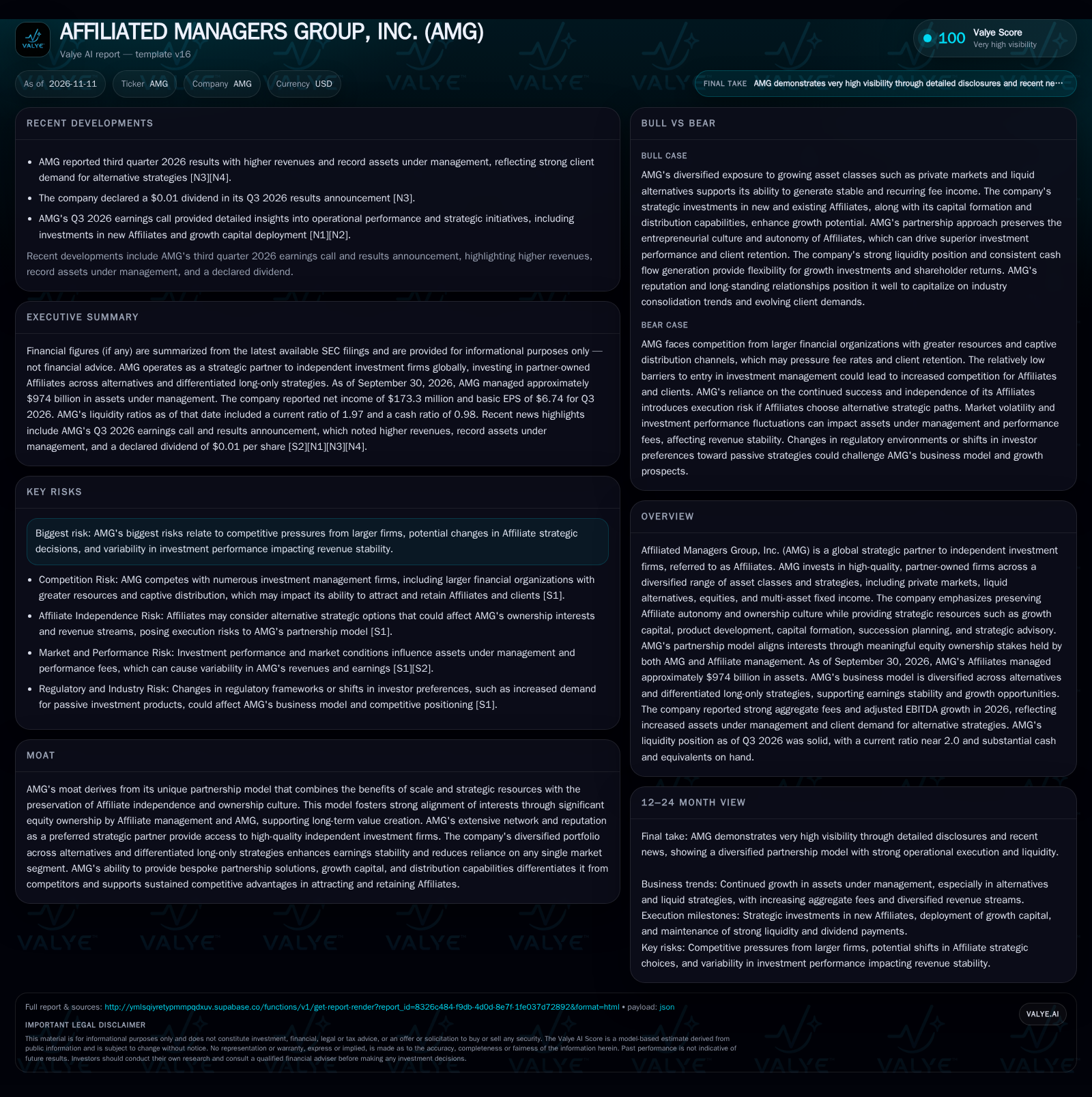
Affiliated Managers Group (AMG) reported record assets under management of $974 billion and a 31% year-over-year surge in aggregate fees for Q3 2026, driven primarily by growth in liquid alternatives and private markets. AMG’s business model centers on minority equity stakes and strategic partnerships with independent investment firms, preserving Affiliate autonomy while providing growth capital and advisory resources. The company’s model supports scalable, diversified fee income, but faces risks from market volatility, performance swings, and competitive pressure from larger asset managers. The durability of its economics depends on continued Affiliate outperformance and the ability to source and integrate new high-performing partners as industry dynamics evolve. [S2] [N3] [N4]
Affiliated Managers Group (AMG) enters late 2026 with record assets under management, surging fee growth, and a robust pipeline of new Affiliate partnerships. AMG’s distinctive model—offering growth capital and strategic support while preserving Affiliate autonomy—enables it to tap into high-performing, specialized managers across alternatives and differentiated strategies. Yet, as industry consolidation accelerates and the demand for alternatives rises, AMG’s future success will depend on its ability to sustain Affiliate investment outperformance, attract new best-in-class partners, and manage the competitive and cyclical forces shaping global asset management.
Record AUM and Fee Growth Reflect Demand for Alternatives
As of September 30, 2026, AMG’s Affiliates collectively managed approximately $974 billion in assets, with a significant $338 billion allocated to liquid alternatives and $161 billion to private markets. This record AUM reflects both organic growth and strategic investments in new Affiliates. Aggregate fees surged 31% year-over-year for Q3 2026, while adjusted EBITDA grew 41% over the same period, signaling strong operating leverage as higher-margin alternative strategies scale within the portfolio. Q3 net income attributable to controlling interest reached $173.3 million, with basic EPS of $6.74. These results were driven primarily by robust client demand for alternative and differentiated strategies, as well as successful execution of the partnership model through new investments in minority stakes in firms like BBH Credit Partners, Garda Capital Partners, and HighBrook Investors [S2] [N3] [N4].
How AMG’s Partnership Model Drives Scalable, Diversified Fee Income
AMG’s economics are fundamentally shaped by its minority equity stakes in a portfolio of independent Affiliates, who operate across a broad range of asset classes and strategies. The company’s revenue stream is primarily composed of asset-based management fees, supplemented in some cases by performance fees and equity income from Affiliates. The mix is skewing increasingly toward alternatives—private markets and liquid alternatives—which generally command higher, less commoditized fee rates than traditional long-only equity or fixed income strategies.
The partnership structure is capital-light versus traditional acquisition, as AMG avoids full consolidation and instead provides growth capital, distribution, and strategic resources in exchange for a share of Affiliate economics. This setup preserves Affiliate entrepreneurial culture and incentivizes performance, as Affiliate management retains significant equity, ensuring alignment of interests. As Affiliates grow, AMG’s fee share scales with AUM and performance, creating significant operating leverage. However, AMG’s economics are sensitive to market-driven AUM fluctuations and underlying Affiliate performance. The company reported cash and liquidity metrics for the period; these figures do not by themselves establish operating runway, investment capacity, financial flexibility, or financing capacity. [S2]
Differentiation and Counterforces in a Crowded Asset Management Arena
AMG’s competitive edge lies in its ability to attract and retain high-performing, independent managers through a partnership model that preserves Affiliate autonomy and equity upside. This stands in contrast to traditional asset management roll-ups and large conglomerates, which often fully acquire or tightly integrate targets. For Affiliates, AMG’s offering is compelling: access to growth capital, product development support, distribution, and strategic advisory—without sacrificing operational independence.
However, AMG faces formidable counterforces. Large asset managers and private equity firms increasingly seek to acquire or partner with boutique investment firms, intensifying competition for the most attractive Affiliates. Fee compression is a persistent risk, especially in commoditized asset classes, though alternatives and specialized strategies remain more insulated. The low structural barriers to entry in asset management mean that talent and performance can migrate, and Affiliate independence introduces the risk that key partners could seek alternative capital or exit AMG’s network. Additionally, the rise of passive investing and regulatory changes could shift client preferences away from higher-fee active strategies, pressuring AMG’s fee pool over time [S1].
Sustained Outperformance and New Affiliate Additions Unlock Compounding Growth
The positive scenario for AMG depends on its ability to systematically source, invest in, and scale high-performing Affiliates—especially in alternatives and differentiated strategies—while preserving their entrepreneurial culture. If AMG’s existing Affiliates continue to outperform benchmarks, and if new investments like those in BBH Credit Partners and Garda Capital Partners deliver incremental AUM and fee growth, aggregate fees and EBITDA could compound well above industry averages. Further, if industry consolidation drives more independent managers to seek AMG’s partnership model, the firm could selectively add new Affiliates at attractive economics, reinforcing its network effect and diversification.
Confirmation of this scenario would include continued above-peer growth in aggregate fees and AUM, a steady pipeline of new Affiliate investments, and sustained outperformance by Affiliates relative to benchmarks. Evidence of increasing performance-fee contributions and a rising share of higher-margin alternatives in the revenue mix would further validate the compounding thesis.
Broad Fee Diversification and Operating Leverage Anchor Steady Growth
The most plausible trajectory for AMG is continued but moderating growth in aggregate fees and AUM, driven by steady demand for alternative strategies and retention of core Affiliates. The company’s diversified mix—across private markets, liquid alternatives, and differentiated long-only strategies—provides resilience against single-strategy downturns. Operating leverage could remain strong if Affiliates maintain investment outperformance and incremental AUM flows are directed toward higher-fee strategies.
Confirmation would consist of stable or modestly rising fee rates, ongoing Affiliate retention, and consistent capital deployment into new or existing Affiliates. Falsification would manifest as a material slowdown in Affiliate additions, sustained underperformance relative to benchmarks, or a shift in client flows toward passive or lower-fee products.
Affiliate Underperformance or Strategic Departures Expose Revenue Volatility
A negative scenario would arise if key Affiliates experience investment underperformance, leading to outflows, weak incentive fee generation, or reputational damage. This could be compounded if Affiliates choose to pursue alternative capital partners, sell to competitors, or otherwise reduce AMG’s economics—undermining both fee income and the value of AMG’s equity stakes. Heightened competition from large managers could increase acquisition multiples or drive higher turnover among top Affiliates.
Additional downside risks include a broad market correction affecting AUM, regulatory shifts favoring passive strategies, or margin compression in alternatives. Evidence confirming this scenario would include declining AUM in core Affiliate strategies, shrinking fee rates, or high-profile Affiliate departures.
Thesis-Testing Developments for AMG: Affiliate Performance, Capital Deployment, and Fee Mix
Net new Affiliate additions or investments—especially in alternative and differentiated strategies—if disclosed, would indicate ongoing sourcing strength and capital deployment.
Affiliate investment performance versus relevant benchmarks; a useful metric would be the percentage of Affiliate AUM outperforming over 3- and 5-year periods.
Aggregate fee rate trends across private markets, liquid alternatives, and long-only strategies; shifts would help test pricing power and mix evolution.
Retention rates of core Affiliates and any disclosed changes in Affiliate ownership or management structure.
Performance-fee contribution to total revenues, if disclosed, as an indicator of alpha generation and mix quality.
Capital deployment pace and size—how quickly AMG reinvests cash into new or existing Affiliates versus returning it to shareholders.
Material changes in regulatory frameworks or client demand for passive strategies, which could pressure fee pools and Affiliate economics.
Any high-profile Affiliate departures, mergers, or alternative partnerships that could signal model stress or competitive leakage.
Disclaimer: This is research-only, informational analysis and not investment advice. It may include AI-generated interpretation and general industry context. Always verify important details using primary sources.

Comments