
Mesa Laboratories: Cost Discipline and Recurring Revenue in the Life Sciences Quality Chain
Mesa Laboratories is executing on a cost-reduction plan while maintaining profitability and a diversified portfolio of regulated products and services. The company's mix of consumables, hardware, and recurring service revenues—especially in Clinical Genomics and Sterilization—positions it for resilience, but global economic and operational risks remain.
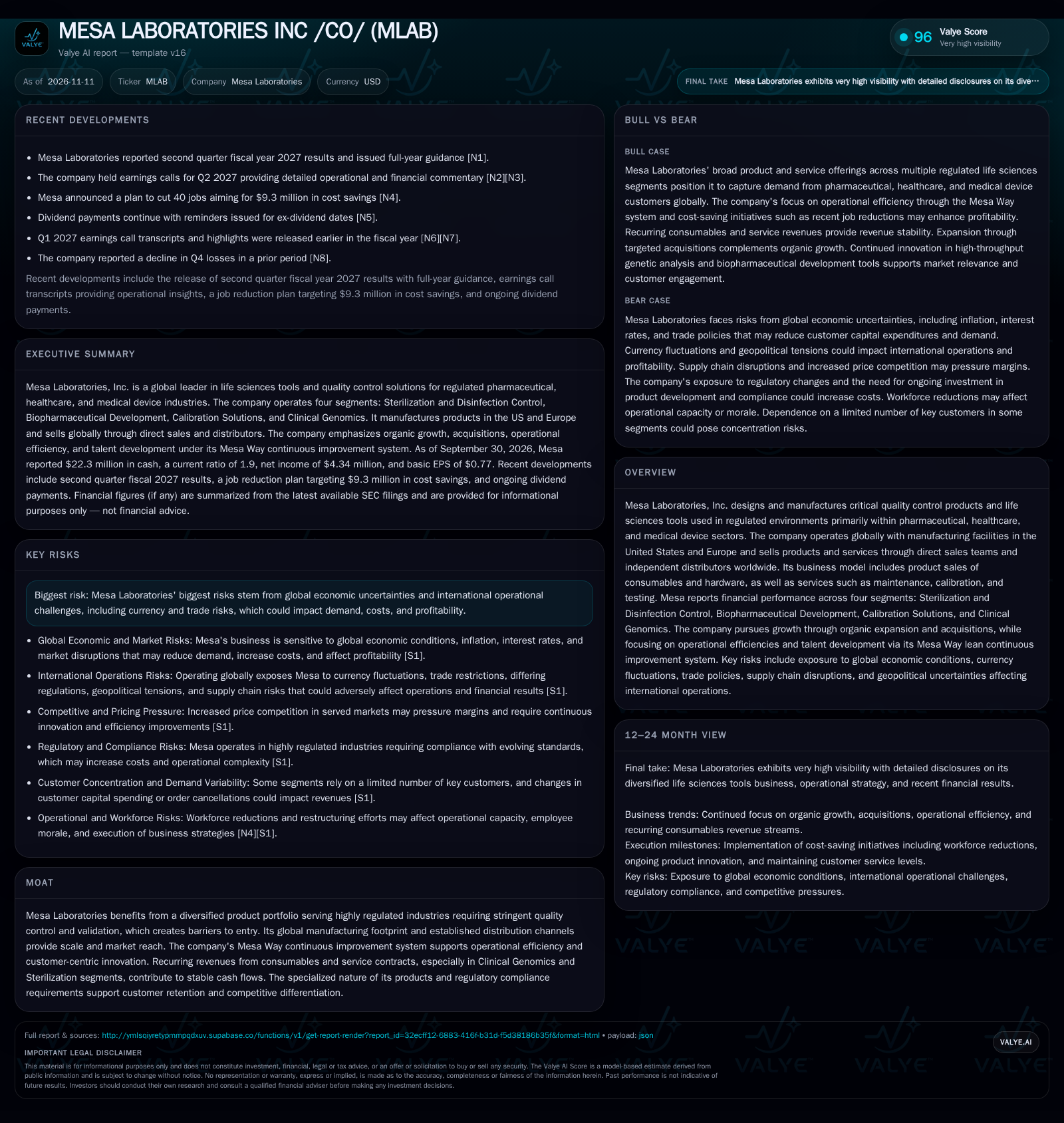
Mesa Laboratories reported $4.34 million in net income for the September 2026 quarter and is implementing a workforce reduction targeting $9.3 million in cost savings. Its diversified portfolio spans consumables, hardware, and services for highly regulated life sciences markets. Recurring revenues and operational efficiency initiatives are central, but exposure to global economic, supply chain, and regulatory risks could shape future performance. Watch for execution on cost savings, segment growth, and stability in consumables-driven lines as key forward indicators. [S2] [N4]
Mesa Laboratories is navigating a complex landscape by doubling down on operational efficiency and cost discipline while maintaining a stable earnings profile. With a diversified portfolio spanning consumables, hardware, and critical quality control services for regulated industries, Mesa is not only targeting $9.3 million in cost savings through job reductions but also sustaining net profitability. The company’s ability to balance recurring revenue streams—especially in consumables-heavy segments like Clinical Genomics—against global economic and operational headwinds will likely determine its next phase of performance and resilience. [S2] [N4]
Recent Cost Initiatives and Profitability Mark a Strategic Inflection
Mesa Laboratories reported net income of $4.34 million for the quarter ended September 30, 2026, equating to a basic EPS of $0.77 and diluted EPS of $0.75 [S2]. The company also announced a workforce reduction of 40 jobs, aiming for $9.3 million in annualized cost savings [N4]. These developments are significant because they reflect a deliberate effort to improve operating leverage and shield margins amid ongoing macroeconomic and operational pressures. The company reported cash and liquidity metrics for the period; these figures do not by themselves establish operating runway, investment capacity, financial flexibility, or financing capacity. [S2] The emphasis on cost control, profitability, and recurring revenue is central as Mesa contends with risks from global economic volatility and industry competition.
How Mesa Generates Cash: Recurring Consumables, Service Contracts, and Hardware Sales
Mesa Laboratories earns revenue from a blend of consumables, hardware, and ongoing services such as calibration and testing, targeting regulated environments in pharmaceuticals, healthcare, and medical devices [S1]. The economics of consumables are particularly attractive: in the Clinical Genomics segment, about 80% of revenue comes from consumables, supporting a recurring revenue base that tends to be less volatile than capital equipment sales [S1]. Service contracts—such as calibration and maintenance—can further stabilize cash flows and foster long-term customer relationships.
Hardware sales (instruments and devices) typically involve higher upfront costs and lower frequency of purchase, but these are often paired with annuity-like consumables and services. This mix provides Mesa with a hybrid revenue stream: capital equipment can create installed base lock-in, while consumables and services generate recurring margin. Fixed costs are meaningful, reflected in the need for cost-saving initiatives, but variable costs tied to consumables and services may allow for operating leverage as volumes grow. Capital requirements are moderate—expansion is more likely to be funded by retained earnings and operational cash flow than by large-scale debt or equity issuance, barring major acquisitions or disruptions.
The recurring nature of consumables revenue provides Mesa with a predictable cash flow foundation, which is particularly valuable in regulated industries where validation and compliance cycles enforce steady demand patterns. This stability can reduce the company's revenue volatility and enhance its ability to forecast and manage working capital. However, the extent to which consumables revenues can grow depends on factors such as market penetration, customer adoption rates, and potential technological shifts that might alter consumable requirements. If Mesa can deepen integration with customer workflows through service contracts and software-enabled monitoring, it could further entrench its position and create higher switching costs, thereby increasing customer lifetime value and smoothing revenue streams.
Hardware sales, while less frequent, play a strategic role in establishing Mesa’s installed base and enabling cross-selling of consumables and services. The capital-intensive nature of hardware development requires disciplined investment prioritization, balancing innovation with cost control. The company's ability to anticipate regulatory changes and evolving customer needs is critical to avoid product obsolescence and maintain relevance. In addition, the lifecycle management of hardware assets—including upgrades, maintenance, and end-of-life replacement—can generate additional service revenue opportunities. The interplay between hardware introduction and consumables/service growth creates a feedback loop that can reinforce recurring revenue, provided Mesa sustains product quality and customer satisfaction.
Barriers to Entry in Regulated Quality Control—and the Limits of Scale
Mesa’s advantage stems from the specialized, regulated nature of its markets. Customers in pharmaceutical, healthcare, and medical device sectors face stringent quality and compliance requirements, which could raise switching costs and creates entry barriers for would-be competitors. The company’s global manufacturing footprint and established direct/distributor sales channels add scale and reach, while recurring consumables and service contracts support customer stickiness [S1].
However, these same attributes attract competition from both large diversified life sciences companies and niche specialists. Price competition can be intense, particularly for commoditized consumables or basic calibration services. Technological innovation—such as automation in biopharmaceutical development or next-gen genetic analysis—could also shift the competitive landscape if Mesa lags in R&D or fails to anticipate customer needs. While Mesa’s lean-based Mesa Way system aims to drive efficiency and responsiveness, the company must continually reinvest to sustain its competitive differentiation.
Efficiency Gains and Consumables Growth Drive Margin Expansion
If Mesa executes its cost reduction plan without significant disruption to operations or customer service, the company could see material improvement in operating margins. This would be amplified if recurring consumables and service revenues continue to grow, particularly in the Clinical Genomics and Sterilization segments, where compliance-driven demand is less discretionary. Successful integration of new innovations or targeted tuck-in acquisitions could also supplement organic growth and enhance the installed base.
Confirmation of this scenario would come from sequential improvement in operating margin, stable or rising gross margin in consumables-heavy segments, and evidence of growing service contract penetration. Additional signals might include increased R&D output (new product launches or platform enhancements) and retention of key customers despite the workforce reduction.
Stable Recurring Revenues Offset Cyclical Pressures and Cost Actions
The most plausible trajectory is that Mesa maintains a stable revenue and earnings base, with recurring consumables and services offsetting variability in capital equipment sales. The $9.3 million cost-saving initiative helps sustain margins, but some modest disruption or adjustment costs may occur as the workforce reduction is implemented. Global economic and supply chain risks could create periodic headwinds, but the company’s diversified segment exposure and regulatory focus provide a buffer.
This scenario would be confirmed by continued positive net income, stable or slightly improved margins, and limited customer attrition or operational disruption. Weakness in capital sales could be offset by resilience in consumables and services; however, any slippage in recurring revenue, or evidence of lost contracts/customers following restructuring, would challenge the base case.
Operational Disruption or Demand Shock Undercuts the Recurring Revenue Thesis
A more adverse outcome would see the cost reduction plan leading to operational bottlenecks, degraded customer service, or loss of key technical talent, resulting in customer churn or contract losses. Simultaneously, a global economic downturn or industry-specific demand shock could depress capital equipment sales and even slow consumables/service growth as customers defer spending or consolidate suppliers.
Confirmation of the downside would be a decline in net income or margin compression, negative trends in recurring revenue lines, or customer loss disclosures linked to operational changes. Additional warning signs might include increased turnover among technical staff, missed product development milestones, or evidence that supply chain disruptions are constraining the company’s ability to deliver on contracts.
Milestones That Will Reveal Mesa Laboratories’ Strategic Trajectory
Quarterly trends in consumables and service revenue by segment—especially in Clinical Genomics and Sterilization—would help clarify the durability of recurring revenue streams, if disclosed.
Sequential changes in operating and gross margins, particularly following the implementation of the $9.3 million cost reduction plan.
Customer retention rates or contract renewal rates, especially among large pharmaceutical and healthcare accounts, would help test the stickiness of Mesa’s offerings.
R&D output and new product launch cadence: announcements of new instruments, consumables, or platform extensions.
Any reported operational disruptions, delays, or customer complaints following workforce reductions.
International revenue mix and the impact of currency fluctuations or geopolitical events on segment profitability, if disclosed.
Updates on supply chain stability and input cost trends, particularly for high-margin consumables and critical hardware components.
Divisional performance breakdowns that reveal shifts in demand or margin structure across the four reported segments.
Disclaimer: This is research-only, informational analysis and not investment advice. It may include AI-generated interpretation and general industry context. Always verify important details using primary sources.

Comments