
Greystone Housing Impact Investors: Income Stability, Regulatory Sensitivity, and the Structure of Affordable Housing Returns
Greystone Housing Impact Investors LP’s Q3 2026 results highlight stable income from affordable and multifamily housing investments, but regulatory shifts and market dynamics remain central to its economic trajectory. The company’s capital structure, risk controls, and sector positioning shape both its resilience and its exposure to policy and interest-rate volatility.
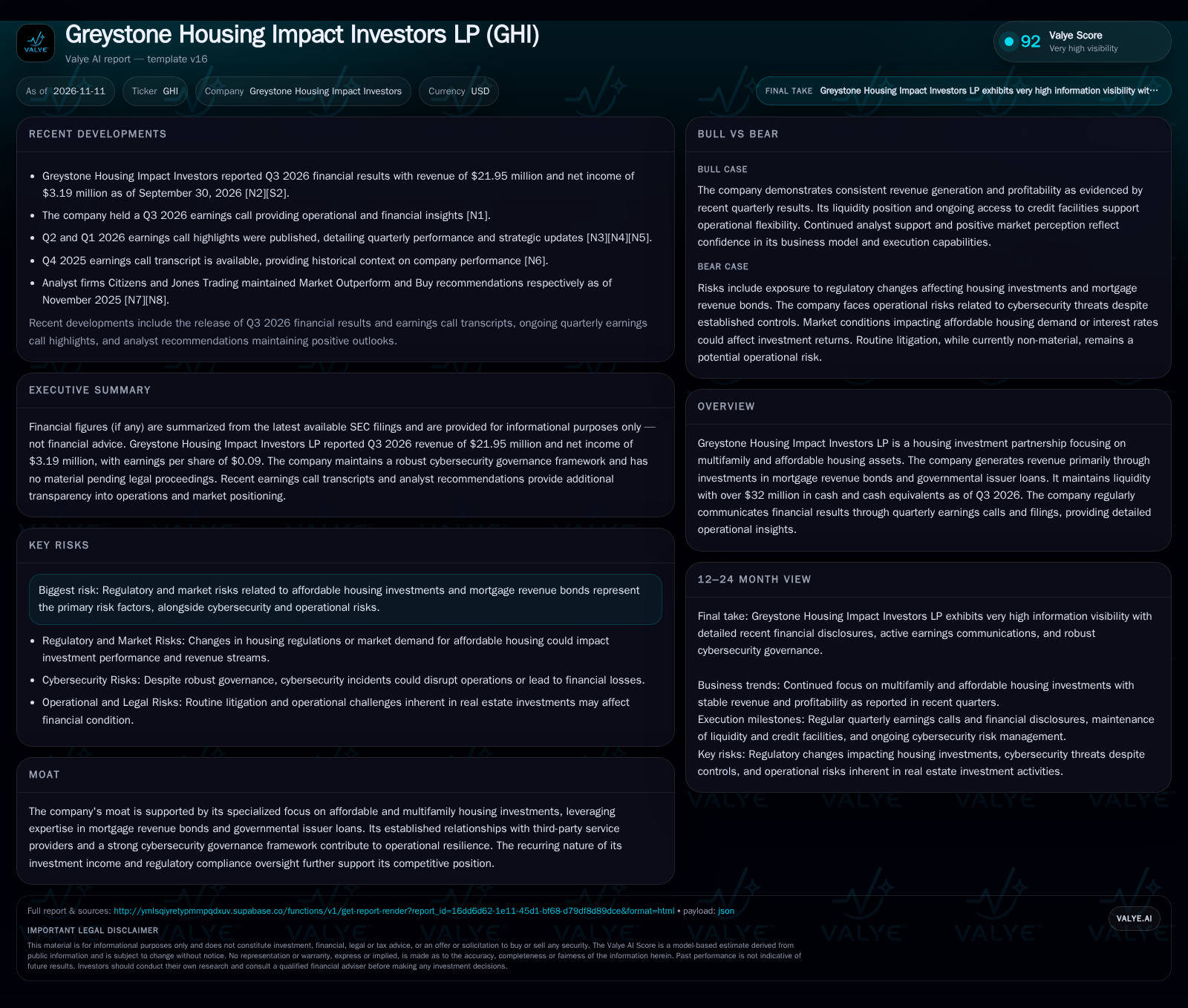
Greystone Housing Impact Investors LP reported Q3 2026 revenue of $21.95 million and net income of $3.19 million, reflecting stable operations in the affordable and multifamily housing investment space. The company maintains over $32 million in cash, has strong cybersecurity governance, and faces no material legal or cyber incidents. While its recurring investment income provides a measure of predictability, the business remains sensitive to regulatory, interest rate, and market risks that could affect returns and asset values. Analyst sentiment remains constructive, but the future trajectory hinges on sector policy and capital markets conditions. [S2] [N2]
Greystone Housing Impact Investors LP sits at the intersection of stable, income-oriented real estate investing and the policy-driven world of affordable housing. Its latest quarterly results affirm the resilience of its core model—generating revenue through mortgage revenue bonds and governmental issuer loans—while also underscoring the ever-present risks from regulatory changes and broader market forces. As the affordable housing landscape evolves and interest rates fluctuate, Greystone’s ability to sustain and grow distributable income will depend on its capital management, investment pipeline, and responsiveness to both external shocks and policy shifts.
Recent Results Underscore Income Stability but Highlight Policy Exposure
The company reported cash and liquidity metrics for the period; these figures do not by themselves establish operating runway, investment capacity, financial flexibility, or financing capacity. [S2] [N2]
No material cybersecurity events or legal proceedings have impaired business operations, and the company continues to maintain a robust governance framework. [S1]
Analyst coverage as of late 2025 remained positive, with Market Outperform and Buy recommendations, reflecting confidence in the business model’s resilience but not necessarily forecasting future outperformance. [N7] [N8]
How Greystone’s Housing Investment Model Generates Income and Faces Constraints
Greystone Housing Impact Investors LP’s revenue model centers on the acquisition and management of mortgage revenue bonds and governmental issuer loans, primarily tied to affordable and multifamily housing projects. These instruments typically provide predictable, recurring interest income, with the potential for additional returns from equity stakes in joint ventures or property sales, though the latter are less predictable and may be lumpy in timing and magnitude.
The economics of mortgage revenue bonds are shaped by the spread between bond yields and the company’s cost of capital. This spread is sensitive to interest rate movements: rising rates can compress margins if asset yields are slow to reset or if funding costs escalate more rapidly. Conversely, declining rates may prompt bond prepayments, potentially reducing reinvestment yields unless new opportunities are sourced quickly.
Operating leverage in this business is moderate; while the cost base is relatively fixed due to a lean team and stable servicing costs, asset-level returns are susceptible to occupancy rates, tenant quality, and local market health. Capital needs are ongoing, as new investments require upfront deployment, and liquidity is essential both for opportunistic acquisitions and to meet any near-term obligations.
The company’s participation in joint ventures as a noncontrolling equity investor introduces a secondary income stream, often realized upon asset refinancing or sale. These returns are inherently less predictable and may be subject to real estate market cycles and exit timing.
Specialization in Affordable Housing: Advantage or Constraint?
Greystone’s niche focus on affordable and multifamily housing investments offers both potential advantages and structural limitations. On the positive side, this specialization allows the company to leverage deep sector relationships, access targeted deal flow, and navigate complex regulatory environments more effectively than generalized real estate investors.
However, the same specialization exposes Greystone to concentrated policy risk: changes in housing tax credits, municipal support, or federal housing policy can rapidly alter the economics of new deals or the value of existing assets. Unlike diversified REITs or broader credit investors, Greystone’s model is less insulated from sector-specific shocks.
Competition comes from other housing-focused investment vehicles, specialized REITs, and large institutional investors seeking income-oriented real estate exposure. Barriers to entry include regulatory expertise, sourcing capabilities, and the ability to underwrite and manage complex affordable housing deals—areas where Greystone may retain an edge, though these advantages are not insurmountable.
If Policy Tailwinds and Capital Flows Sustain, Predictable Income and Asset Growth Are Achievable
The most favorable outcome for Greystone would involve continued government and municipal support for affordable housing, stable or declining interest rates, and resilient tenant demand. In this environment, the pipeline of new mortgage revenue bonds and governmental issuer loans could remain robust, allowing Greystone to deploy capital at attractive spreads and grow recurring income.
Confirmation of this scenario would come from sequential growth in revenue and net income, stable or improving occupancy rates in underlying properties, and evidence of successful new investment deployment without material credit losses. Analyst upgrades or increased institutional investor interest could also signal confidence in the durability of the model.
Falsification would occur if legislative changes erode tax-advantaged bond economics, if funding costs rise meaningfully faster than asset yields, or if a material increase in tenant delinquencies emerges, leading to asset impairments or reduced distributable income.
Sector Cyclicality and Policy Uncertainty Temper Otherwise Stable Returns
The most plausible outlook is continued, but modest, revenue and net income growth, punctuated by periodic volatility as market and policy conditions fluctuate. Greystone’s recurring income from mortgage revenue bonds should provide a stable baseline, but the company’s capacity to scale distributable income may be capped by competitive deal sourcing and the pace of new affordable housing development.
Evidence supporting this scenario would include ongoing quarterly results in line with recent trends, maintenance of cash balances and liquidity, and no material changes in the regulatory landscape. Occasional asset sales or joint venture exits may contribute incremental, but unpredictable, upside.
This base case would be challenged by a sharp downturn in the affordable housing market, a spike in interest rates without a corresponding increase in asset yields, or adverse regulatory developments curtailing new issuance or refinancing activity.
Rising Rates or Policy Shifts Could Disrupt Income Streams and Asset Values
Should interest rates rise sharply or government support for affordable housing diminish, Greystone could face margin compression and asset value declines. Higher funding costs may outpace the yields on existing mortgage revenue bonds, while a freeze or reduction in new affordable housing initiatives would limit reinvestment opportunities and slow portfolio growth.
This scenario could be confirmed by a drop in quarterly revenue or net income, increased asset impairments, or disclosures of material tenant delinquencies and property-level stress. Regulatory changes reducing the attractiveness of tax-advantaged bonds would be an early warning signal.
Further downside would be evident if liquidity tightens, forcing the company to sell assets at unfavorable prices or curtail its investment program.
What Could Validate or Challenge the Greystone Thesis in the Next Year
Sequential revenue and net income trends: Sustained or accelerating growth would support the thesis of stable, expanding income; a reversal would signal emerging stress.
Credit quality and asset impairments: Any rise in delinquencies or write-downs on mortgage revenue bonds would challenge the predictability of income streams.
Interest rate sensitivity: Disclosure of funding costs and asset yield spreads, if provided, would clarify margin risk as rates move.
Deal sourcing and investment pipeline: Data on new mortgage revenue bond investments or joint venture commitments would indicate the company’s ability to reinvest at attractive returns.
Regulatory or legislative changes: Announcements affecting affordable housing tax credits, bond issuance, or housing policy would materially affect the business outlook.
Liquidity and capital management: Updates on cash, debt, and credit facilities would help assess the company’s ability to withstand shocks and fund new investments.
Disclaimer: This is research-only, informational analysis and not investment advice. It may include AI-generated interpretation and general industry context. Always verify important details using primary sources.

Comments