
Alta Equipment Group’s Q3 Loss: Navigating Thin Cash Margins and Profitability Hurdles
Alta Equipment Group reported a Q3 2026 net loss and negative earnings per share, with a cash ratio of just 0.04 despite a current ratio of 1.35.
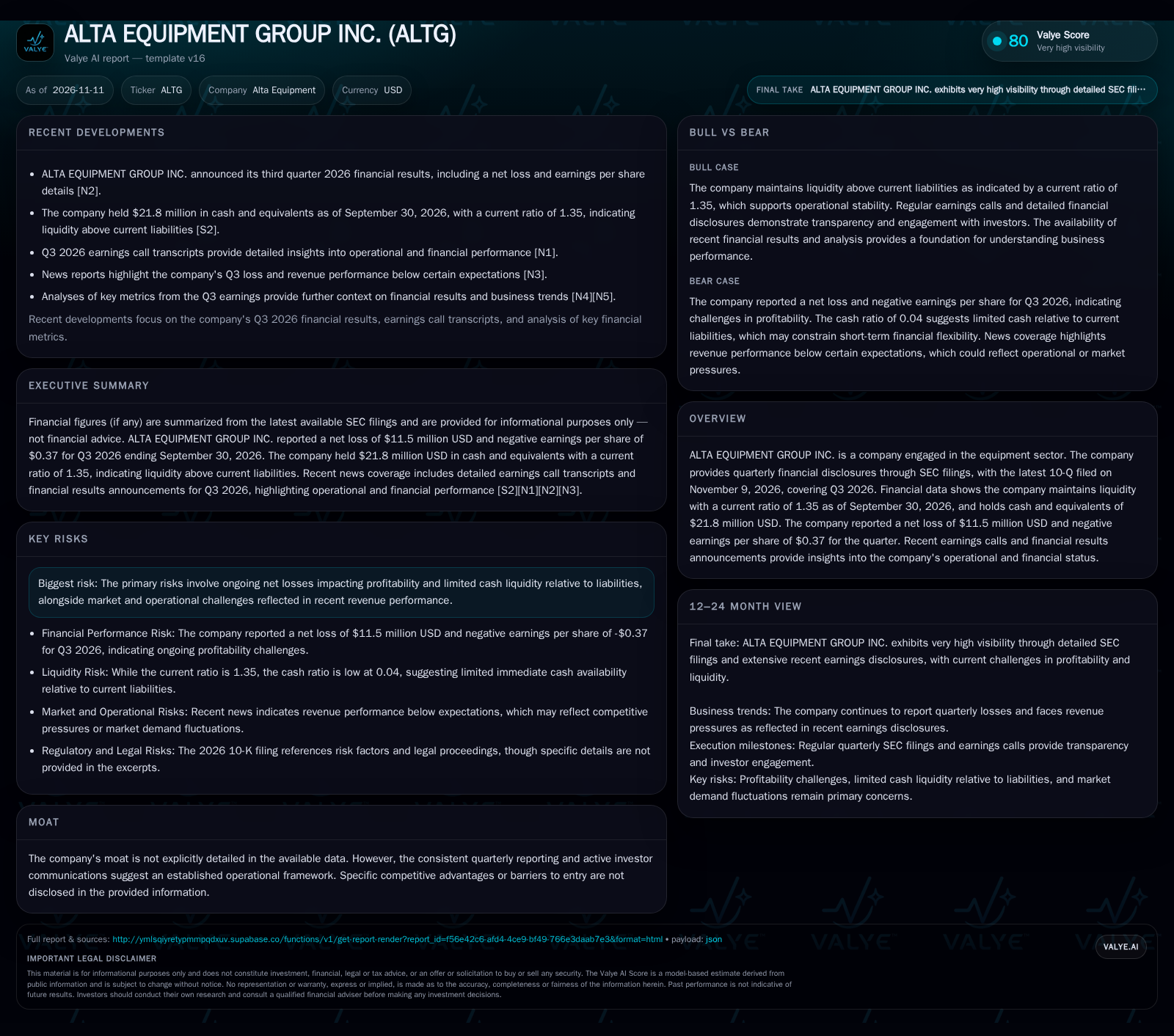
Alta Equipment Group reported a Q3 2026 net loss and negative earnings per share, with a cash ratio of just 0.04 despite a current ratio of 1.35. Revenue came in below expectations, and cash on hand is limited relative to current liabilities. [S2] [N3]
With operational losses persisting and top-line growth lagging, Alta’s ability to self-fund growth or absorb external shocks is in question, making its next strategic moves and external financing options pivotal. [S2] [N3]
Q3 2026 Snapshot: Net Losses and a reported cash balance
Alta Equipment Group ended Q3 2026 with a net loss of $11.5 million and negative earnings per share of $0.37, underscoring ongoing profitability challenges. News reports confirm that revenue for the quarter missed expectations, adding pressure to an already strained operating environment. These facts highlight both the company’s transparency in financial reporting and the urgency of addressing operational and liquidity constraints. [S2] [N3]
Equipment Distribution Economics: Fixed Costs, Working Capital, and Margin Pressures
Alta Equipment operates in the equipment sector, a space typically characterized by high fixed costs, significant working capital requirements, and cyclical revenue patterns. The business model often involves sourcing new and used equipment, providing maintenance or leasing services, and managing a large inventory—each with distinct margin profiles. Revenue growth can be driven by equipment sales volume, service contract penetration, or recurring leasing income, but the mix between these streams strongly influences overall profitability and cash flow.
When net losses persist, as in Alta’s Q3 2026, it may signal that gross margins are insufficient to cover operating expenses, or that fixed costs (such as labor, facility leases, and inventory financing) are too high relative to revenue. In such models, negative operating leverage can quickly amplify losses if revenue growth stalls or pricing comes under pressure.
Capital intensity is a persistent theme: ongoing investment in inventory and equipment fleets is needed to maintain competitiveness, but doing so without robust free cash flow can increase reliance on external financing—potentially raising risk if capital markets tighten or if the company’s credit profile deteriorates.
In equipment distribution, the interplay between working capital management and margin sustainability is critical. For example, extended payment terms to customers can boost sales volume but may strain cash flow and increase days sales outstanding, thereby elevating financing costs. Conversely, negotiating better payment terms with suppliers can improve liquidity but risks supplier relationship deterioration if pushed too far. Therefore, companies like Alta must carefully balance these trade-offs to maintain operational fluidity without compromising supplier or customer goodwill. Additionally, inventory obsolescence risk is a persistent challenge, especially when market demand shifts rapidly or technological advances render equipment less desirable, necessitating prudent inventory forecasting and turnover strategies.
How Liquidity and Scale Shape Competitive Standing in Equipment Distribution
In the equipment sector, competitive position is often determined by access to inventory, breadth of service offerings, customer relationships, and the ability to offer financing or leasing solutions. Scale can confer purchasing power and enable better terms with manufacturers, but only if working capital is available to support inventory turns and customer financing.
Alta’s regular financial disclosures and investor communications suggest an established operational framework, but there is no evidence in the current data of a unique competitive moat such as exclusive supplier relationships, proprietary technology, or material switching costs.
Substitution risk in the equipment sector can come from both direct competitors and alternative business models, such as equipment rental platforms, vertically integrated OEMs, or digital marketplaces that compress distributor margins. Without evidence of differentiated offerings or structural cost advantages, Alta’s current position appears vulnerable to both traditional and emerging competitive threats.
The capacity to innovate operationally can also influence competitive standing in equipment distribution. Firms that integrate advanced data analytics to optimize inventory levels, predict maintenance needs, or personalize leasing terms may reduce costs and enhance customer satisfaction, creating differentiation beyond scale alone. Moreover, digital transformation initiatives that streamline order processing, improve transparency, or enable remote diagnostics can strengthen customer retention and reduce service costs. However, such investments require upfront capital and organizational commitment, which may be constrained if liquidity is tight. Without these capabilities, companies risk falling behind competitors who leverage technology to compress costs and improve service quality.
Margin Recovery and Working Capital Optimization Could Restore Momentum
An upside scenario would see Alta Equipment Group stabilize or grow revenue—potentially through improved equipment sales, expansion of higher-margin service contracts, or better utilization of inventory. If management can drive gross margin expansion (via pricing discipline or product mix) and reduce fixed costs, operating leverage could turn positive, allowing incremental revenue to flow more directly to the bottom line.
Evidence confirming this scenario would include sustained improvements in gross margin, declining SG&A as a percentage of revenue, and an upward trend in operating cash flow.
Further, if Alta can secure new supplier partnerships, exclusive distribution rights, or digital channel efficiencies, it may be able to differentiate its offering, boosting both revenue resilience and pricing power. Confirmation would come from management commentary, contract announcements, or visible market share gains.
For instance, implementing just-in-time inventory practices or dynamic pricing models may reduce holding costs and increase turnover rates, thus freeing capital for reinvestment or debt reduction. Additionally, expanding higher-margin service offerings, such as maintenance contracts or value-added consulting, can diversify revenue streams and reduce reliance on cyclical equipment sales. If Alta can successfully execute these strategies, it may not only stabilize margins but also build resilience against competitive pressures and economic downturns.
Sustained Losses and Liquidity Pressures Define the Status Quo
Revenue may remain under pressure from industry cyclicality or competitive discounting, while fixed costs and inventory requirements constrain flexibility.
Unless Alta can meaningfully improve gross margins or materially grow service revenue, negative operating leverage may persist. The company’s regular investor communications and transparent reporting will help maintain stakeholder confidence, but this alone is unlikely to offset the impact of ongoing net losses and low cash liquidity.
Evidence supporting this scenario would be further quarters of net losses, stagnant or declining cash balances, and news coverage continuing to highlight revenue or margin shortfalls. Any external capital raises or increased debt reliance would further validate a thesis of operational strain and limited internal funding flexibility.
External Shocks or Prolonged Losses Could Force Dilution or Strategic Retreat
In a downside scenario, Alta faces either a sharp industry downturn or persistent revenue shortfalls, quickly exhausting its reported cash balance. With a cash ratio of just 0.04, any significant customer default, supply chain disruption, or spike in input costs could create a liquidity crisis.
Should the company be unable to generate positive operating cash flow or secure affordable external financing, it may be forced to sell assets, cut headcount, or pursue dilutive equity raises—potentially at depressed valuations. In the extreme, sustained negative cash flow could lead to covenant violations or restructuring negotiations with creditors.
Confirmation of this scenario would include a rapid decline in current assets, emergency credit facility draws, asset sales, or announcements of new equity or debt issuances under distressed terms. Deterioration in supplier or customer relationships, as reflected in earnings calls or news reports, would further signal deepening operational stress.
A prolonged inability to generate positive operating cash flow could exacerbate liquidity constraints, forcing Alta into reactive measures that erode strategic flexibility. For example, asset sales under distressed conditions often yield lower proceeds and may compromise future revenue-generating capacity. Similarly, dilutive equity raises can weaken shareholder value and reduce incentives for operational improvements. In such scenarios, the company’s bargaining power with suppliers and lenders may diminish, leading to less favorable terms and increased cost of capital. This negative feedback loop underscores the importance of early intervention to restore financial health before liquidity pressures become acute.
Milestones That Will Reveal Alta Equipment’s Ability to Rebound or Restructure
Quarterly trends in gross margin and SG&A as a percentage of revenue—improvements here would indicate progress toward profitability if disclosed.
Cash flow from operations, particularly whether positive operating cash flow is achieved or negative trends persist.
Inventory turnover ratio and days sales outstanding—faster turns would suggest working capital is being released and cash liquidity is improving, if disclosed.
Any announcements of new supplier agreements, exclusive distribution rights, or strategic partnerships that could boost revenue or margins.
Evidence of cost reduction initiatives, such as facility consolidation, headcount reduction, or renegotiated lease terms.
Disclosure of new debt facilities, equity raises, or asset sales—especially if terms are punitive or indicate distress.
Management guidance on capital allocation priorities, including whether growth investments are being scaled back or deferred.
Analyst or news coverage highlighting changes in competitive dynamics or material shifts in market share.
Disclaimer: This is research-only, informational analysis and not investment advice. It may include AI-generated interpretation and general industry context. Always verify important details using primary sources.

Comments