
Rare Element Resources: Advancing Demonstration Plant and Commercialization Ambitions
Rare Element Resources advances its Bear Lodge Project with proprietary REE processing and strong DOE-backed support, but faces the core challenge of converting technical milestones and demonstration-scale output into sustainable commercial operations amid volatile markets and heavy capital needs.
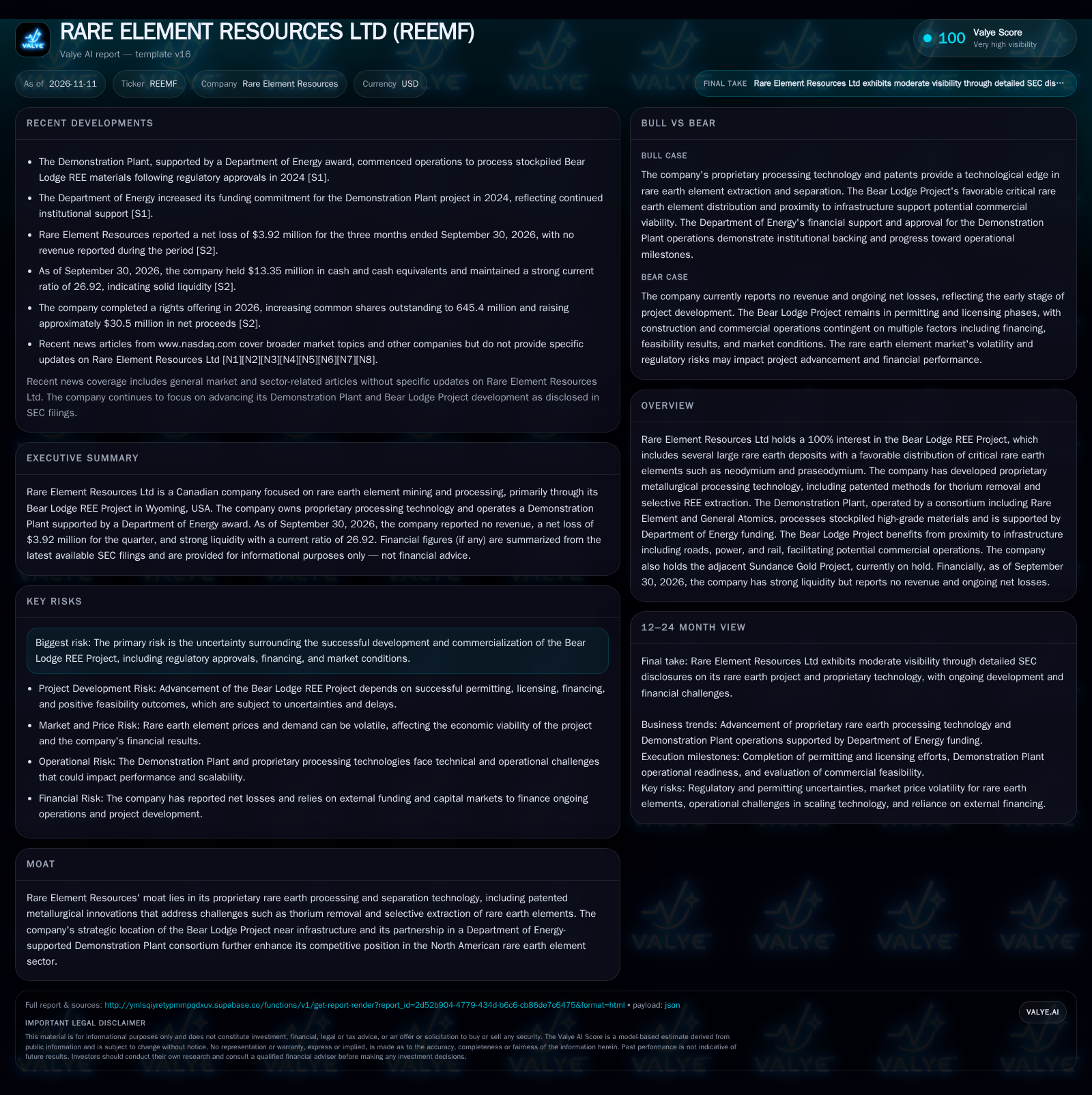
Rare Element Resources Ltd remains pre-revenue, reporting a net loss of $3.92 million for Q3 2026, but has advanced its DOE-supported Demonstration Plant and maintains a reported liquidity position through recent capital raising. The company’s patented REE processing technology and Bear Lodge’s favorable critical mineral profile create potential for a North American supply chain play, but future success will hinge on commercial feasibility, permitting, and market dynamics. Monitoring project milestones and external funding will be crucial for assessing Rare Element Resources’ transition from development-stage to operating miner.
Rare Element Resources Ltd sits at a pivotal stage as it works to convert its Bear Lodge rare earth project from a DOE-supported demonstration into a potentially strategic North American REE supplier. With proprietary metallurgical processes and a Demonstration Plant now operational, the company has attracted institutional backing and maintained reported liquidity position through capital raising. However, with no revenue and ongoing net losses, the critical test is whether Rare Element can translate technical progress and favorable geology into a commercially viable, fully permitted, and funded mining and processing operation. Success will depend on external market conditions, regulatory progress, and the ability to secure long-term financing and offtake agreements.
Financial Position and Recent Progress Shape Near-Term Prospects
Rare Element Resources reported no revenue and a net loss of $3.92 million for the quarter ended September 30, 2026, underlining its current status as a development-stage company. The company’s Demonstration Plant, supported by a Department of Energy award, began processing high-grade stockpiled materials from Bear Lodge in 2024 after receiving regulatory approvals. The company reported a current ratio of 26.92 for the period. The Demonstration Plant’s progress and the company’s liquidity buffer are critical as it navigates the transition from demonstration to potential commercial operations. [S1] [S2]
Linking Technology and Resources to Economic Viability
At its core, Rare Element Resources’ business model depends on moving from demonstration-scale processing of rare earth elements (REEs) to full-scale commercial extraction and separation. The company’s proprietary metallurgical technology—featuring patented processes for thorium removal and selective REE extraction—could lower processing costs and improve recovery rates, potentially providing a cost advantage over conventional flowsheets if scalable. However, the current absence of revenue and the ongoing net losses highlight the capital-intensive nature of resource development and the long lead times before potential cash flow generation.
The economics of the Bear Lodge Project will hinge on several interdependent factors: the capital costs to build a commercial mine and processing plant (likely in the hundreds of millions of dollars for a project of this scale), the operating expenses associated with extraction and separation, and the realized prices for critical REEs, particularly neodymium and praseodymium, which are essential for permanent magnets. The demonstration plant, if successful, may validate lower operating costs or higher recoveries, but meaningful operating leverage will only emerge if the company secures financing for, constructs, and ramps up a full-scale facility. The present funding from the DOE and rights offering supports near-term R&D and de-risking, but does not cover the much larger capital needs of commercial buildout.
Evaluating Competitive Strength through Proprietary Processing and Location
Rare Element Resources’ competitive position is anchored in two primary factors: its proprietary REE processing technology and the strategic location of Bear Lodge in the continental United States. The patented metallurgical processes could offer technical differentiation, especially if they enable more efficient extraction of critical elements and safe handling of radioactive byproducts such as thorium—an issue that has historically hindered North American REE projects.
Geographically, Bear Lodge’s proximity to roads, power, and rail infrastructure provides logistical benefits, potentially reducing both capital and operating costs compared to more remote peers. Institutional support, as evidenced by DOE funding and the consortium with General Atomics, also signals credibility and may ease future permitting and offtake negotiations.
Nonetheless, Rare Element will face competition from global REE producers (particularly China), emerging North American projects, and alternative supply chain solutions such as recycling or substitution. The key question is whether the company’s process innovations and location advantages can overcome the entrenched scale, integrated value chains, and price volatility that characterize the global rare earth sector.
Unlocking Transformative Value from Demonstration to Commercial Scale
The most favorable scenario for Rare Element Resources is that its Demonstration Plant validates the scalability and cost-effectiveness of its proprietary extraction technology, leading to successful permitting and the attraction of project-level financing or strategic offtake partnerships. If the process delivers high recovery rates, low environmental impact (especially with effective thorium removal), and robust economics in pilot-scale runs, this could de-risk the technical and regulatory path to commercial mining.
Confirmation of this scenario would likely come from: (1) positive Demonstration Plant operational data—such as high-purity NdPr output and low unit costs—publicly disclosed; (2) progress in securing key permits and licenses for commercial development; (3) announcements of binding offtake agreements with magnet or automotive OEMs; and (4) securing debt or equity financing for mine construction. If these milestones are achieved amid favorable REE pricing, Rare Element could emerge as a strategic supplier for the North American critical minerals supply chain.
Technology Validation, Cost Management, and Permitting Define the Expected Path
The most plausible path for Rare Element Resources is one of incremental progress but ongoing uncertainty. The company is likely to continue operating its Demonstration Plant, refining its process technology, and pursuing permitting and licensing for Bear Lodge. Cash burn will persist as no revenue is expected until at least commercial-scale production, and the company will likely need to raise additional capital to bridge the gap between demonstration and construction.
Confirmation of this scenario would include continued technical updates from the Demonstration Plant (even if not yet commercial-scale), extensions of DOE or other government support, progress on permitting, and additional equity or grant funding. Falsification would occur if technical setbacks, permitting delays, or inability to raise further funding stall progress, forcing the company to shelve or slow the Bear Lodge Project.
Potential Setbacks from Technical, Regulatory, and Funding Challenges
In the adverse scenario, Rare Element Resources faces one or more of the classic challenges that have stymied North American REE projects: technical difficulties in scaling its proprietary process beyond demonstration scale, regulatory or permitting delays (including environmental objections), or an inability to secure the substantial capital required for commercial buildout. In this case, the company could remain stuck in a pre-revenue, development-stage limbo, eventually exhausting its cash resources and being forced to seek strategic alternatives or asset sales.
Confirmation of the downside would include: (1) disclosure of technical setbacks at the Demonstration Plant (such as lower-than-expected recoveries or cost overruns); (2) major permitting or licensing delays; (3) inability to secure additional funding as cash balances dwindle; or (4) sustained weakness or volatility in global REE prices, undermining project economics.
Key Milestones Influencing Rare Element Resources’ Future
Operational performance data from the Demonstration Plant—such as recovery rates, product purity, and operating cost per tonne—if disclosed, would provide critical insight into the scalability and competitiveness of Rare Element’s technology.
Progress in securing major permits and licenses for the Bear Lodge Project, including environmental clearances and mining approvals, remains a gating factor for commercial advancement.
Announcements regarding binding offtake agreements or strategic partnerships with downstream users (e.g., magnet manufacturers, automotive OEMs) would help validate demand and support financing efforts.
Updates on the company’s ability to raise additional capital—either through project finance, further equity issuance, or government grants—will be essential for bridging the gap to commercial construction.
Market prices and demand outlook for neodymium, praseodymium, and other critical REEs will shape the project’s long-term economic viability.
Any disclosed technical or operational setbacks at the Demonstration Plant, such as cost overruns, equipment failures, or lower-than-expected yields, would be early warning signs for the commercial risk profile.
Competitive developments, such as advances by rival North American REE projects or changes in global supply chain policy, would help contextualize Rare Element’s strategic position.
Disclaimer: This is research-only, informational analysis and not investment advice. It may include AI-generated interpretation and general industry context. Always verify important details using primary sources.

Comments