
BlackRock’s Revenue Engine: Fee Compression, Technology Leverage, and the Future of Global Asset Management
BlackRock’s scale, product breadth, and Aladdin technology platform anchor its leadership in investment management, but ongoing market volatility, client fee sensitivity, and the push into digital assets present both upside and execution risk. The next phase will test whether innovation and operational discipline can offset structural margin headwinds and industry disruption.
The durability of BlackRock’s competitive edge will depend on its ability to innovate in digital assets, retain clients amid industry fee wars, and harness Aladdin to deepen enterprise relationships.
BlackRock’s evolution from a pure-play asset manager to a diversified investment and technology powerhouse has powered its rise to the top of global finance. Yet the very forces that reinforced its dominance—massive AUM, a broad product set, and the Aladdin platform—are now double-edged swords. With $1.66 billion in quarterly net income and nearly $13 billion in cash, BlackRock has financial firepower, but faces an environment where market-driven AUM volatility, relentless fee compression, and rapid innovation cycles threaten the traditional economics of asset management. Whether BlackRock can sustain its leadership will hinge on its ability to adapt its fee model, deepen technology adoption, and execute on new asset classes without sacrificing operational discipline.
Recent Financial Performance and the Strategic Stakes
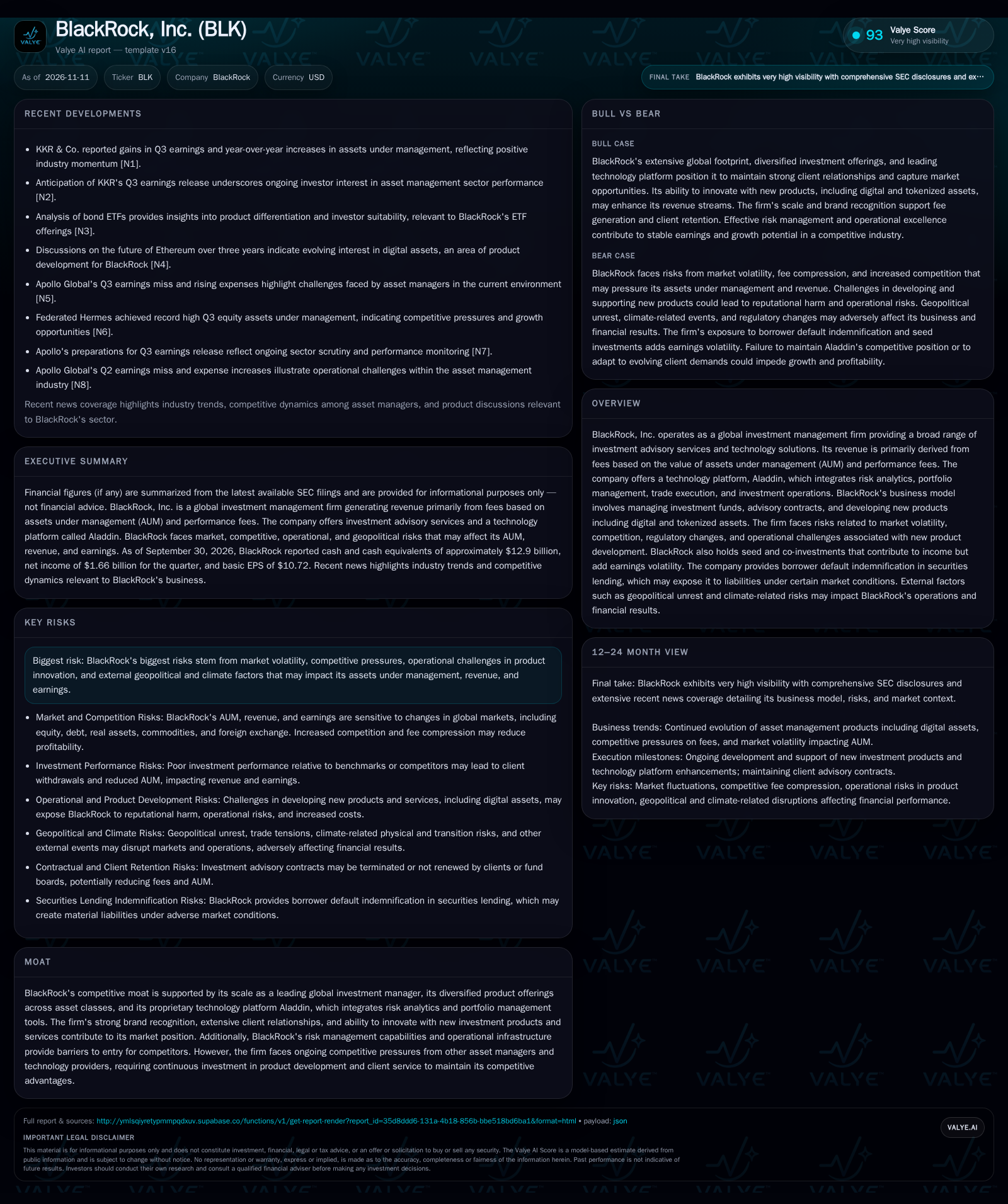
As of September 30, 2026, BlackRock reported $1.66 billion in net income for the quarter and held $12.9 billion in cash and cash equivalents [S2]. This robust profitability and liquidity underscore the firm’s resilience, but the business remains inherently sensitive to market-driven fluctuations in assets under management (AUM) and external shocks. The latest annual revenue was $12.79 billion in 2024, highlighting the scale at which BlackRock operates [S1]. Recent industry news has focused on competitive positioning, ETF product innovation, and the broader outlook for asset managers—areas where BlackRock’s leadership is both an asset and a source of vulnerability as industry dynamics shift.
How BlackRock Makes—and Risks—Its Money
BlackRock’s revenue engine is fundamentally tied to fees calculated as a percentage of AUM, with additional performance fees where contractually available [S2]. This model offers strong operating leverage in rising markets, as incremental AUM translates into high-margin fee income with limited variable costs. However, the same structure amplifies downside risk in volatile or declining markets, since costs are more fixed than revenues. The firm’s technology platform, Aladdin, generates subscription- or licensing-type income streams, which may offer more stability and margin resilience if adoption grows.
Fee compression is an industry-wide headwind: as institutional and retail clients demand lower costs, average fee rates trend downward, forcing asset managers to scale or innovate to maintain profitability. BlackRock’s sheer size allows for cost efficiencies, but also limits the ability to raise fees or easily pivot product mix. The push into digital and tokenized assets could create new higher-fee revenue streams, but these offerings tend to be operationally complex and face regulatory uncertainty. Additionally, BlackRock’s practice of providing borrower default indemnification in securities lending introduces contingent liabilities that can materialize under adverse conditions.
The interplay between BlackRock’s fee structure and market cycles underscores a fundamental tension in asset management economics. While rising markets inflate AUM and thus fees, the lagging effect of market downturns can compress revenues before cost adjustments materialize, creating episodic margin pressure. This cyclical sensitivity necessitates a balanced approach to capital allocation and cost management, emphasizing flexible expense structures and diversified revenue sources. Moreover, the reliance on performance fees, which are inherently volatile and contingent on outperformance, adds complexity to forecasting and risk management, especially as benchmark-relative performance becomes more challenging in efficient markets.
Can Scale and Technology Sustain BlackRock’s Moat?
BlackRock’s competitive advantages historically stem from its global scale, product diversity, and the Aladdin platform, which integrates risk analytics, portfolio management, and trade execution. These elements create switching frictions for large institutional clients, as migrating complex portfolios and workflows is costly and disruptive. However, the barriers are not insurmountable: rival asset managers and fintechs are investing aggressively in proprietary technology and client experience, eroding the uniqueness of Aladdin and narrowing product differentiation.
Fee wars, especially in passive and ETF products, have intensified as competitors pursue scale and cost leadership. While BlackRock’s brand and client relationships are formidable, performance shortfalls or technology missteps could accelerate client churn. The company’s ability to innovate—especially in digital assets and customization—will be critical to defending its moat. The question is whether BlackRock can maintain pricing power and retention as technology commoditizes and clients become more cost-sensitive.
The erosion of Aladdin’s technological uniqueness is a critical factor that could reshape competitive dynamics. As fintech innovation accelerates and open architecture platforms gain traction, clients may demand greater interoperability and customization, potentially reducing the switching costs that currently favor BlackRock. If competitors successfully integrate advanced data analytics, artificial intelligence, or blockchain-based solutions into their offerings, BlackRock’s platform could face pressure to continuously evolve at significant R&D expense. This scenario implies that sustaining the moat will depend not only on scale but on the firm’s agility in technology development and strategic partnerships that enhance platform capabilities without diluting margins.
If Innovation and Aladdin Drive New Growth Vectors
A favorable scenario for BlackRock would see the firm successfully leveraging Aladdin to deepen integration with institutional clients, driving higher-margin technology revenue and increasing client stickiness. If BlackRock’s investments in digital and tokenized assets result in differentiated products with robust demand and regulatory acceptance, new revenue streams could partially offset fee compression in legacy products.
Confirmation of this scenario would include accelerating Aladdin adoption among large asset owners, new partnerships or wins in digital asset management, and evidence that technology-related revenues are growing as a share of the total. Sustained or rising average fee rates in new product categories, alongside stable or increasing client retention rates, would also support the upside thesis.
Structural Headwinds and Incremental Progress in Asset Management
The most plausible trajectory is a continuation of current industry pressures: gradual fee compression across traditional products, stable but market-sensitive AUM, and incremental growth in technology and digital assets. BlackRock’s scale and operational discipline may allow it to defend margins better than smaller peers, but not fully offset industry headwinds.
In this scenario, Aladdin adoption grows, but competition reduces its pricing power over time. Digital assets contribute to product breadth but remain a small portion of total revenue. The base case is confirmed by ongoing modest revenue growth, stable (but not expanding) margins, and a product mix that shifts incrementally toward technology and alternative offerings without dramatic swings in AUM or profitability.
Incremental progress in digital asset integration also hinges on regulatory clarity and market acceptance, which remain fluid. Even modest advances in product adoption must be weighed against the operational overhead and risk management frameworks required to support these assets at scale. The cost-benefit analysis of expanding digital offerings involves assessing whether the marginal revenue justifies the incremental compliance, cybersecurity, and infrastructure investments. In this context, BlackRock’s ability to leverage existing client relationships and Aladdin’s infrastructure to cross-sell new digital products could be a pivotal factor in achieving sustainable growth without disproportionately increasing operational complexity.
How Structural Shocks Could Erode Profitability and Franchise Value
A negative scenario would be triggered by a combination of severe market downturns (which contract AUM and fee revenue), persistent underperformance relative to benchmarks, and/or technology obsolescence that undermines Aladdin’s value proposition. In such a case, client outflows accelerate, revenue shrinks, and fixed-cost leverage turns into a profit drag.
Additional risk comes from operational missteps in new product launches—particularly in digital assets or tokenized securities—that could result in reputational damage, regulatory intervention, or outright losses. A material borrower default in securities lending could crystallize indemnification liabilities, further pressuring earnings. This scenario would be evidenced by sharp declines in AUM, negative operating leverage, rising client attrition, and margin contraction.
What Will Reveal Whether BlackRock’s Model Remains Resilient?
Net inflows or outflows by client segment and product type—if disclosed—would provide insight into whether BlackRock is gaining or losing share in core franchises.
Trends in average fee rates, especially across passive, ETF, and digital asset products, would help test the severity of fee compression and pricing power.
Aladdin platform revenue growth and client wins—disclosed in segment reporting or management commentary—would indicate progress in technology-driven differentiation.
Development milestones or client traction in digital and tokenized asset products would clarify whether these initiatives are contributing materially to growth.
Client contract renewal and termination rates, if available, would help gauge retention risks and switching frictions.
Incidence and magnitude of indemnification claims in securities lending, as reported in financial statements, would reveal contingent liability realization.
Disclosures of regulatory or operational setbacks in new product categories would provide early warning on execution risk.
Shifts in expense ratios and operating margin trends would show whether BlackRock is successfully managing costs as revenue mix evolves.
Disclaimer: This is research-only, informational analysis and not investment advice. It may include AI-generated interpretation and general industry context. Always verify important details using primary sources.

Comments