
ServisFirst Bancshares: Regional Banking Scale, Credit Risk Discipline, and the Limits of Organic Growth
ServisFirst Bancshares, a commercial banking specialist in the southeastern U.S., leverages a lean branch model and disciplined credit culture to drive loan and deposit growth. As competition and regional concentration intensify, the bank’s ability to sustain returns will hinge on risk management, customer loyalty, and capital allocation discipline—especially as stock repurchases and credit exposures shape its future flexibility.
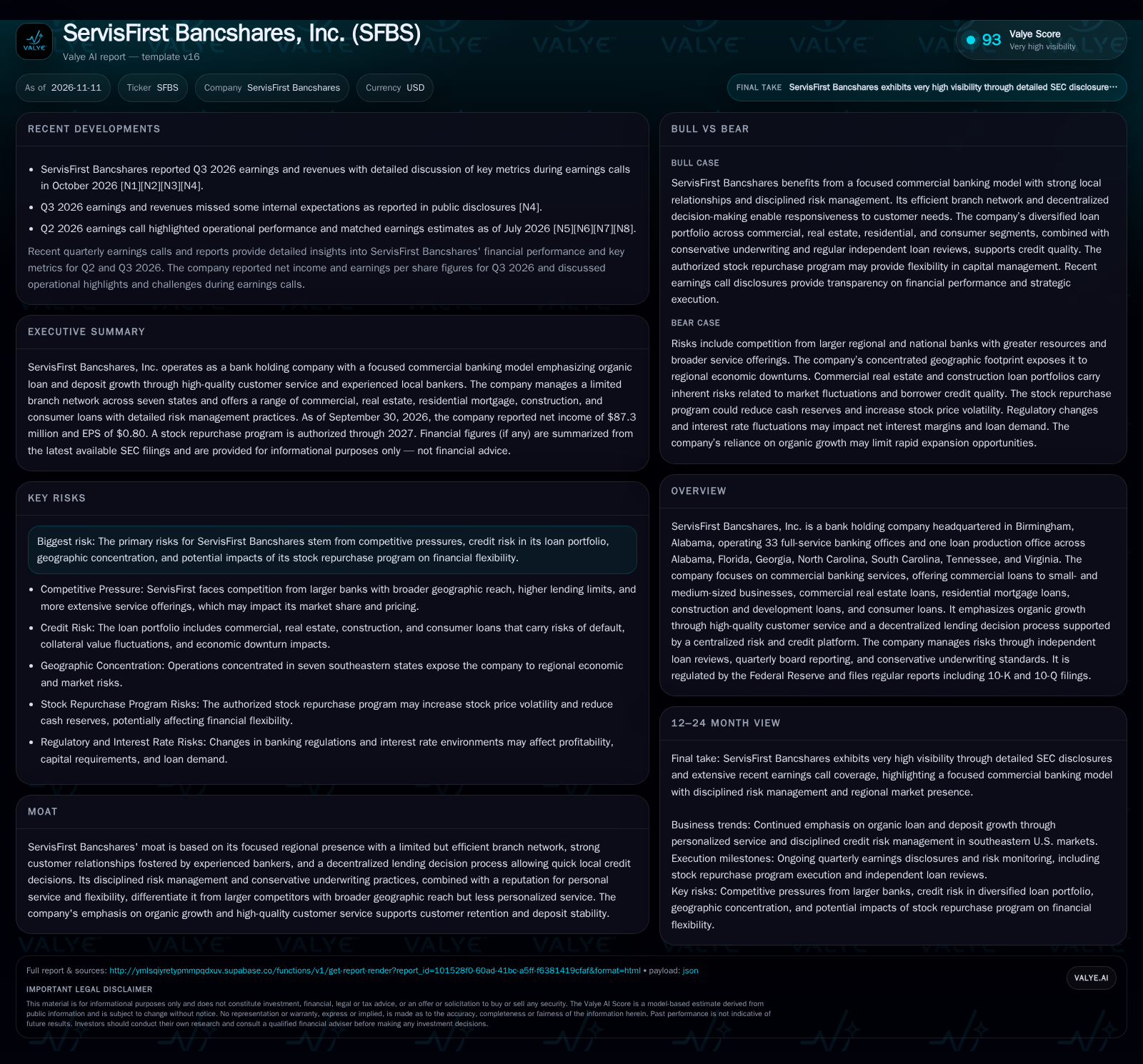
ServisFirst Bancshares reported Q3 2026 net income of $87.3 million and maintains a sizable loan book and deposit base, with operations concentrated in seven southeastern states. Its model emphasizes commercial lending to small- and medium-sized businesses via a lean branch network, decentralized lending, and rigorous risk oversight. The company faces mounting competitive and credit pressures, while its newly authorized share repurchase program introduces new capital allocation questions. The balance between growth, risk, and capital flexibility will define its path forward. [S1] [S2]
ServisFirst Bancshares, Inc. operates at the intersection of disciplined commercial banking and regional focus, serving small- and medium-sized businesses through a streamlined network across the southeastern United States. The company’s most recent quarterly results—net income of $87.3 million for Q3 2026—underscore its consistent earnings power, but also reveal the growing tension between organic loan growth, credit risk management, and external pressures from both competitors and regulators. As the bank embarks on a significant share repurchase program and navigates a challenging regional environment, investors must weigh the durability of its relationship-driven approach against the limits of scale and the evolving risk landscape. [S1] [S2] [N1] [N4]
Q3 2026 Performance and Capital Moves Shape the Near-Term Outlook
ServisFirst Bancshares reported net income of $87.3 million for Q3 2026, with basic and diluted EPS of $0.80, maintaining a track record of profitability but falling short of some internal earnings targets. As of September 30, 2026, the company held total assets of $17.73 billion, loans of $13.70 billion, and deposits of $14.22 billion. Cash and equivalents stood at approximately $1.55 billion. [S1] [S2] [N4]
A newly authorized stock repurchase program allows the company to buy back up to 2 million shares through December 2027, potentially impacting cash reserves and share price volatility. This capital allocation decision introduces a new dimension to the bank’s financial strategy, especially as it balances growth, risk, and return on equity. [S2]
Recent earnings missed some internal expectations, and management has highlighted both operational strengths and ongoing challenges during recent calls, signaling both resilience and the reality of margin pressures in a competitive and evolving market. [N1] [N4]
How the Commercial Banking Model Drives Profitability and Risk
ServisFirst’s business model is centered on commercial lending to small- and medium-sized businesses, with typical client sales ranging from $2 million to $250 million. The bank generates revenue primarily through net interest income arising from loans—seasonal, term, bridge, and revolving—collateralized by business assets, as well as commercial real estate and construction lending. Fee income supplements revenue but is likely a smaller proportion given the focus on traditional lending. [S1]
The company operates a lean branch structure (33 full-service branches plus a loan production office), yielding high loan and deposit balances per branch. This branch-light approach reduces fixed overhead and allows resources to be concentrated on high-touch relationship management and local market responsiveness. Centralized risk and credit functions support decentralized decision-making, aiming to balance credit growth with risk controls. [S1]
Operating leverage in this model is driven by the ability to grow loan and deposit volumes without proportionally increasing fixed costs. However, as the bank matures and its markets saturate, marginal loan growth may require either riskier credits or expansion into new geographies or product lines—potentially eroding historical margin and risk advantages.
Capital needs are moderate by industry standards, with strong deposit funding and a historically conservative approach to capital management. However, the introduction of a sizable share repurchase program raises questions about future capital flexibility, especially in a scenario of rising credit losses or regulatory tightening. [S2]
Defending Local Relationships as Larger Banks and New Entrants Target the Southeast
ServisFirst’s competitive positioning is built on deep local relationships, experienced bankers, and rapid, decentralized lending decisions. This model has enabled the bank to win business away from larger, slower-moving regional and national banks—especially among business clients frustrated with bureaucracy or seeking tailored service. [S1]
However, the competitive landscape is intensifying. Larger banks are increasingly investing in digital capabilities and local market coverage, eroding some of the service and speed advantages historically enjoyed by regional players. Fintechs and non-bank lenders are also targeting small- and medium-sized businesses, sometimes with more flexible credit criteria or lower-cost digital origination, which could pressure both pricing and retention.
ServisFirst’s geographic concentration in seven southeastern states is a double-edged sword: it enables brand strength and operational focus, but exposes the bank to regional economic shocks and limits diversification benefits. The ability to maintain asset quality and defend market share as the region attracts more competitors will be crucial to sustaining above-peer returns.
Relationship Banking and Disciplined Growth Deliver Outsized Returns
In a favorable scenario, ServisFirst leverages its reputation for high-quality service and disciplined risk management to deepen relationships with existing clients and selectively win new business clients from competitors. Organic loan and deposit growth remain robust, supported by stable regional economic conditions and continued migration into the Southeast, fueling business formation and real estate activity.
Credit quality remains strong, with low charge-offs and nonperforming asset levels, allowing the bank to sustain high net interest margins relative to peers. The lean branch network continues to drive operating leverage, and effective capital management—including disciplined execution of the share repurchase program—boosts return on equity without compromising balance sheet strength.
Evidence confirming this scenario would include: above-peer loan and deposit growth (if disclosed), stable or improving credit metrics (net charge-offs, nonperforming assets, reserve ratios), and consistent return on equity in the upper tier of regional banks. Demonstrated ability to absorb competitive pressures without sacrificing margin or asset quality would further support the thesis.
Sustaining Returns Amid Margin Pressure and Incremental Growth
The most plausible path forward is one of steady, incremental growth, tempered by intensifying competition and a gradually normalizing credit environment. Loan and deposit balances grow in line with the broader southeastern economy, but net interest margins face pressure from both rising funding costs and competitive loan pricing.
Asset quality remains broadly stable, but incremental credit costs rise as the lending environment reverts to historical norms. The branch-light operating model continues to provide a cost advantage, but efficiency gains slow as the bank’s footprint matures. Fee income contributes modestly but does not transform the revenue base.
The share repurchase program is executed opportunistically but does not materially impair capital ratios. Earnings grow at a moderate pace, with return on equity remaining solid but no longer industry-leading. Evidence for this scenario includes: loan growth tracking regional GDP, stable but slightly rising credit costs, and modest improvement in earnings per share driven more by buybacks than by organic profit expansion.
Credit Deterioration or Regional Slowdown Exposes Limits of Concentration
In a negative scenario, economic weakness or sector-specific shocks—particularly in commercial real estate or construction—trigger a rise in nonperforming loans and credit losses. ServisFirst’s geographic concentration amplifies the impact, as regional downturns in the Southeast directly affect both loan demand and credit quality.
Competitive pressure drives down loan yields as the bank is forced to match pricing from larger banks and fintechs to retain clients, further compressing net interest margins. The stock repurchase program, if executed aggressively in this environment, could constrain capital at precisely the wrong time, limiting flexibility to absorb losses or pursue growth opportunities.
Confirmation of this downside would come from a spike in nonperforming assets or charge-offs (if disclosed), a marked decline in net interest margin, or regulatory commentary around capital adequacy. Weak loan growth or evidence of deposit outflows would also signal growing stress.
What Could Change the ServisFirst Thesis in the Next 12–24 Months
Trends in nonperforming loans, net charge-offs, and overall credit quality—especially within commercial real estate and construction portfolios—would help test the resilience of risk management.
Loan and deposit growth rates relative to regional economic benchmarks—if disclosed—would clarify whether the relationship-driven model continues to win share.
Net interest margin trajectory and funding cost trends, particularly as competition for deposits heats up.
Execution pace and scale of the stock repurchase program, and its impact on capital ratios and cash reserves.
Any regulatory feedback or changes in capital requirements that could affect lending capacity or capital management flexibility.
Branch productivity metrics (loans and deposits per branch), if disclosed, to illuminate the sustainability of the lean network advantage.
Customer retention and business client acquisition rates, as pressure from larger banks and digital entrants grows.
Shifts in the competitive landscape—for example, major regional bank mergers or fintech market share gains in the Southeast.
Disclaimer: This is research-only, informational analysis and not investment advice. It may include AI-generated interpretation and general industry context. Always verify important details using primary sources.

Comments