
Intermex’s Merger Standoff: Remittance Economics, Competitive Pressures, and the Uncertain Path Forward
International Money Express (Intermex) faces a pivotal period as a merger with Western Union hangs in limbo. With a reported liquidity position and a core focus on US-to-Latin America money transfers, the company’s economics and long-term strategy are under the spotlight. The outcome of the merger, regulatory developments, and shifting competitive dynamics could materially affect Intermex’s future direction.
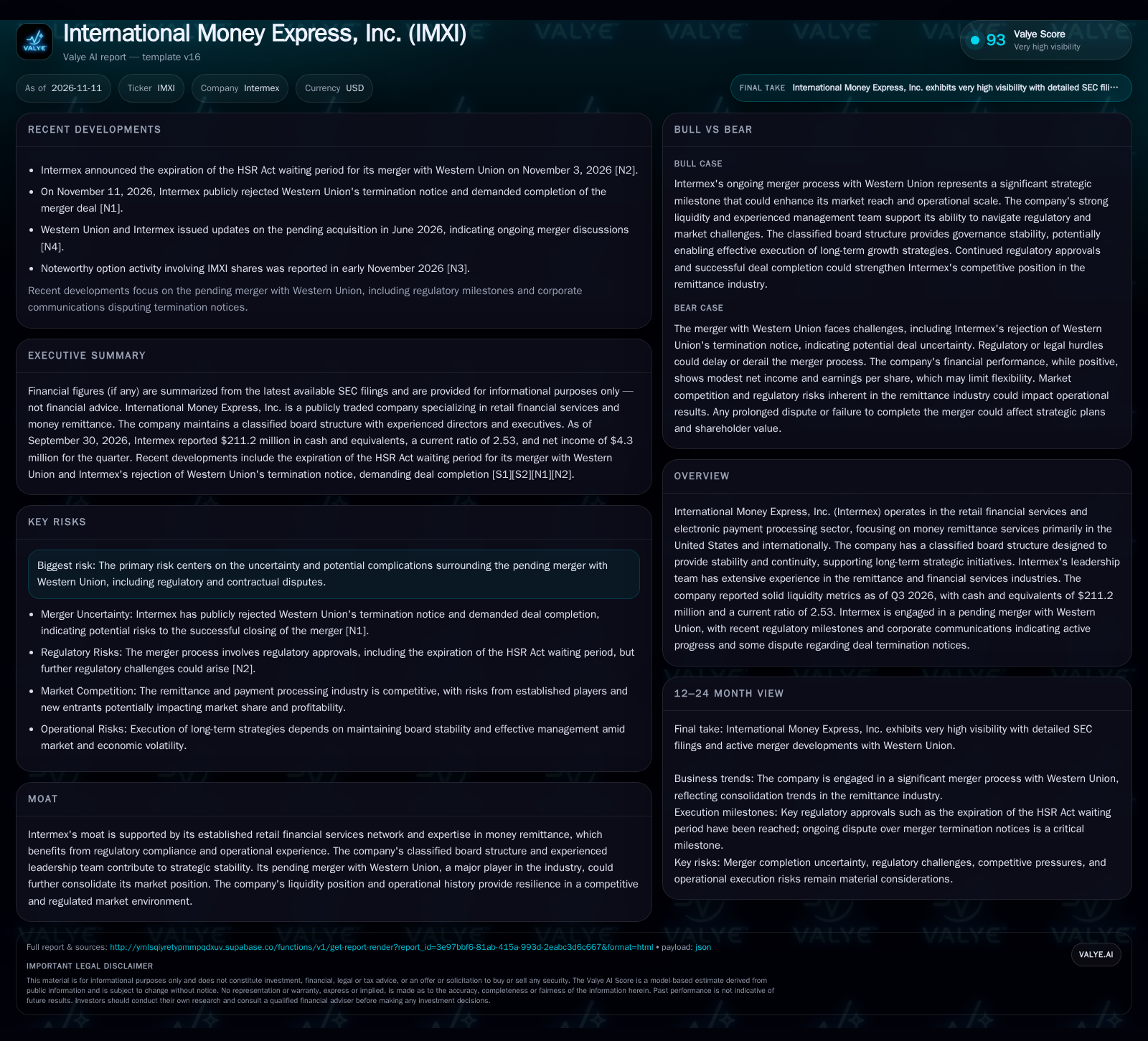
Intermex’s core business—remittances from the US to Latin America—remains fundamentally strong, supported by substantial liquidity and a broad agent network. However, the uncertain status of its merger with Western Union introduces significant strategic ambiguity. Future performance will hinge on the outcome of merger negotiations, regulatory risks, and the company’s ability to compete in a consolidating and digitally evolving remittance landscape. [S1] [S2] [N2]
International Money Express, Inc. (Intermex) stands at a crossroads as it navigates a high-stakes merger dispute with Western Union—a development that could reshape its strategic trajectory in the fiercely competitive remittance market. With a reported liquidity position base and a business model anchored in cross-border money transfers from the US to Latin America, Intermex’s near-term fate is closely tied to both the outcome of the merger and broader industry shifts. Investors and industry observers will need to scrutinize not just the company’s financial position but also its ability to adapt as competitive and regulatory pressures mount.
Merger Uncertainty and Financial Stability Define Intermex’s Present
The company reported cash and liquidity metrics for the period; these figures do not by themselves establish operating runway, investment capacity, financial flexibility, or financing capacity. Quarterly net income stood at $4.3 million, with basic and diluted EPS at $0.14, indicating ongoing profitability but limited earnings scale. [S2]
The company’s most consequential recent development is the unresolved status of its proposed merger with Western Union. On November 3, 2026, Intermex announced that the HSR Act waiting period for the merger had expired, theoretically clearing a major regulatory hurdle. However, Western Union issued a termination notice, which Intermex has publicly rejected, insisting the deal should proceed. The potential outcomes—deal completion, renegotiation, or outright collapse—will have significant implications for Intermex’s strategic direction, capital structure, and competitive positioning. [N2]
How Intermex Makes Money: Fee Revenue, Network Scale, and Digital Migration
Intermex’s primary source of revenue is transaction fees paid by consumers sending money, particularly from the US to Latin America and the Caribbean. The company operates a hybrid distribution model that combines a broad agent network (over 100,000 independent sending and paying agents and 115 company-operated stores) with digital channels, including websites and mobile apps. [S2]
The economics of the remittance business are driven by transaction volume, average send amount, and fee take-rate. Fixed costs arise from technology infrastructure, compliance, and network management, while variable costs are linked to agent commissions and transaction processing. Historically, the sector has exhibited moderate operating leverage: incremental transaction volume can drive margin expansion if fixed costs are well managed, but intense price competition and regulatory costs can erode profitability.
Capital requirements are moderate compared to traditional banks, as working capital is needed to settle remittances and fund operational reserves. However, regulatory compliance and technology investments—especially to support digital platforms and anti-money-laundering controls—can be significant.
If disclosed, trends in digital transaction mix, average fee per transaction, and agent commission rates would help clarify the company’s margin trajectory and adaptability to industry shifts.
Competitive Pressures: From Traditional Giants to Digital Challengers
Intermex’s competitive landscape is defined by a mix of large incumbents (such as Western Union and MoneyGram), regional players, and a rising cohort of digital-first remittance platforms. The company’s core strength lies in its established US-to-Latin America corridor, supported by an extensive agent network and operational expertise in regulatory compliance and cross-border payments. [S2]
However, the remittance business is increasingly shaped by digital adoption, with fintech entrants offering app-based transfers, lower fees, and faster settlement. These challengers can erode fee margins and threaten agent-based distribution models by appealing directly to banked and digitally savvy migrants. At the same time, regulatory complexity and the need for robust anti-fraud systems serve as barriers to entry, favoring established players with scale and compliance infrastructure.
The unresolved merger with Western Union could signal both the attractiveness and vulnerability of Intermex’s position: on one hand, as a target, it validates the value of its network and brand; on the other, it highlights the pressures for consolidation and the risks if the deal falls through.
Unlocking Value: What a Successful Merger or Digital Pivot Could Deliver
A favorable scenario unfolds if Intermex successfully completes its merger with Western Union. This could yield synergies through network integration, expanded distribution, and technology leverage, potentially driving higher volumes and improved operating margins. The combined entity might also have greater pricing power and investment capacity to accelerate digital transformation.
Alternatively, if the merger fails but Intermex capitalizes on its liquidity to invest aggressively in digital channels, it could defend or even expand its market share by capturing younger, digitally native remittance senders.
Evidence confirming this scenario would include: formal merger completion and disclosed synergy targets; rapid growth in digital transaction mix; sustained or rising fee take-rate despite competition; and margin expansion attributable to operating leverage or technology efficiencies.
Maintaining Momentum Amid Industry Flux and Strategic Ambiguity
The most plausible scenario is one of operational continuity amid persistent uncertainty. Intermex continues to generate steady fee-based revenue from its core US-to-Latin America corridors, leveraging its agent network and proprietary technology. Modest profitability persists, supported by disciplined cost management and stable transaction volumes.
However, the unresolved merger and intensifying competition from digital entrants constrain strategic flexibility. Regulatory and compliance costs remain a drag on margins, while the company’s ability to accelerate digital adoption is tested by both internal execution and external market trends.
This scenario would be confirmed by stable or gradually rising transaction volumes, consistent net income, and incremental progress in digital channel adoption—without material disruption from the merger outcome or sudden market share losses.
Strategic Drift: Consequences of a Failed Merger and Intensified Digital Disruption
A negative scenario materializes if the merger with Western Union collapses, triggering significant legal, management distraction, or reputational costs. In this case, Intermex could face heightened difficulty competing against both large incumbents and nimble digital-first challengers, especially if it is perceived as a standalone player lacking scale or resources for rapid innovation.
Further downside risk emerges if regulatory changes or enforcement actions increase compliance costs, or if remittance volumes decline due to macroeconomic or immigration-policy shocks. Erosion of agent network relevance in the face of digital migration could compress margins and threaten the company’s core economics.
Confirmation would come from merger litigation or breakup fees impacting financials; declining transaction volumes or market share; margin compression; and lagging digital adoption relative to peers.
Developments That Will Reveal Intermex’s Strategic Trajectory
Progress on the Western Union merger, including formal deal closure, renegotiation, or definitive termination and any associated financial impacts.
Quarterly trends in total remittance transaction volumes, with particular focus on US-to-Latin America corridors (if disclosed).
Digital channel penetration—growth in the share of transactions initiated or received digitally versus through agent locations (a useful metric would be disclosed digital mix).
Average fee per transaction and agent commission rates, as indicators of pricing power and competitive pressure (if disclosed).
Updates on regulatory or compliance costs, especially in response to changing anti-money-laundering or financial oversight requirements.
Management commentary or disclosures on technology investment and digital platform enhancements.
Changes in liquidity or capital allocation, especially if material merger-related expenses or legal costs are recognized.
Customer retention or churn rates, especially if digital competitors accelerate share gains (would help test the thesis if disclosed).
Disclaimer: This is research-only, informational analysis and not investment advice. It may include AI-generated interpretation and general industry context. Always verify important details using primary sources.

Comments