
Solana Co’s Validator Economics After Alpenglow: Fixed Costs, Protocol Shifts, and the Stakes of Staking Rewards
Solana Co operates a single validator on the Solana blockchain, earning staking rewards that fluctuate with protocol changes, competition, and network performance. The recent 'Alpenglow' upgrade, ongoing commission pressure, and regulatory uncertainty reshape both the economics and the risk calculus for this blockchain infrastructure company.
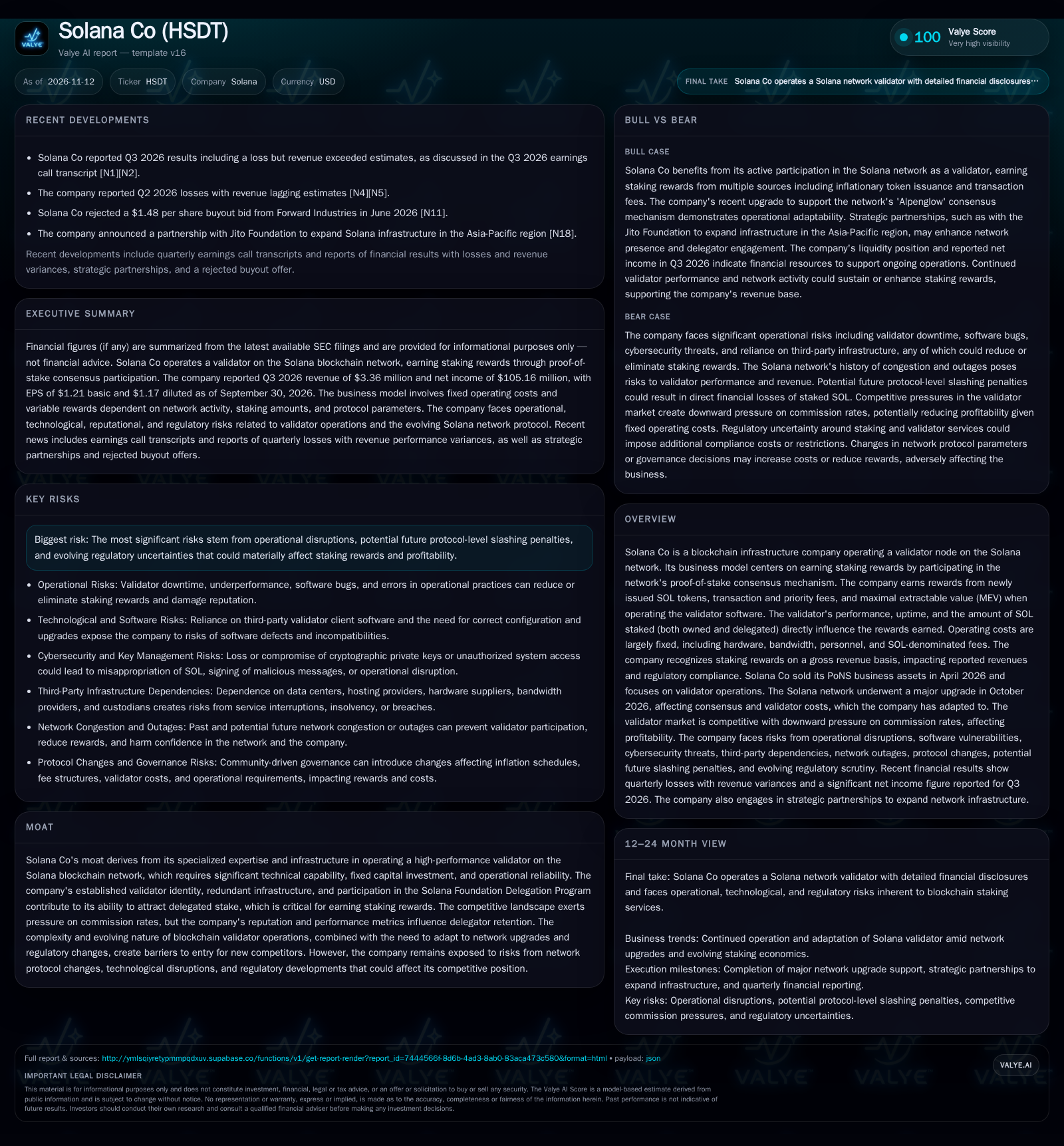
Solana Co’s Q3 2026 results highlight the inherent volatility of validator economics: reported revenue of $3.36 million, a large net income spike, and persistent operating losses in prior quarters. Its validator’s performance, commission rates, and exposure to protocol changes—especially post-Alpenglow—define both upside and downside. The validator market’s pressure on commissions and the looming threat of slashing penalties could compress margins, while regulatory scrutiny remains an unresolved wildcard. Execution hinges on performance metrics, infrastructure reliability, and the company’s ability to sustain delegator trust and network relevance as staking dynamics evolve. [S2] [N1] [N2]
Solana Co’s business is a distilled bet on blockchain infrastructure: it operates a single validator node on the Solana network, earning staking rewards from inflationary SOL issuance, transaction fees, and MEV. The company’s recent financial results—Q3 2026 revenue of $3.36 million and a sharp net income—underscore the volatility and leverage inherent in this model. However, the validator landscape is in flux: the October 2026 'Alpenglow' protocol upgrade, intensifying commission competition, and persistent regulatory uncertainty all test the durability of Solana Co’s current economics. Going forward, the company’s fortunes will depend on its ability to maintain validator performance, attract delegated stake, and navigate the evolving rules and risks of staking on Solana. [S2] [N1] [N2]
Recent Results and Protocol Upgrades Reshape Solana Co’s Risk-Reward Profile
Solana Co reported Q3 2026 revenue of $3.36 million and net income of $105.16 million, with basic EPS of $1.21 and diluted EPS of $1.17 as of September 30, 2026. This quarter marked an apparent inflection after prior sequential losses, although the company’s earnings history remains volatile. The company operates a single validator node, and its business model is highly sensitive to protocol-level changes and market dynamics. In October 2026, the Solana network implemented the 'Alpenglow' upgrade, which changed consensus and voting mechanics, validator cost structures, and operational requirements. Solana Co adapted its validator accordingly. The company’s core cash and current ratios as of the end of Q3 2026 were 0.07 and 2.33, respectively, with $1.129 million in cash and $38.647 million in current assets against $16.615 million in current liabilities. [S2] [N1] [N2]
The competitive validator environment continues to exert downward pressure on commission rates, directly influencing Solana Co’s ability to attract delegations and maintain profitability. Regulatory scrutiny of staking and validator services remains a material risk. The company’s sale of its PoNS business assets in April 2026 has further narrowed its operational focus to core validator operations.
Staking Rewards, Fixed Costs, and the Leverage of Validator Operations
Solana Co’s primary revenue stream is staking rewards, which are a mix of inflationary SOL issuance, transaction fees, priority fees, and MEV captured by its validator. The company recognizes these rewards on a gross basis, inflating reported revenues relative to net cash flows. Variable revenue is driven by the total SOL staked to its validator—both its own and delegated from others—multiplied by the protocol’s reward rate and filtered through the validator’s commission percentage.
Operating costs are predominantly fixed: hardware, bandwidth, personnel, and SOL-denominated fees. This structure creates high operating leverage—incremental increases in delegated stake or network activity can disproportionately boost profits, but revenue declines or commission compression can quickly erode margins. Post-Alpenglow, validator costs and operational requirements have shifted, potentially increasing the baseline expense and raising the bar for break-even performance.
The capital intensity is moderate by traditional standards but high for pure software operations; maintaining redundant infrastructure and best-in-class uptime is essential for retaining delegator trust and maximizing rewards. The company reported cash and liquidity metrics for the period; these figures do not by themselves establish operating runway, investment capacity, financial flexibility, or financing capacity.
Validator Competition, Commission Wars, and the Fragility of Delegator Loyalty
The Solana validator landscape is crowded, with hundreds of operators vying for delegations. Commission rates are the primary lever for competition, and persistent downward pressure limits the ability of any single validator—including Solana Co—to expand margins without risking loss of delegated stake. Performance metrics such as vote credits, skip rate, and uptime are critical for attracting and retaining delegators. Even small lapses can trigger stake migration to higher-performing or lower-fee validators.
Solana Co’s competitive moat is built on technical reliability, established validator identity, and participation in the Solana Foundation Delegation Program. However, these advantages are not insurmountable: operational missteps, reputational hits, or protocol shifts can rapidly erode market share. The October 2026 network upgrade has raised operational complexity, favoring validators with robust infrastructure and rapid adaptation, but also increasing the cost of maintaining a competitive edge.
Substitution risk is high, as delegators can reallocate stake with modest friction. The company’s governance influence is limited to its associated stake and does not confer protocol-level decision power, leaving it exposed to adverse community-driven changes.
Outperformance in Network Upgrades and Delegator Growth Could Drive Breakout Profitability
If Solana Co consistently delivers top-quartile validator performance—minimizing downtime, maximizing vote credits, and maintaining high uptime—its reputation could attract additional delegated stake even amid commission compression. The Alpenglow upgrade, if it results in higher network throughput and transaction activity, could lift the overall staking reward pool, amplifying the company’s revenue without a commensurate increase in fixed costs.
Strategic partnerships, such as infrastructure collaborations in growing regions, could funnel new delegations to Solana Co’s validator, further increasing staked SOL and reward share. Continued adaptability to protocol changes would reinforce its reputation for reliability.
Evidence for this scenario would include sustained growth in delegated stake, improvement in validator performance metrics (if disclosed), and a trend of positive net income across multiple quarters, even as commission rates trend lower.
Sustaining Operations Amid Margin Pressure and Evolving Protocol Demands
The most plausible trajectory for Solana Co is continued operation as a mid-tier validator, with modest fluctuations in revenue and net income as network conditions, commission rates, and protocol parameters evolve. Alpenglow’s increased cost structure and complexity may offset some gains from higher network activity, resulting in stable but thin margins.
Persistent competition will likely keep commission rates low, forcing the company to optimize for performance and uptime to avoid losing delegations. Occasional protocol changes may require further capital investment in infrastructure or operational adaptation.
Confirmation of this scenario would be a pattern of quarterly revenues in the $2–4 million range, intermittent profitability, and stable or slightly declining delegated stake. Falsification would come from either a sustained loss of delegation (shrinking rewards) or an unexpected regulatory or slashing event materially impacting operations.
Revenue Compression from Slashing, Regulatory Shocks, or Major Delegation Loss
The major downside risks for Solana Co are operational or protocol-driven shocks that materially reduce staking rewards or trigger outright losses. If the Solana community implements aggressive slashing penalties and Solana Co’s validator suffers downtime or key compromise, the company could forfeit significant staked SOL, damaging both revenue and reputation.
A regulatory crackdown—such as new licensing requirements, registration burdens, or outright bans on staking services—could impose costs that overwhelm the company’s reported cash balance or force a strategic pivot. Similarly, if validator performance drops below peer benchmarks or a reputational incident triggers a mass delegator exodus, the company’s reward base could shrink rapidly.
This scenario would be confirmed by a sharp drop in delegated SOL, a sudden swing to negative net income with no recovery, or material disclosures of slashing penalties or compliance costs.
Performance, Protocol, and Delegation Trends That Will Shape Solana Co’s Future
Quarterly changes in total SOL delegated to Solana Co’s validator—if disclosed—would provide a direct measure of market confidence and future reward potential.
Published validator performance metrics such as vote credits, skip rate, and uptime (if disclosed) should be tracked for signs of operational excellence or underperformance.
Commission rate trends, both for Solana Co and the broader validator market, will signal the intensity of price competition and margin pressure.
Any disclosures of slashing penalties, downtime events, or security incidents would be highly material for both financial and reputational reasons.
Changes in Solana protocol parameters—especially around reward structure, inflation, and validator costs—should be monitored for their impact on economics.
Regulatory developments affecting staking, validator operations, or crypto infrastructure providers could force business model changes or trigger new compliance costs.
Evidence of new strategic partnerships or infrastructure initiatives that might increase delegated stake or network influence would help test upside potential.
Disclaimer: This is research-only, informational analysis and not investment advice. It may include AI-generated interpretation and general industry context. Always verify important details using primary sources.

Comments