
CorMedix After Melinta: Portfolio Scale, Reimbursement Headwinds, and the Stakes of Integration
CorMedix Inc. has executed a strategic pivot from a single-product focus to a diversified infectious disease platform, anchored by DefenCath and amplified by the Melinta acquisition. The company now faces the dual challenge of integrating new assets and navigating a volatile reimbursement landscape—both of which will determine whether it can translate clinical success into sustainable commercial momentum.
CorMedix’s transformation into a multi-product anti-infective platform brings new commercial opportunities and risks. The expiry of premium DefenCath reimbursement and the integration of Melinta’s complex portfolio heighten both revenue volatility and operational demands. The next phase hinges on realizing synergies, stabilizing pricing, and demonstrating that expanded indications can offset reimbursement and competitive pressures.
CorMedix Inc. is at an inflection point. With DefenCath’s initial commercialization now tempered by the expiry of favorable reimbursement and the complex integration of Melinta’s portfolio, the company has evolved from a single-product story to a diversified anti-infective platform. However, this transformation amplifies both opportunity and risk: commercial scale offers leverage, but reimbursement headwinds and operational complexity could erode gains. Investors and operators alike must now focus on whether CorMedix can stabilize pricing, execute on label expansions, and integrate its acquisitions to deliver sustainable growth.
Recent Milestones Reshape CorMedix’s Commercial and Financial Landscape
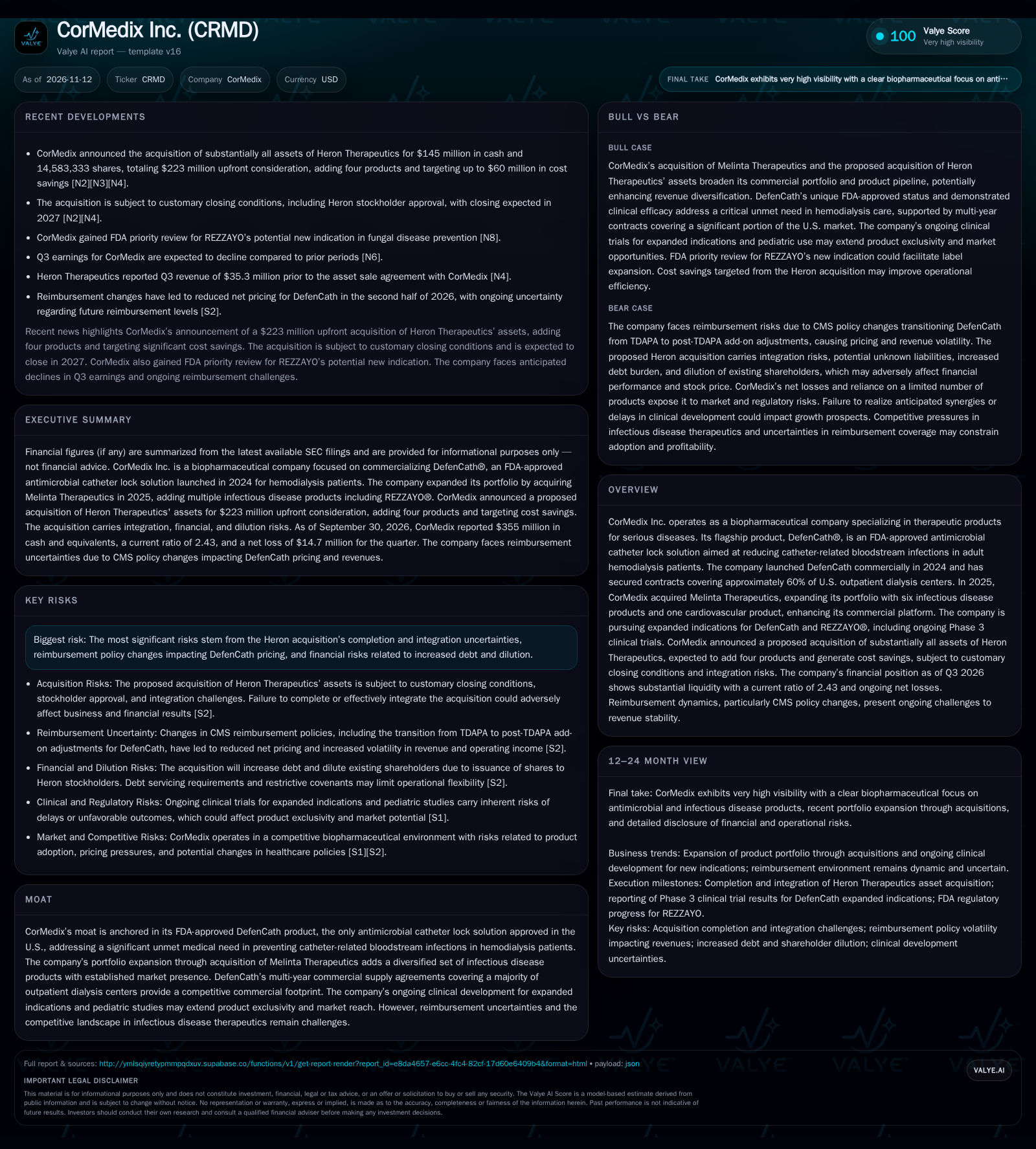
CorMedix’s commercial portfolio has undergone a dramatic expansion following its 2025 acquisition of Melinta Therapeutics, which added six marketed infectious disease drugs and a cardiovascular product to its flagship DefenCath franchise [S1]. This diversification comes as DefenCath, the only FDA-approved antimicrobial catheter lock solution in the U.S., faces a critical reimbursement transition: its original Medicare New Technology Add-on Payment (NTAP) expired on November 14, 2026, and outpatient reimbursement shifted to a less favorable post-TDAPA add-on, reducing net pricing in late 2026 [S1] [S2]. Meanwhile, REZZAYO—one of the acquired Melinta assets—has received FDA priority review for a new prophylaxis indication, potentially unlocking new markets if approved [N8]. As of September 30, 2026, CorMedix reported $355.15 million in cash and equivalents, a current ratio of 2.43, and a quarterly net loss of $14.7 million, with full-year 2025 revenue at $311.7 million [S2]. These developments set the stage for a business model now defined by both portfolio breadth and heightened execution risk.
How Portfolio Expansion Alters Revenue Mix and Cost Structure
CorMedix’s revenue model has shifted from reliance on a single specialty product to a multi-asset infectious disease platform. Historically, DefenCath’s economics benefited from premium reimbursement via NTAP and TDAPA, which supported high net pricing and gross margins. With the expiration of these programs, net pricing for DefenCath has declined, and the company is now exposed to the less predictable reimbursement environment of post-TDAPA add-on payments [S1] [S2]. This change introduces both volume and margin uncertainty, as future CMS policy adjustments could further compress profitability.
The Melinta acquisition introduces new revenue streams—REZZAYO, MINOCIN IV, VABOMERE, and others—each with distinct pricing, payer mix, and market penetration profiles. The integration of these assets increases fixed costs (in commercial infrastructure, regulatory compliance, and supply chain management) but may also enable operating leverage if scale efficiencies and cross-selling materialize. However, the acquisition brings increased debt and potential dilution, raising the stakes for successful synergy realization and cost control [S2]. If CorMedix can grow volumes across its expanded portfolio and secure new indications for flagship assets like DefenCath and REZZAYO, it could offset margin compression from reimbursement headwinds. Conversely, persistent pricing pressure or operational setbacks could limit the benefits of scale.
DefenCath’s Unique Status, But Competitive Pressures Intensify in Anti-Infectives
DefenCath’s status as the only FDA-approved antimicrobial catheter lock solution in the U.S. confers a temporary competitive moat, particularly given its clinical data showing up to 71% risk reduction in catheter-related bloodstream infections [S1]. This exclusivity, combined with contracts covering approximately 60% of outpatient dialysis centers, provides a strong commercial foundation. However, the expiration of premium reimbursement erodes some of this advantage, as cost-conscious providers may reevaluate adoption if net pricing rises relative to alternatives.
In the broader anti-infective and hospital therapeutics market, CorMedix now competes with both established pharmaceutical companies and smaller specialty players. The Melinta assets—especially REZZAYO—face competition from other antifungals and anti-infective agents, some of which may be entrenched in hospital formularies or benefit from broader label indications. As CMS and private payers scrutinize costs, and as generics or novel alternatives emerge, CorMedix’s ability to maintain pricing and share will depend on continued clinical differentiation, formulary access, and successful label expansions.
If the company can leverage its larger commercial platform to secure favorable contracts, drive adoption of new indications, and realize cross-selling synergies, it may defend or even expand its market position. However, the risk of competitive encroachment and reimbursement-driven price erosion remains elevated.
Unlocking Value Through Successful Integration and Indication Expansion
The most favorable scenario for CorMedix is one in which management executes a smooth integration of Melinta’s complex portfolio, realizing targeted synergies and cost savings while minimizing disruption to commercial operations [N3]. If DefenCath’s expanded indications in total parenteral nutrition (TPN) and pediatrics are approved, and REZZAYO secures its new prophylactic label following FDA priority review, the company could see a meaningful expansion in addressable markets and improved revenue diversification [S1] [N8].
In this scenario, the company’s commercial infrastructure supports increased sales velocity across both legacy and acquired products, operating leverage improves as fixed costs are absorbed by higher revenues, and the risk of reimbursement-driven margin compression is offset by volume growth and new clinical data. Evidence of this trajectory would include: sequential revenue growth from non-DefenCath assets, successful completion of integration milestones, positive clinical trial readouts for expanded indications, and stable to improving gross margins despite reimbursement changes.
Managing Volatility: Revenue Growth Meets Reimbursement and Integration Headwinds
The most plausible near-term path for CorMedix is one of mixed outcomes: portfolio expansion drives incremental revenue growth, but reimbursement volatility and integration complexity create margin pressure and operational risk. DefenCath retains significant market share in hemodialysis but sees net pricing decline post-TDAPA, partially offset by increased volumes or expanded indications if clinical trials succeed [S1] [S2]. The Melinta assets contribute to top-line growth, but synergies and cost savings take time to materialize, and integration costs weigh on near-term profitability.
Under this scenario, operating losses persist but are gradually reduced as the company leverages its commercial platform and achieves moderate efficiency gains. Confirmation of this scenario would come from quarterly revenue growth in both core and acquired products, stable or only modestly declining margins, and regular progress updates on integration and clinical development.
Erosion of Margin and Momentum if Reimbursement and Integration Falter
The primary risk for CorMedix is that reimbursement erosion outpaces any gains from portfolio expansion, leading to sustained or worsening operating losses. If CMS or private payers further reduce reimbursement for DefenCath or other key products, and if integration of Melinta’s assets is slower or more costly than anticipated, the company could struggle to maintain commercial momentum [S2]. Failure to achieve anticipated synergies, delays or setbacks in clinical trials for expanded indications, or unexpected post-acquisition liabilities could further undermine profitability and strain liquidity.
In this scenario, revenues plateau or decline, margins compress, and net losses persist or widen. Evidence would include: sharp declines in DefenCath net pricing, sluggish sales from acquired assets, rising integration or restructuring expenses, missed clinical milestones, and deteriorating operating cash flow. Under such conditions, CorMedix could be forced to pursue additional dilutive financing or restructure its operations—potentially eroding shareholder value.
What Will Determine CorMedix’s Long-Term Value Creation?
Quarterly net pricing for DefenCath (if disclosed), especially in the wake of TDAPA expiration and post-TDAPA add-on adjustments—critical for gauging margin resilience.
Sequential revenue growth from Melinta-acquired products, indicating successful integration and commercial traction.
Progress and outcomes of Phase 3 clinical trials for DefenCath in TPN and pediatric indications—key for long-term market expansion.
FDA decision and subsequent uptake for REZZAYO’s prophylaxis indication, which could materially alter the revenue mix.
Updates on synergy realization and cost savings post-Melinta acquisition, including integration milestones and expense trends.
Trends in operating cash flow and burn rate, testing the sufficiency of the current liquidity cushion against ongoing net losses.
Management commentary on payer negotiations and formulary wins, especially in response to changing CMS reimbursement methodologies.
Disclaimer: This is research-only, informational analysis and not investment advice. It may include AI-generated interpretation and general industry context. Always verify important details using primary sources.

Comments