
Monopar Therapeutics: Progress and Prospects in Wilson Disease Treatment
Monopar Therapeutics is a clinical-stage biotech focused on rare disease therapies, notably ALXN1840 for Wilson Disease.
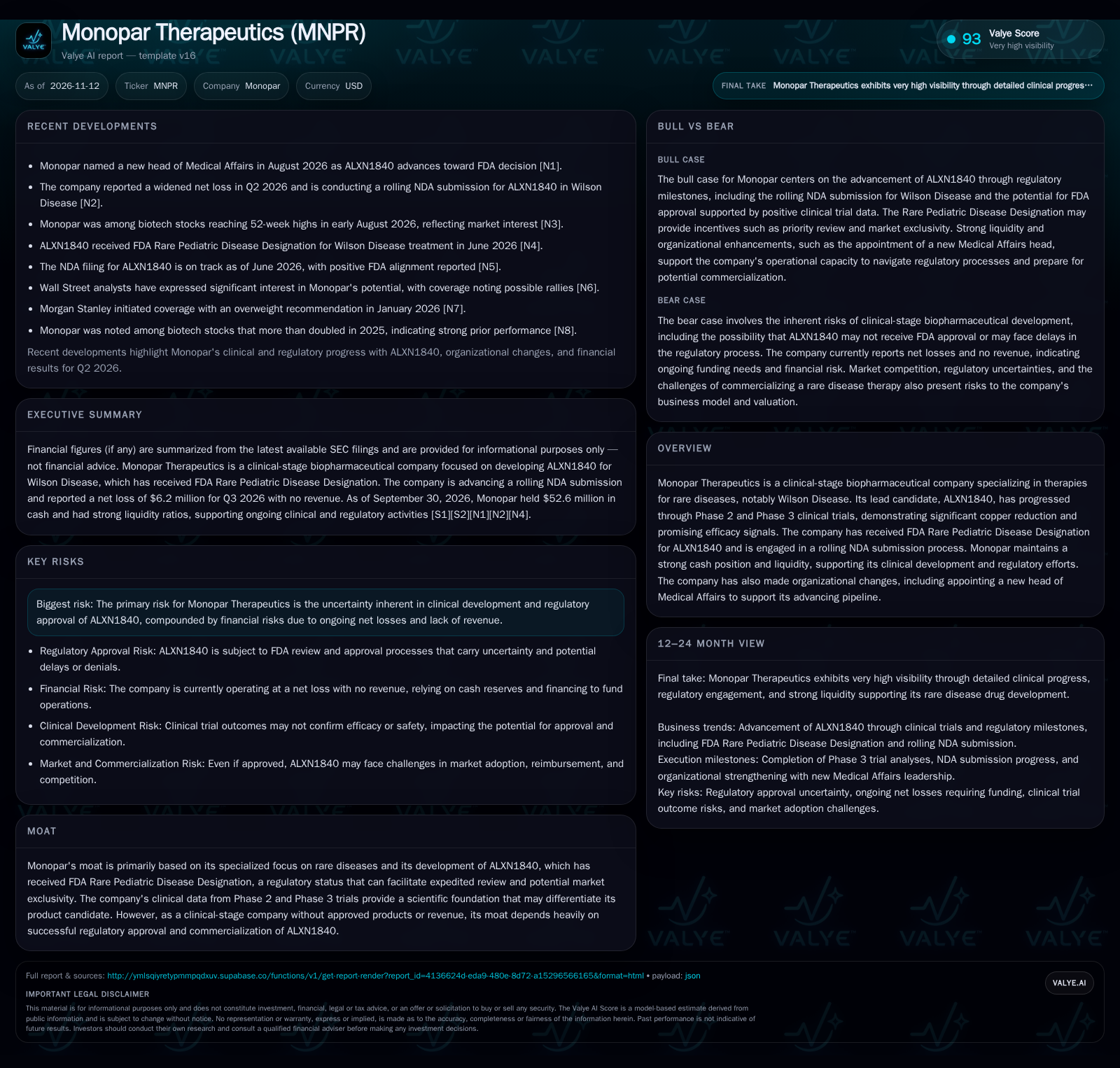
Monopar Therapeutics is a clinical-stage biotech focused on rare disease therapies, notably ALXN1840 for Wilson Disease. The company holds $52.6 million in cash as of September 2026 and is conducting a rolling NDA submission after promising Phase 3 results. With no revenue and ongoing net losses, Monopar’s future hinges on regulatory approval and eventual market adoption of its lead asset. The next 12-24 months will be critical as the company navigates regulatory review, potential commercialization, and ongoing funding needs. [S2] [N1] [N2] [N4]
Monopar Therapeutics stands at a crucial juncture as it advances ALXN1840, its lead therapy for Wilson Disease, through the final stages of regulatory review. The company’s reported cash position and recent organizational enhancements are aligned with its late-stage clinical progress, but Monopar remains pre-revenue and faces the perennial uncertainties of biotech development. The next year will likely define whether Monopar transitions from a clinical-stage entity to a commercial rare disease player—or faces renewed funding and strategic challenges.
ALXN1840’s Regulatory Advances and Monopar’s Financial Position
Monopar Therapeutics is progressing its lead drug candidate, ALXN1840, for Wilson Disease, with a rolling NDA submission underway as of late 2026. The company’s Phase 2 and Phase 3 trials have demonstrated significant copper reduction and promising efficacy, supporting its case for regulatory approval. Monopar reported a net loss of $6.2 million for Q3 2026, with no revenue recognized during this period, reflecting its pre-commercial status. As of September 30, 2026, Monopar held $52.6 million in cash and cash equivalents, with current assets of $129.9 million and current liabilities of $2.98 million—resulting in a current ratio of 43.55 and a cash ratio of 17.65. The company also appointed a new head of Medical Affairs in August 2026, indicating organizational alignment with its advancing pipeline. [S2] [N1] [N4] [N5]
While the current ratio and cash ratio appear robust, these figures must be contextualized against the timing and magnitude of upcoming regulatory milestones, which typically drive significant expenditure bursts. The company’s ability to manage its burn rate effectively during the NDA review period will be critical, as delays or additional data requests could extend this phase. Furthermore, the appointment of a new head of Medical Affairs suggests an intentional strengthening of regulatory and clinical interfaces, which may improve interactions with health authorities but could also increase short-term overhead costs.
Scaling Monopar’s Business Model Following Potential Approval
Monopar’s current economics are typical of late-stage biotech: substantial R&D and regulatory costs, no product revenue, and a reliance on cash reserves and capital markets. If ALXN1840 is approved, the economic model would shift dramatically. Pricing for rare disease therapies often reflects both unmet need and limited patient populations, potentially supporting high per-patient annual costs and attractive gross margins. However, commercialization would require new investments in market access, medical affairs, and post-marketing commitments. Fixed costs could rise with commercial infrastructure, but variable costs (such as manufacturing and distribution) are likely to be manageable given the targeted patient base. The rare pediatric disease designation may trigger priority review and a valuable priority review voucher, which—if granted—could be sold or used to accelerate another asset, representing a potential one-time or recurring source of value. Until approval and launch, Monopar’s economics remain highly sensitive to funding timing and regulatory milestones.
If ALXN1840 achieves approval, the transition from development to commercialization will necessitate strategic decisions about the scale and scope of Monopar’s commercial infrastructure. Given the rarity of Wilson Disease, a lean and targeted sales and marketing approach might be more cost-effective than building a broad commercial footprint. Contracting with specialty pharmacies or leveraging third-party distributors could optimize reach while controlling fixed costs. Additionally, reimbursement negotiations will be pivotal; payers often scrutinize rare disease drug pricing, balancing clinical benefit against budget impact. Monopar’s ability to demonstrate cost-effectiveness and long-term health outcomes through robust pharmacoeconomic data will materially influence payer willingness to cover and patients’ access to ALXN1840.
Differentiation and Competitive Dynamics in Wilson Disease Therapy
Monopar’s competitive position in Wilson Disease depends on the clinical differentiation of ALXN1840 versus existing copper chelators and newer entrants targeting rare metabolic diseases. The reported efficacy in copper reduction and the prospective regulatory incentives (such as exclusivity from rare pediatric disease designation) may give ALXN1840 initial market advantages if approved. However, established therapies are already available, and switching frictions—such as physician familiarity, payer coverage, and long-term safety data—could slow adoption. Larger pharmaceutical players with rare disease portfolios or new entrants leveraging gene therapy or advanced biologics represent potential competitive threats. The company’s ability to generate compelling real-world evidence and secure reimbursement will be critical to sustaining any initial commercial foothold.
The competitive landscape for Wilson Disease treatments is shaped not only by clinical efficacy but also by patient adherence and quality of life considerations. ALXN1840’s differentiation may hinge on its safety profile and dosing convenience relative to existing copper chelators, which historically have challenges with tolerability and compliance. If ALXN1840 can demonstrate superior patient-centric outcomes, it could shift prescribing patterns despite entrenched therapies. However, the entrance of advanced modalities such as gene therapies may redefine the treatment paradigm in the medium term, potentially compressing Monopar’s market window. Therefore, strategic foresight in lifecycle management, including potential combination therapies or label expansions, could be necessary to sustain competitive advantage.
Value Creation Opportunities if ALXN1840 Receives Approval
In a favorable scenario, the FDA and other regulators approve ALXN1840 for Wilson Disease, validating Monopar’s clinical data and unlocking immediate commercial opportunities. Approval could trigger rare pediatric disease incentives, including a priority review voucher that may be monetized. Successful launch would depend on rapid physician uptake, payer acceptance, and evidence of clinical benefit in real-world settings. Given the rare disease focus, per-patient pricing could support high gross margins, and Monopar could become an acquisition target or partner with larger biopharma firms seeking to expand their rare disease portfolios. Confirmation of this scenario would include successful NDA acceptance, positive regulatory feedback, and early commercial traction post-launch—such as formulary inclusion or initial sales contracts.
Monopar’s Expected Developments While Awaiting Regulatory Outcome
The most plausible near-term outcome is that Monopar completes the NDA submission and enters the regulatory review period for ALXN1840, with no product revenue in the interim. Regulatory feedback could require additional data or analyses, potentially delaying approval or increasing costs. The company may seek to partner or out-license ALXN1840 to mitigate commercialization risks. Evidence supporting this scenario would be continued updates on regulatory milestones, additional financing announcements, or strategic partnerships prior to approval.
Risks to Sustainability from Approval or Commercial Setbacks
If ALXN1840 fails to gain regulatory approval, or if the FDA requests additional clinical data, Monopar could face extended cash burn and the need to raise further capital under less favorable terms. Even if approved, weak market adoption—due to payer resistance, competitive therapies, or safety concerns—could result in disappointing revenue and inability to achieve scale. In this scenario, Monopar’s valuation would likely suffer, and the company might be forced to restructure, pursue asset sales, or seek strategic alternatives. Indicators of this downside would include regulatory setbacks, clinical safety signals, or delays in NDA review timelines.
Upcoming Milestones Shaping Monopar’s Rare Disease Journey
Progress and timing of the rolling NDA submission for ALXN1840, including acceptance and potential priority review by the FDA.
Regulatory feedback, including requests for additional data or clarification, which would impact approval timelines and resource requirements.
Updates on the monetization of any potential priority review voucher if rare pediatric disease incentives are confirmed.
Early signals of payer coverage decisions or formulary inclusion following (if) regulatory approval.
Cash burn rate and updated guidance on runway, especially as Monopar approaches potential commercialization or faces extended review.
Evidence of partnership discussions, licensing deals, or acquisition interest from larger pharma companies.
Organizational updates—such as further leadership hires or commercial buildout—that indicate readiness for launch.
If disclosed, real-world data or post-market surveillance outcomes supporting ALXN1840’s clinical and economic value.
Disclaimer: This is research-only, informational analysis and not investment advice. It may include AI-generated interpretation and general industry context. Always verify important details using primary sources.

Comments