
CoreWeave’s AI Cloud Ambition: Scale, Differentiation, and the Realities of Capital-Intensive Growth
CoreWeave’s rapid revenue ascent and multi-year, take-or-pay contract backlog highlight its differentiated approach to AI-native cloud infrastructure. Yet, persistent net losses, supplier concentration, and capital demands reveal the operational and financial balancing act required to sustain its leadership in a fiercely competitive landscape.
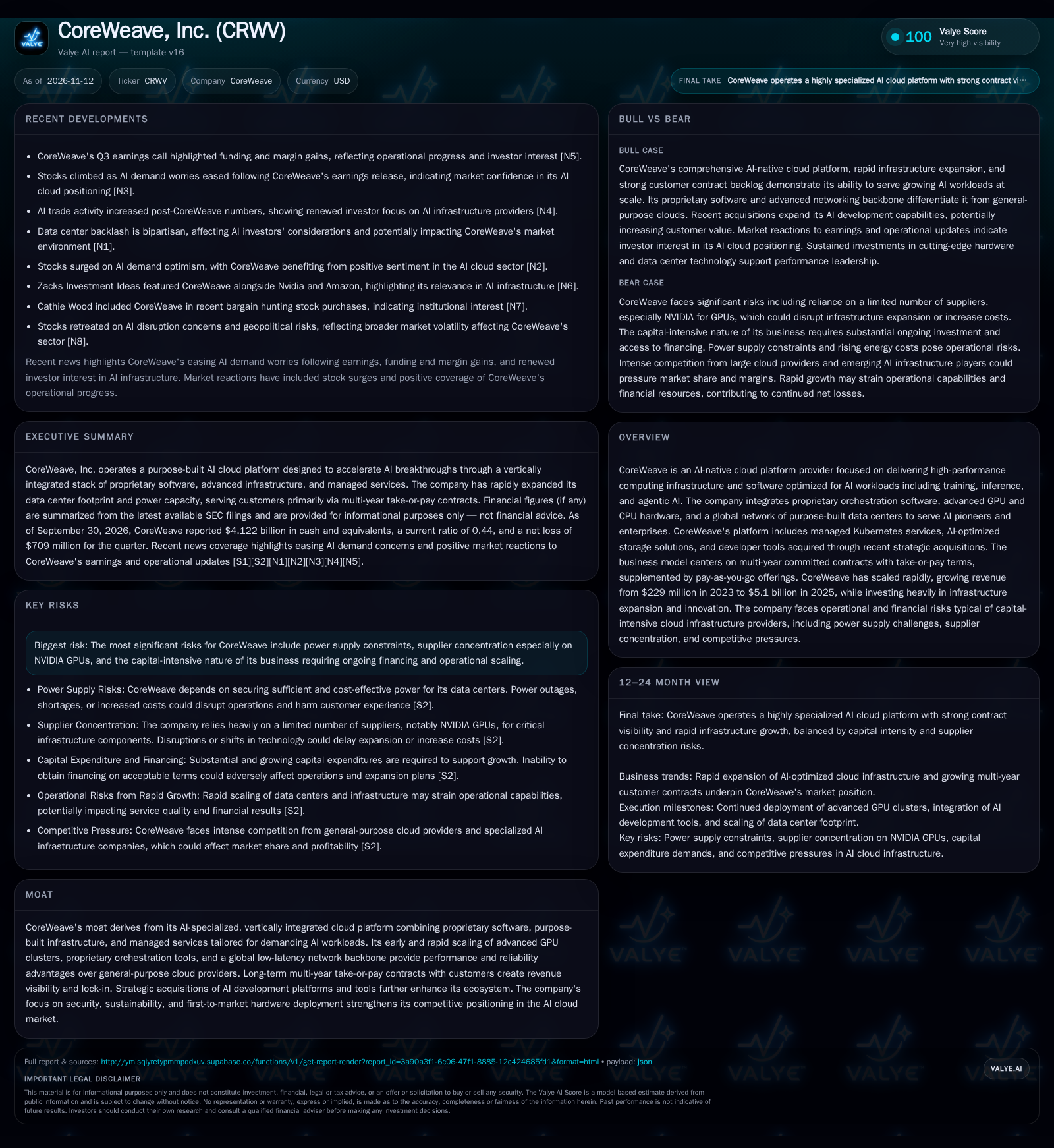
CoreWeave has emerged as a leading AI-specialized cloud platform by combining proprietary software, advanced GPU clusters, and a rapidly expanding global data center footprint. The company’s future hinges on its ability to translate technical and contractual advantages into sustainable, profitable growth while navigating power, financing, and competitive pressures. [S1] [S2]
CoreWeave, Inc. has rapidly positioned itself as a linchpin in the AI cloud ecosystem, uniquely targeting the computational and operational demands of large-scale AI workloads. The company’s blend of proprietary software, purpose-built infrastructure, and a sprawling network of data centers underpins a robust pipeline of multi-year, take-or-pay contracts—an approach that has yielded explosive revenue growth and an industry-leading $60.7 billion backlog. Yet, the company’s journey is defined by a high-wire act: persistent net losses, supplier dependency, and a capital structure that reflects the immense costs of scaling next-generation infrastructure. Whether CoreWeave can convert its technical and contractual strengths into a durable, cash-generative business remains the central question for investors and industry observers alike. [S1] [S2]
What CoreWeave’s Contract Backlog and Financials Reveal About Its Operating Trajectory
The most material facts shaping CoreWeave’s near-term outlook are its massive $60.7 billion in remaining performance obligations under multi-year, take-or-pay contracts (weighted average duration of five years as of December 31, 2025), and its dramatic revenue growth from $229 million in 2023 to $5.1 billion in 2025. These figures confirm that CoreWeave has achieved substantial commercial traction, leveraging its specialized AI cloud infrastructure to secure long-term commitments from research labs and enterprises. [S1]
However, the company’s rapid scaling has come at a cost: net losses deepened to $1.2 billion in 2025 and $709 million for the quarter ending September 30, 2026. The company reported cash and liquidity metrics for the period; these figures do not by themselves establish operating runway, investment capacity, financial flexibility, or financing capacity. [S2]
The company’s network now spans 43 data centers across six countries, with over 850 MW of active power—evidence of its aggressive infrastructure rollout and commitment to serving large-scale AI workloads. [S1]
The Economics of AI Cloud: Revenue Visibility, High Fixed Costs, and the Capital Conundrum
CoreWeave’s economics are defined by a blend of high revenue visibility—thanks to multi-year, take-or-pay contracts—and the heavy fixed costs associated with building and operating state-of-the-art data centers optimized for AI. These contracts likely provide predictable cash inflows and some insulation from short-term demand shocks, but the company’s persistent net losses and negative operating leverage underscore the challenge of converting scale into profitability. [S1] [S2]
The revenue model is driven by committed usage, with customers likely paying for guaranteed access to high-density compute and storage resources. This structure can create a high-margin opportunity if utilization rates remain strong and incremental costs are kept in check. However, CoreWeave’s fixed cost base—comprising infrastructure depreciation, power, and hardware procurement (notably NVIDIA GPUs)—means that underutilization or unexpected cost inflation could rapidly erode margins.
The company finances infrastructure expansion through a mix of asset-level debt and equity, exposing it to interest rate and refinancing risks, especially in a rising-rate environment. Capital intensity is further exacerbated by the need to stay at the bleeding edge of hardware (e.g., first-to-market NVIDIA GB200/GB300 GPUs) and networking technology, which can require frequent, large capex outlays.
Variable costs, such as energy and maintenance, are significant given the power demands of AI workloads, but may be partially offset by CoreWeave’s use of renewable energy and advanced liquid cooling to improve efficiency. The integration of proprietary orchestration software (e.g., Mission Control, Slurm on Kubernetes) could help optimize resource allocation and improve operational leverage over time, but such gains are not yet evident in the reported financials. [S1]
Differentiation in AI-Native Cloud: CoreWeave’s Edge and the Pressures of Scale
CoreWeave’s core competitive advantage stems from its vertically integrated, AI-specialized platform—combining proprietary workload orchestration, advanced networking (Quantum-X800/InfiniBand), and data centers built for high-density GPU clusters. This focus differentiates it from general-purpose cloud providers whose infrastructure and software are not expressly tuned for the unique demands of AI model training, inference, and agentic workflows. [S1]
The company’s early adoption of next-generation NVIDIA GPUs, along with its proprietary developer tools (through acquisitions like Weights & Biases and Marimo), may enable faster model iteration and deployment for customers, potentially boosting retention and pricing power. Its global network, with low-latency fiber and 'Zero Egress Migration' to reduce data transfer friction, further appeals to enterprise and research customers seeking performance and cost predictability.
However, CoreWeave’s reliance on a concentrated supplier base—especially NVIDIA for GPUs—introduces significant risk. Any disruption in GPU supply, pricing shifts, or changes in technology standards could undermine its infrastructure advantage. In parallel, hyperscale cloud providers (such as AWS, Azure, and Google Cloud) are rapidly investing in their own AI-specialized offerings, while new entrants and chipmakers are exploring alternative architectures. This landscape raises the prospect of margin pressure, customer churn, or obsolescence if CoreWeave’s technical lead narrows or customer preferences shift.
How CoreWeave Could Turn Scale and Specialization into Sustainable Profits
A favorable scenario for CoreWeave involves continued robust demand for AI model training and inference, driving high utilization of its platform and enabling the company to leverage its substantial contract backlog into strong, recurring cash flows. If CoreWeave can maintain its technical edge—by consistently deploying the latest GPUs, optimizing workload management, and integrating acquired AI development tools—customers may deepen their commitments, expand workloads, and renew contracts at attractive terms.
Operating leverage could materialize as fixed costs are absorbed by a growing revenue base and as proprietary software drives efficiency gains across the infrastructure. In this scenario, net losses would narrow and potentially flip to profitability as capital outlays stabilize and high-margin services scale. Confirmation would come from improving gross and operating margins, sustained or rising contract backlog, and evidence of cash flow from operations outpacing capex requirements.
A further upside would be CoreWeave’s ability to diversify its supplier base or secure more favorable terms with NVIDIA, reducing input risk. Successful integration of acquisitions into a seamless developer ecosystem could also increase switching costs, supporting pricing power and customer retention.
Balancing Growth and Risk: The Most Likely Trajectory for CoreWeave
The most plausible path for CoreWeave is continued rapid revenue growth underpinned by its existing contract base, but with ongoing net losses as infrastructure and operational investments remain high.
Competitive intensity may limit the company’s ability to raise prices or materially improve margins in the near term, especially as hyperscalers and new entrants expand AI-specific offerings. Supplier concentration (notably NVIDIA) and power availability will remain critical operational risks, potentially leading to cost volatility or supply interruptions.
Any signs of margin stabilization or incremental supplier diversification would serve as early indicators of a shift toward a more durable, self-funding business model.
Where the Model Breaks: Supplier Disruption, Power Constraints, and Financing Gaps
A negative scenario would be triggered if CoreWeave encounters a major disruption in GPU supply—either through a breakdown in its relationship with NVIDIA, chip shortages, or a major shift in AI hardware standards. Such an event could stall infrastructure expansion, degrade service quality, or force the company to secure less optimal (and potentially more expensive) alternatives.
Power supply constraints—such as grid shortages, price spikes, or regulatory changes—could sharply raise operating expenses or even force data center downtime, eroding customer trust and contract value. Simultaneously, if capital markets tighten or investor appetite wanes, CoreWeave might struggle to raise new debt or equity on acceptable terms, leading to liquidity stress, delayed expansion, or even covenant breaches.
Evidence of this scenario would include missed deployment milestones, contract delays or cancellations, rising accounts payable, or forced asset sales.
Milestones That Will Test CoreWeave’s AI Cloud Thesis in the Next 12-24 Months
Progression of contract backlog and renewal rates—sustained or rising multi-year take-or-pay commitments would confirm demand durability; a useful metric would be disclosed renewal/churn rates.
Gross and operating margin trends—improvement would suggest operating leverage and successful cost management; further deterioration would indicate structural margin limitations.
Utilization rates of AI clusters and data centers—if disclosed, rising utilization would validate scale economics; underutilization would signal demand or execution issues.
Supplier diversification—evidence of successful procurement from non-NVIDIA GPU sources or more favorable supply terms would reduce input risk.
Power cost and availability disclosures—updates on energy sourcing, pricing, and grid reliability would help gauge operational resilience.
Integration and uptake of acquired developer tools (e.g., Weights & Biases, Marimo)—customer adoption rates would support the ecosystem thesis.
Free cash flow and financing activity—positive cash generation or reduced reliance on external capital would indicate greater financial self-sufficiency.
Deployment pace of next-generation hardware and new data centers—on-time launches would reinforce technical leadership; delays or cost overruns would raise execution concerns.
Disclaimer: This is research-only, informational analysis and not investment advice. It may include AI-generated interpretation and general industry context. Always verify important details using primary sources.

Comments