
Acurx Pharmaceuticals in Late 2026: Antibiotic Ambitions, Funding Realities, and the Road to Commercialization
Acurx Pharmaceuticals remains a clinical-stage biotech with a focused pipeline targeting Clostridioides difficile infection. As of late 2026, the company is navigating the capital demands of drug development, regulatory milestones, and market competition, with Ibezapolstat as its lead asset and over $14 million in cash to support ongoing trials. The path forward hinges on clinical outcomes, regulatory decisions, and the ability to transition from R&D to commercial execution.
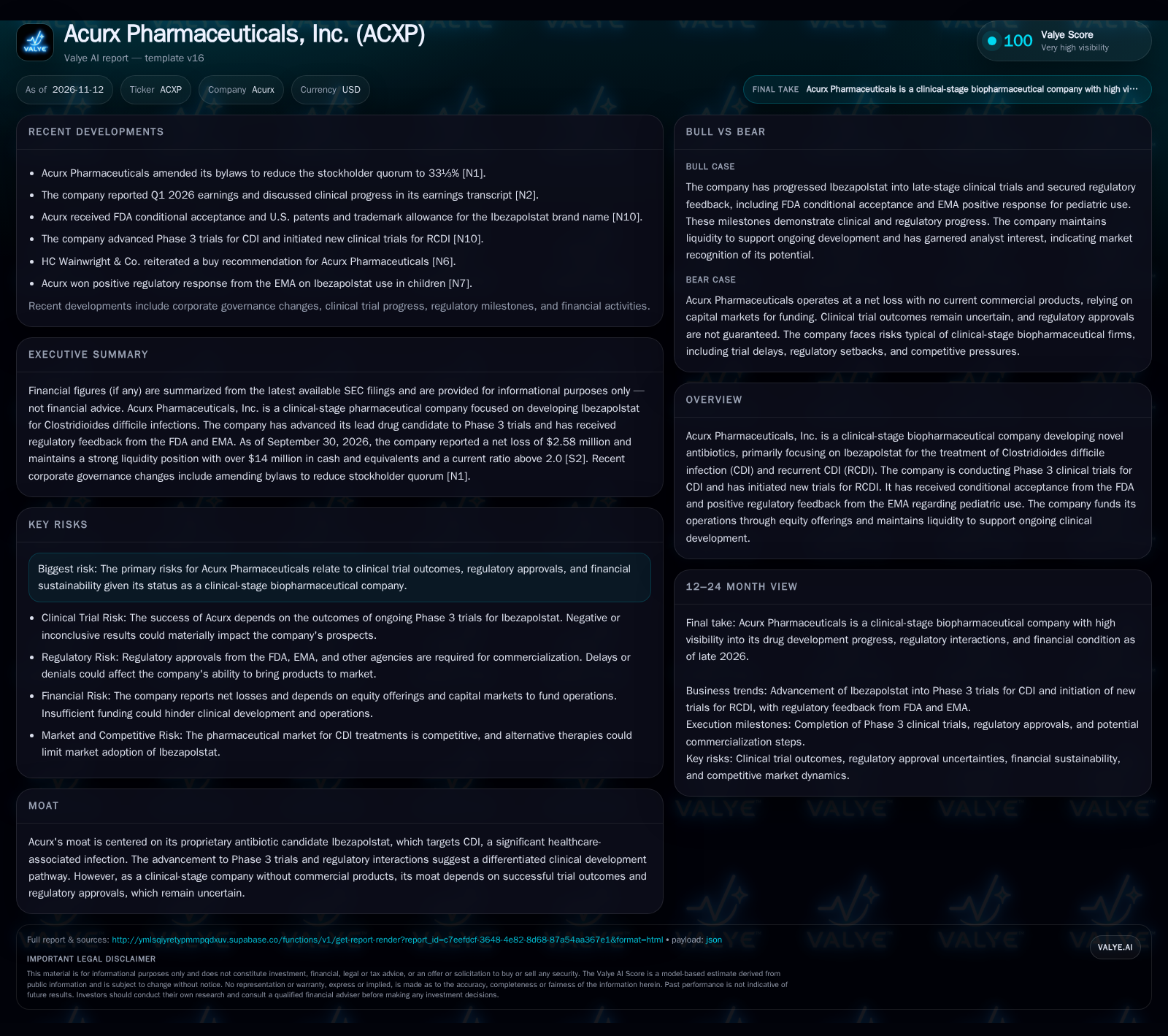
Acurx Pharmaceuticals is advancing Ibezapolstat for C. difficile infection with a healthy cash balance of $14.46 million and a current ratio above 2.0 as of September 2026, but continues to operate at a net loss with no approved products. The company’s prospects depend on successful clinical trials, regulatory approval, and eventual commercialization in a competitive antibiotic market [S2].
Acurx Pharmaceuticals, Inc. enters the final quarter of 2026 as a clinical-stage biopharma with a singular focus: developing novel antibiotics for the persistent and costly challenge of Clostridioides difficile infection (CDI). With its lead asset, Ibezapolstat, still in the clinical pipeline and no products on the market, Acurx’s current value proposition is defined by its R&D progress, regulatory milestones, and the ability to secure capital to fund ongoing trials. As competitive pressures and capital markets evolve, Acurx’s journey from scientific promise to commercial reality will be determined by a handful of clinical, regulatory, and financial inflection points over the next 12-24 months.
Where Acurx Stands: Clinical Pipeline, Funding, and Corporate Moves in 2026
As of September 30, 2026, Acurx Pharmaceuticals holds $14.46 million in cash and equivalents and reported liquidity-ratio trends of 2.06, with current liabilities of $2.99 million [S2]. [S2]
The company remains pre-commercial, with Ibezapolstat as its primary clinical asset targeting the CDI market. No commercial products have been approved or launched, so Acurx’s revenues are driven solely by financing activities, not product sales [S2].
Acurx amended its bylaws in 2026 to reduce the stockholder quorum to 33⅓%, a move that may facilitate future shareholder meetings and potentially ease the execution of corporate actions such as further capital raises or strategic transactions [N1].
Analyst coverage, including a reiterated buy recommendation from HC Wainwright & Co., signals ongoing market interest but does not guarantee future capital access or clinical success [N6].
Funding Drug Development: The Economics Behind Acurx’s Clinical Model
Acurx’s business model is emblematic of clinical-stage biotechs: substantial upfront R&D costs, persistent operating losses, and reliance on external capital until a product reaches commercialization. The company’s expenses are dominated by clinical trial costs, regulatory filings, and ongoing pre-commercial manufacturing arrangements. With no revenue from product sales, the timeline and probability of future cash generation are entirely dependent on the successful progression and approval of Ibezapolstat.
Drug development is capital-intensive and non-linear. The roughly $2.58 million net loss in Q3 2026 illustrates the ongoing cash burn typical of this stage [S2]. Fixed costs (management, core R&D staff) are relatively modest, but variable costs can spike as trials progress or scale. Margins, if Ibezapolstat reaches market, will depend on pricing, reimbursement, and adoption in the competitive CDI landscape—factors that are highly uncertain until late-stage trial results and payer negotiations are known.
Acurx currently outsources manufacturing and does not maintain internal production capability, relying on third-party suppliers for clinical trial material, with future commercial supply chain decisions still pending. This outsourcing model allows for capital efficiency and flexibility but may compress margins if commercial scale is reached and third-party manufacturing remains the norm.
The need for periodic equity offerings is a structural feature of the model. Until clinical data de-risk the asset and/or a licensing or acquisition event occurs, dilution for existing shareholders is a persistent overhang.
Defending Share in a Crowded Antibiotics Arena: Acurx’s Prospects and Pitfalls
Acurx’s competitive positioning is anchored to Ibezapolstat’s potential clinical differentiation in treating CDI—a serious hospital-associated infection with high recurrence rates and significant healthcare costs. The market includes entrenched therapies (e.g., vancomycin, fidaxomicin) and ongoing innovation from larger pharmaceutical players and biotech peers. The real-world adoption of any new entrant hinges on superior efficacy, safety, resistance profile, and cost-effectiveness.
The company’s proprietary approach may offer mechanistic advantages, but these must be validated in late-stage trials and, crucially, translated into meaningful clinical and economic outcomes for payers and providers. Barriers to entry in antibiotics are relatively high due to regulatory scrutiny and the need for robust evidence of superiority or non-inferiority.
Switching costs for prescribers are moderate: while hospitals and infectious disease specialists are open to new therapies that address resistance or recurrence, formulary inclusion, guideline endorsement, and payer reimbursement are critical hurdles. Acurx’s lack of a commercial infrastructure and reliance on third-party manufacturing and distribution could be a disadvantage against established competitors unless mitigated by partnerships or licensing deals.
The threat of substitutes is persistent: alternative modalities (e.g., microbiome therapies, phage therapy) are in development, and genericization of older antibiotics can pressure pricing. Thus, even with approval, commercial success is not assured.
If Clinical and Regulatory Dominoes Fall: How Acurx Could Emerge as a CDI Leader
The favorable scenario for Acurx is a sequence in which Ibezapolstat demonstrates clear clinical superiority or a compelling safety/resistance profile in pivotal trials, leading to expedited regulatory approval in the U.S. and potentially Europe. This would unlock not only revenue from product sales but also the possibility of lucrative partnership or licensing deals, particularly if larger pharma companies seek to expand their infectious disease franchises.
Commercial economics could benefit from premium pricing if payers perceive a reduction in recurrence rates or downstream healthcare costs. Acurx could leverage positive data to negotiate advantageous reimbursement and secure rapid formulary uptake, especially if Ibezapolstat is included in treatment guidelines.
Evidence that would confirm this scenario includes: robust late-stage trial results showing superiority or meaningful differentiation, clear regulatory feedback (such as priority review or breakthrough designation), and announcements of pre-commercial or commercial partnerships with established pharmaceutical companies.
A sharp inflection in market capitalization or trading volume following clinical data releases would also suggest that the market is pricing in a higher probability of commercial success.
Most Likely Trajectory: Continued Clinical Progress, Incremental Funding, and Ongoing Uncertainty
Regulatory interactions may proceed as planned, but the timeline for approval is inherently uncertain and could be delayed by additional data requests or safety concerns. Even with eventual approval, initial commercial uptake may be gradual as payers and prescribers evaluate real-world effectiveness and cost impact.
Shareholder dilution remains a risk, and the lack of commercial infrastructure means that Acurx would likely need to partner for sales and distribution or accept lower profitability through third-party arrangements.
Evidence supporting this base case would include incremental clinical milestones, further equity offerings, and measured progress in regulatory filings without major accelerations or setbacks.
When the Clock Runs Out: Adverse Outcomes and the Threat of Capital Exhaustion
The primary risk is that Ibezapolstat fails to demonstrate sufficient efficacy or safety in pivotal trials, or that regulatory agencies require additional studies that extend timelines and increase costs. In this scenario, Acurx’s cash reserves could be depleted before a value-creating event, forcing the company to raise capital on highly dilutive terms or seek strategic alternatives under duress.
Competition could intensify if new therapies reach the market first, eroding the perceived value of Acurx’s pipeline. Even in the event of approval, if payers resist premium pricing or adoption is slow due to entrenched alternatives, the company may struggle to achieve sustainable revenues.
Negative developments would be confirmed by trial discontinuations, adverse regulatory feedback, or a sharp increase in financing activity at unfavorable terms. Delays in clinical milestones, management turnover, or the announcement of strategic reviews could also signal trouble.
If Acurx is unable to secure additional funding or attract a partner, the risk of asset sales, down-round financings, or even bankruptcy would increase.
What Will Determine Acurx’s Transition from Pipeline to Product?
Progress and outcomes in ongoing and future pivotal clinical trials for Ibezapolstat, including efficacy and safety data releases, will be the most direct indicators of value inflection.
Regulatory milestones: announcements of FDA or EMA feedback, designations (such as fast track, breakthrough, or priority review), and timing of new drug applications.
Updates on cash runway and capital-raising activities, especially if clinical timelines extend or trial costs escalate; a useful metric would be projected runway under current burn rates if disclosed.
Partnership or licensing announcements with larger pharmaceutical companies, which could signal validation and provide non-dilutive capital.
Progress toward establishing commercial manufacturing and distribution capabilities, or concrete plans for outsourcing or partnering these functions if disclosed.
Changes in the competitive landscape, including approvals or launches of rival CDI therapies and new clinical data from competing assets.
Evidence of payer and prescriber receptivity, such as inclusion in clinical guidelines or formulary listings, would help test the future commercial adoption thesis.
Disclaimer: This is research-only, informational analysis and not investment advice. It may include AI-generated interpretation and general industry context. Always verify important details using primary sources.

Comments