
Eikon Therapeutics: Expanding Pipeline and Sustained R&D Investment in Oncology Innovation
Eikon Therapeutics advances a diversified oncology pipeline with substantial cash reserves, but its value hinges on high-stakes clinical milestones years away. The company’s ability to translate its multi-asset approach and scientific leadership into eventual regulatory success and commercial viability remains unproven in a fiercely competitive sector.
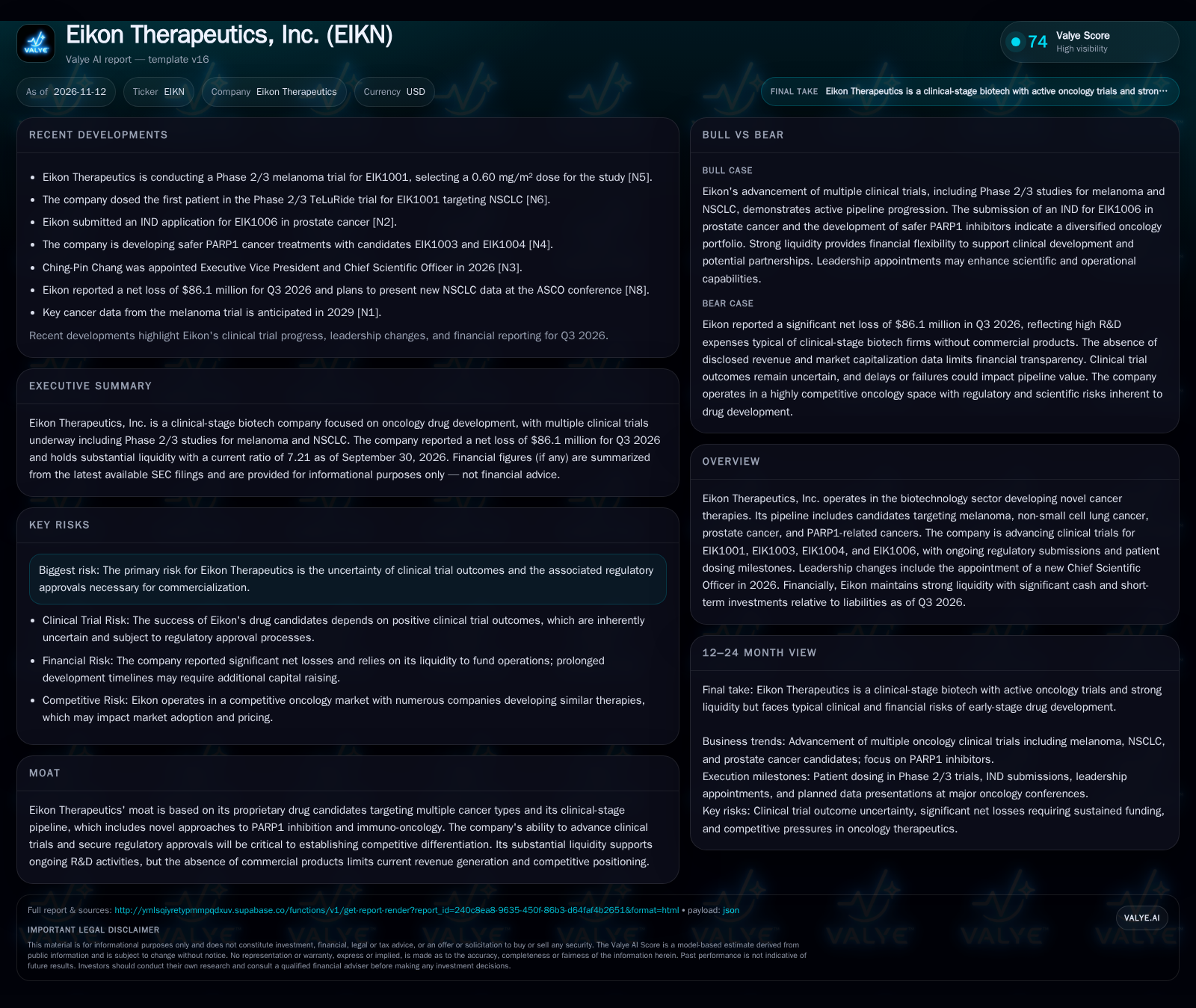
Eikon Therapeutics is pushing multiple cancer drug candidates into advanced clinical trials, notably EIK1001 for melanoma and NSCLC, with additional programs targeting prostate cancer and PARP1 pathways. The company’s $478.1 million in current assets provides a significant runway, but with no commercial revenue and a Q3 net loss of $86.1 million, the risk of clinical setbacks or prolonged timelines is material. Key data from its lead melanoma trial will not arrive until 2029, making near-term value inflection dependent on interim results, regulatory progress, and portfolio diversification.[S2] [N1] [N5] [N6]
Eikon Therapeutics, Inc. exemplifies the promise and peril of clinical-stage biotech. With a deep oncology pipeline spanning melanoma, NSCLC, prostate cancer, and PARP1-driven tumors, the company is moving multiple assets through mid- and late-stage studies. Its reported cash position buys time, but the absence of revenue, steep quarterly losses, and a multi-year wait for the first pivotal data create a classic high-risk, high-reward profile. The next few years will test whether Eikon’s scientific bets and operational discipline can survive the slow grind of oncology drug development and deliver eventual market traction.
Recent Portfolio Growth and Financial Developments Influencing Eikon’s Path
Eikon Therapeutics is actively advancing a multi-asset oncology pipeline, with its lead candidate EIK1001 now in Phase 2/3 trials for both melanoma and non-small cell lung cancer (NSCLC). The company recently dosed its first NSCLC patient and selected a 0.60 mg/m² regimen for the melanoma study, signaling clinical momentum.[N5] [N6] Beyond EIK1001, Eikon has submitted an IND for EIK1006 targeting prostate cancer and is developing two PARP1 inhibitor candidates (EIK1003, EIK1004), indicating a strategy of portfolio breadth.[N2] [N4]
The company reported cash and liquidity metrics for the period; these figures do not by themselves establish operating runway, investment capacity, financial flexibility, or financing capacity. [S2]
A leadership change—specifically, the appointment of Ching-Pin Chang as Chief Scientific Officer—may influence R&D execution and scientific priorities going forward.[N3]
Notably, key clinical data from the pivotal melanoma trial are not expected until 2029, meaning near-term value inflection is likely to hinge on interim results, regulatory milestones, or external validation.[N1]
Eikon’s Approach to Turning Pipeline Assets into Long-Term Value
Eikon’s current economics are defined by heavy R&D investment and zero product revenue—a standard profile for clinical-stage biotech. Its $86.1 million quarterly net loss reflects the costs of running multiple late-stage trials, expanding pipeline assets, and maintaining a robust research organization. [S2]
If any of Eikon’s lead programs achieve regulatory approval, the company could transition to a model driven by high-margin oncology drug sales. In this scenario, pricing power would rest on clinical differentiation, safety/tolerability, and the ability to secure favorable reimbursement—factors that depend on trial outcomes and competitive positioning. Commercialization would likely require further investment in sales infrastructure or a commercial partner.
The multi-asset pipeline increases optionality: positive data in any one indication (melanoma, NSCLC, prostate cancer, or PARP1-driven tumors) could trigger out-licensing deals, milestone payments, or strategic buyout interest, all of which are common liquidity events in biotechnology. However, the capital needs for late-stage trials and potential commercialization are substantial, and dilution risk remains material if timelines slip or data disappoint.
Eikon’s Positioning Amid Intense Competition in Oncology
Eikon operates in one of the most competitive segments of biotech: oncology. Its lead assets target melanoma and NSCLC, both of which are fields with multiple approved therapies and ongoing innovation, particularly in immuno-oncology and targeted agents. The company’s development of PARP1 inhibitors (EIK1003, EIK1004) puts it up against established drugs from larger pharmaceutical players, requiring clear efficacy or safety advantages to gain clinical and commercial traction.
Eikon’s potential advantages could stem from novel mechanisms of action, improved safety profiles (as suggested by its pursuit of ‘safer’ PARP1 inhibitors), or the ability to address patient segments underserved by current treatments.[N4] However, the company faces significant counterforces: entrenched competitors, high regulatory hurdles, and the risk of being outpaced by faster-moving or better-capitalized peers.
Switching costs in oncology can be high once a standard of care is established, but initial adoption curves for new therapies are often slow unless supported by compelling clinical data. Eikon’s ability to differentiate will depend not just on scientific innovation but also on its execution in clinical development, regulatory strategy, and eventual commercial partnerships.
Value Creation Potential from Breakthrough Results or Strategic Partnerships
The most favorable scenario for Eikon involves one or more of its lead assets—most plausibly EIK1001—demonstrating clear clinical superiority or safety advantages in Phase 2/3 trials, leading to accelerated regulatory review and eventual approval in melanoma or NSCLC. Interim data presentations, such as the planned ASCO update, could catalyze external interest if results are positive, potentially unlocking partnership or licensing deals that bring in non-dilutive capital and validate the platform.[N8]
A strong safety/tolerability signal from EIK1003 or EIK1004 in the PARP1 space could open doors to new patient populations or combination strategies, increasing both market potential and strategic value. The appointment of an experienced Chief Scientific Officer may also enhance the probability of robust trial design and execution.[N3]
Confirmation of this upside would come from positive interim clinical readouts, partnership announcements, or significant licensing revenue. Conversely, failure to deliver differentiated efficacy/safety or an inability to secure external validation would undermine this scenario.
Anticipated Pipeline Advances and the Timeline for Value Emergence
The most plausible trajectory for Eikon is continued advancement of its clinical programs, with periodic interim updates but no major value inflection until the full melanoma trial data in 2029.[N1] The company likely continues to report sizable net losses as R&D spending remains high and no commercial revenue materializes.
In this scenario, reported liquidity position for the next several years, but additional financing may be required if development timelines extend or if new trials are initiated. The pipeline’s breadth offers some risk diversification, but the company’s fate will ultimately hinge on clinical outcomes for its lead programs.
Evidence confirming this path would include steady patient enrollment, incremental milestone achievements, and the absence of major clinical or regulatory setbacks. Signs of slippage—such as delayed enrollment, trial pauses, or negative safety signals—would challenge this base case.
Implications of Clinical Challenges and Extended Development Periods
Eikon faces the classic biotechnology downside: a material clinical failure or safety signal in its lead programs could sharply reduce pipeline value, making additional fundraising difficult and potentially forcing the company to halt or reprioritize development efforts. Prolonged timelines without compelling interim data would steadily erode the cash position, increasing dilution risk or the need for asset sales.
The heavily competitive oncology landscape exacerbates this risk—if rival therapies demonstrate superior efficacy or safety before Eikon’s readouts, payer and prescriber enthusiasm could wane, even for assets that eventually prove effective. Regulatory hurdles or unanticipated trial design issues could further delay or derail progress.
Downside confirmation would come from negative or inconclusive interim results, announcements of trial discontinuations, or the need for emergency capital raises at unfavorable terms.
Eikon’s Milestone Progress and Performance Indicators in Oncology
Interim clinical data releases for EIK1001 in both melanoma and NSCLC—particularly any efficacy or safety signals that exceed existing standards of care—would be pivotal.
Progress on patient enrollment rates and trial site activation for ongoing Phase 2/3 studies; delays here would increase timeline and capital risk.
Updates on the IND status and clinical initiation for EIK1006 in prostate cancer, as well as any movement into human trials for EIK1003/EIK1004.
Announcements of partnership, licensing, or non-dilutive funding deals, which would signal external validation and potentially extend runway.
Any material changes to the cash burn rate or R&D spending trajectory; a useful metric would be quarterly operating cash outflows if disclosed.
Leadership commentary or disclosed plans regarding commercial strategy or potential out-licensing of pipeline assets.
Regulatory feedback or trial design amendments from the FDA or other global agencies that could impact development timelines or approval probability.
Competitive developments in the melanoma, NSCLC, PARP1, or prostate cancer therapeutic areas that might shift the standard of care or raise the bar for new entrants.
Disclaimer: This is research-only, informational analysis and not investment advice. It may include AI-generated interpretation and general industry context. Always verify important details using primary sources.

Comments