
Pixelworks After the Semiconductor Sale: Can TrueCut Motion Become the Standard for Cinematic Video Quality?
With the divestiture of its traditional chip business and a pivot to software-driven cinematic visualization, Pixelworks is betting its future on the adoption of its TrueCut Motion platform.
Pixelworks has exited semiconductor manufacturing and now focuses on its proprietary TrueCut Motion platform for cinematic video processing. The next phase hinges on whether TrueCut Motion can win buy-in from filmmakers and display manufacturers to become a new industry standard.
Pixelworks has undergone a radical transformation, shedding its legacy semiconductor operations to become a pure-play provider of cinematic video processing software and intellectual property. The company’s future now rides on its TrueCut Motion platform—a suite of tools designed to let filmmakers preserve creative intent and optimize motion quality across diverse display technologies. Whether TrueCut Motion can become a widely adopted standard, or whether Pixelworks will struggle to gain critical mass, is the central question facing the business.
A New Era: Pixelworks’ Cinematic Pivot and Its Immediate Impact
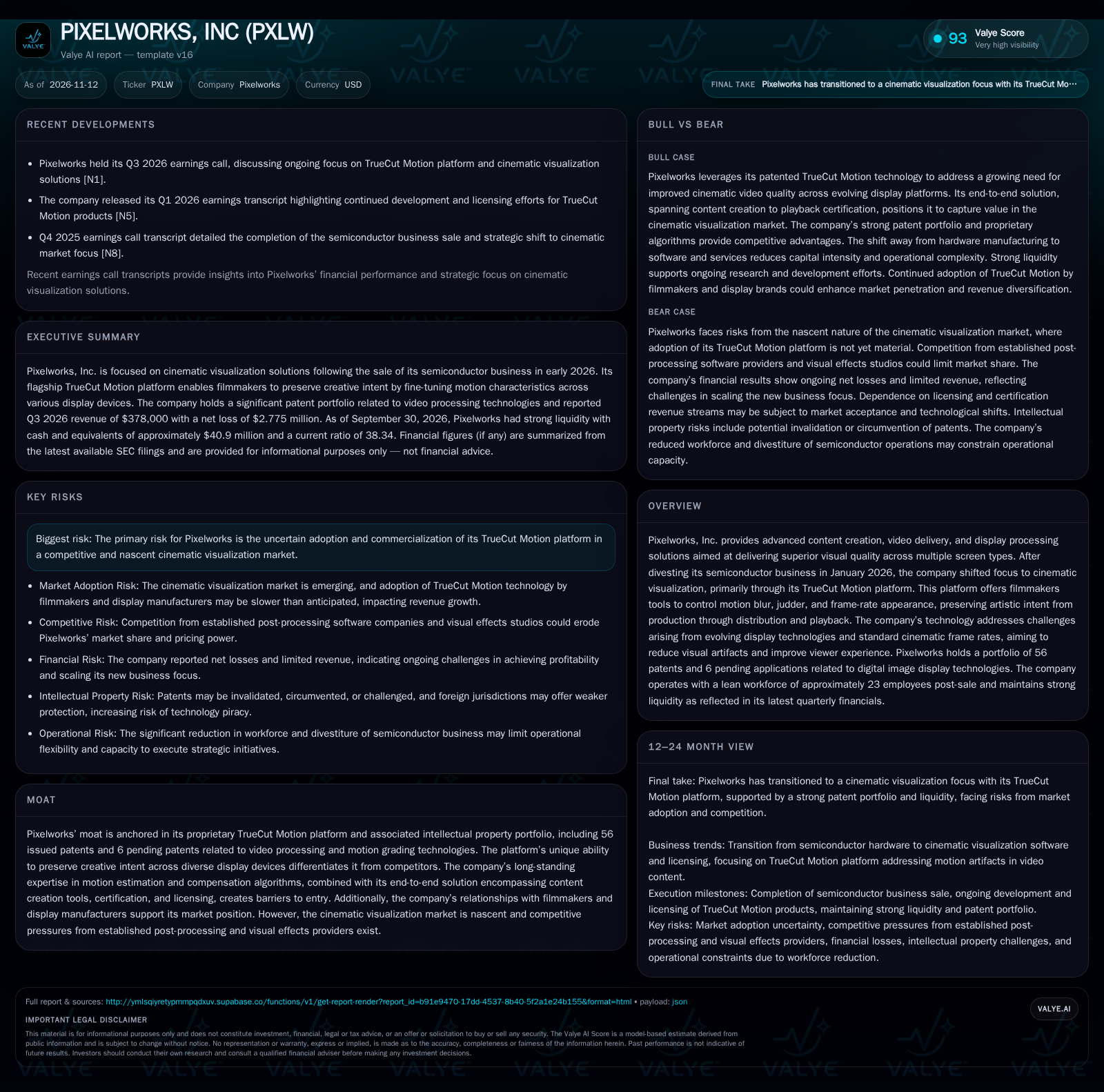
In January 2026, Pixelworks completed the sale of its semiconductor business—including its Mobile and Home & Enterprise segments—for approximately $51 million net, marking a fundamental shift from hardware to software and IP licensing [S1]. This transition leaves the company sharply focused on its TrueCut Motion platform, which targets the emerging need for cinematic-quality motion processing across a wide range of modern displays. Post-sale, Pixelworks operates with only 23 employees, a dramatic reduction from 196 in 2024, and reported Q3 2026 revenue of $378,000 alongside a net loss of $2.775 million [S2]. The company reported cash and liquidity metrics for the period; these figures do not by themselves establish operating runway, investment capacity, financial flexibility, or financing capacity. [S2] The key near-term question is whether the market for cinematic motion grading will materialize quickly enough to drive meaningful revenue growth before liquidity becomes a concern.
Licensing, Certification, and Services: Pixelworks’ Emerging Revenue Model
Pixelworks’ new business model is anchored in licensing its TrueCut Motion platform, offering content creation tools, motion grading and finishing services, and display device certification. Unlike its prior hardware-centric approach, this model is asset-light, with minimal manufacturing or inventory requirements [S1]. The company’s economics will likely hinge on a mix of per-title or per-project service fees for content creators, recurring or one-time licensing arrangements with display manufacturers, and potentially certification fees for device makers that adopt the TrueCut standard.
The shift to software and IP licensing introduces the prospect of high gross margins once meaningful scale is achieved, as incremental delivery costs are low. However, revenue growth is currently limited, and the company is absorbing losses as it invests in business development and R&D. The size of the potential addressable market depends on (1) the willingness of content creators and studios to pay for motion grading services, (2) the adoption of TrueCut certification by major display makers, and (3) the ability to build a recognized standard that commands premium pricing. The absence of hardware means Pixelworks faces less capital intensity and operating leverage risk, but it also means topline growth will require rapid and broad adoption across the film and display value chain.
Defining Differentiation in a Crowded Visual Effects Ecosystem
Pixelworks is seeking to carve out a niche in the broader post-production and display technology landscape. Its TrueCut Motion platform claims to solve a real technical problem: the misalignment between traditional cinematic frame rates and the increasingly high refresh rates and processing capabilities of modern displays, which can cause artifacts such as judder and motion blur [S1]. The company’s portfolio of 56 issued and 6 pending patents in motion estimation, grading, and signal processing is a potential barrier to entry for direct imitators.
However, Pixelworks faces competition from established post-processing software providers, visual effects studios, and potentially in-house solutions developed by large studios or display manufacturers. Many of these competitors benefit from long-standing relationships in Hollywood and with consumer electronics brands, as well as deeper integration into production workflows. The company’s main differentiation lies in its end-to-end solution—spanning content creation tools to device certification—and its claim to preserve creative intent more authentically than generic motion interpolation algorithms. If Pixelworks can secure partnerships with influential filmmakers or major display brands, it could build network effects and could raise switching costs. Yet, if competitors can achieve similar visual outcomes without infringing Pixelworks’ IP, pricing power could prove elusive.
When TrueCut Motion Becomes the Industry Standard: What Would Drive a Breakout?
The best-case scenario for Pixelworks is that TrueCut Motion is embraced by leading filmmakers, studios, and display manufacturers, becoming the potentially leading standard for cinematic motion grading. This could happen if the platform demonstrates clear, repeatable improvements in visual quality and creative intent preservation—particularly for blockbuster releases or high-profile streaming content.
Confirmation of this scenario would come from major content studios announcing TrueCut-graded releases, high-profile director or cinematographer endorsements, and consumer electronics brands marketing TrueCut-certified devices. As adoption spreads, Pixelworks could shift from bespoke service fees to scalable, recurring licensing and certification revenues, driving operating leverage and margin expansion. The existence of a robust patent portfolio would help defend margins and deter direct imitation.
Falsification would be evident if, after pilot projects or initial industry trials, studios revert to legacy workflows, display makers adopt alternative standards, or Pixelworks’ IP is circumvented without legal recourse. Stagnant revenue, lack of marquee partnerships, or minimal consumer awareness would indicate the platform is not gaining traction.
Building a Foothold: Gradual Adoption and the Challenge of Market Education
The most plausible near-term outcome is that Pixelworks secures a handful of early adopters—perhaps independent studios, select streaming originals, or niche display brands—while broader industry adoption proceeds slowly. In this scenario, the company’s revenues remain modest but nonzero, with pilot projects, limited licensing agreements, and ongoing demonstrations of the technology.
Progress would be evidenced by incremental increases in licensing/service revenue, a growing roster of content credited with TrueCut Motion grading, and periodic announcements of new device certifications. However, adoption could be slowed by entrenched post-production workflows, inertia among display makers, or the need for industry-wide education on the value of motion grading.
If Market Skepticism Prevails: The Risks of a Niche Solution
In an adverse scenario, the cinematic visualization market proves too narrow or slow-moving for Pixelworks to achieve meaningful scale before its reported cash balance erodes. Studios and device makers might see TrueCut Motion as an incremental, non-essential upgrade—especially if consumer demand for improved motion quality is muted or hard to monetize.
Confirmation would come from persistently minimal revenues, a lack of repeat business from early pilot partners, and the introduction of competing solutions that match or exceed TrueCut’s capabilities. If Pixelworks’ patents are challenged or circumvented, the company could lose its technical edge. Shrinking cash reserves without a path to profitability could force further cost cuts, strategic pivots, or a search for a buyer of the IP portfolio.
Milestones That Will Shape the TrueCut Motion Thesis
The number and prominence of content projects—especially studio or streaming originals—using TrueCut Motion for motion grading, if disclosed.
Announcements of partnerships or licensing deals with major display manufacturers or consumer electronics brands.
Growth in quarterly revenue from licensing and services, as distinct from legacy or one-off sources.
Expansion of the patent portfolio or successful defense of existing patents in the face of legal challenges.
Cash burn rate relative to revenue growth and the evolving timeline for breakeven.
Evidence of TrueCut Motion being integrated into standard post-production workflows or widely adopted industry toolchains.
Statements from filmmakers, studios, or device makers endorsing the platform’s creative or technical value, if disclosed.
The emergence of credible competing solutions or industry standards that could substitute for TrueCut Motion.
Disclaimer: This is research-only, informational analysis and not investment advice. It may include AI-generated interpretation and general industry context. Always verify important details using primary sources.

Comments