
AGI Inc’s Strategic Expansion: Navigating Asset Growth, Governance Divergence, and New Business Lines in Brazil
AGI Inc has demonstrated record profits and rapid asset expansion in Brazil while pursuing new business lines such as asset management and launching a substantial share repurchase program. The company’s Cayman Islands governance structure and exposure to Brazilian economic and regulatory volatility create a distinctive risk-reward profile for investors.
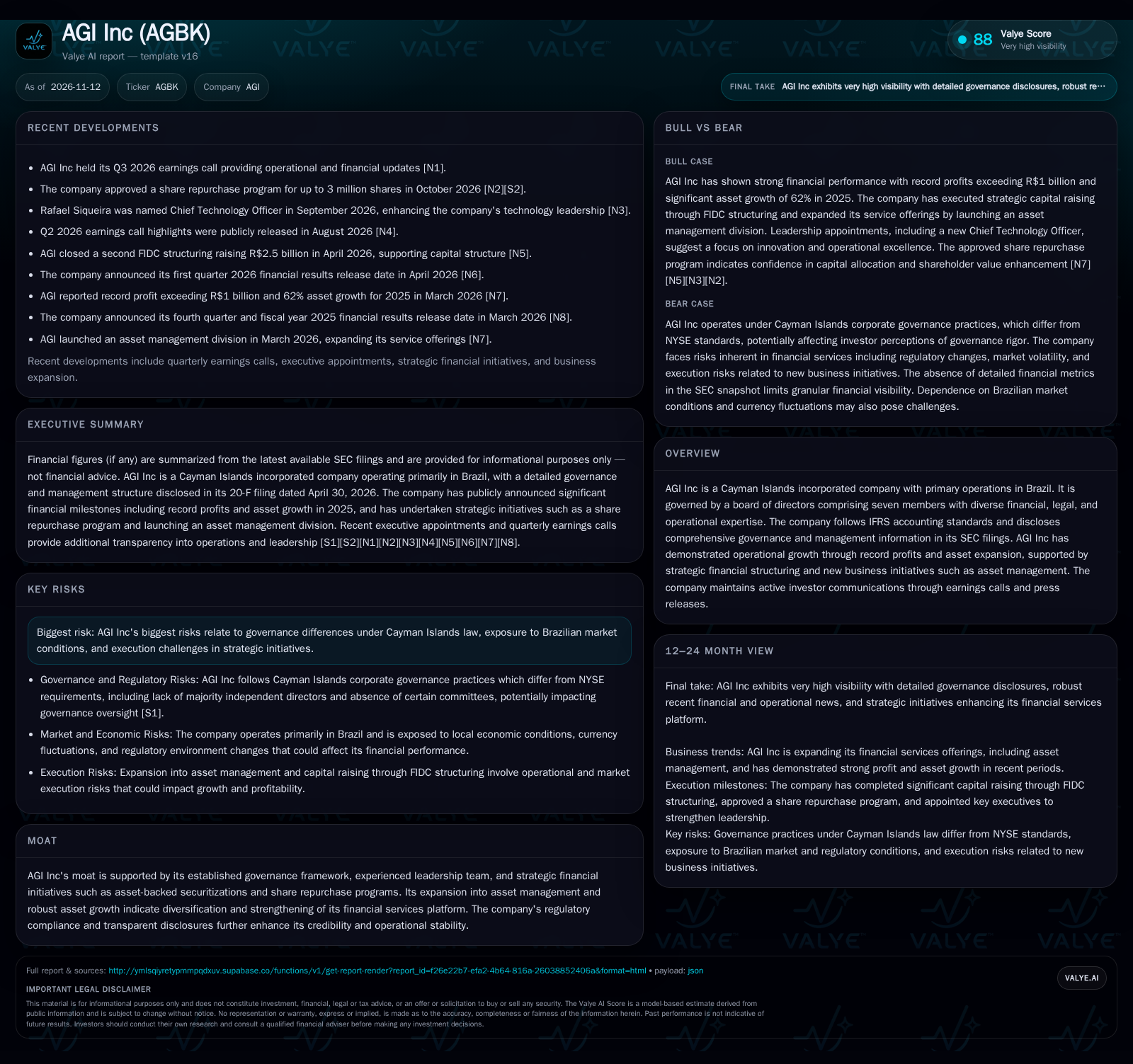
AGI Inc, a Cayman Islands-incorporated financial services player operating in Brazil, has reported record profits exceeding R$1 billion and 62% asset growth in 2025, expanded into asset management, and announced a 3 million share buyback. Its governance deviates from NYSE norms, while execution and market risks remain pronounced. The company’s evolving business mix and capital allocation moves could reshape its growth trajectory [S1] [S2] [N1].
AGI Inc stands at a strategic inflection point after delivering record profits and substantial asset growth in Brazil, launching a buyback program, and moving into asset management. Yet, its Cayman Islands governance structure and reliance on volatile Brazilian macroeconomic conditions present investors with both unique upside and distinct risks. The company’s ability to translate asset expansion into durable earnings, navigate regulatory differences, and execute on new business lines will likely determine its long-term value creation.
Recent Profit Milestones, Asset Expansion, and Capital Return Moves
AGI Inc reported record profits above R$1 billion and 62% year-over-year asset growth in 2025, underscoring rapid operational expansion [S1]. The company has also formally approved a share repurchase program for up to 3 million shares, indicating an active approach to capital management [S2]. These developments matter because they suggest both internal profitability and the potential financial flexibility to return capital to shareholders. Additionally, AGI Inc’s move into asset management signals a strategic effort to diversify its business mix beyond its core operations.
How AGI Inc’s Business Mix and Capital Structure Could Drive Long-Term Earnings
AGI Inc’s business economics likely hinge on its ability to generate fee-based and interest income from its core Brazilian financial operations, while layering on new revenue streams through asset management. The 62% asset growth implies either organic expansion or acquisitions, both of which can drive scale advantages if cost structures are well-managed. Asset management, if executed successfully, could introduce higher-margin, recurring fee income, but typically requires upfront investments in talent, technology, and distribution.
The company’s capital structure—evidenced by the share buyback—suggests a degree of balance sheet strength or at least management confidence in future cash flows. However, the economics of Brazilian financial services often involve exposure to local interest rates, funding costs, and credit risk, which can amplify both upside and downside through operating leverage. The use of FIDC (credit receivables funds) structuring for capital raising may enable AGI Inc to leverage off-balance-sheet funding, though it introduces complexity and potential liquidity risks if underlying receivables deteriorate.
Operating leverage could materialize if cost growth lags revenue expansion, but the move into asset management carries execution risk and may delay margin expansion if scale is not rapidly achieved.
In addition to the direct revenue implications, AGI Inc’s evolving business mix may influence its risk profile and capital adequacy requirements. Asset management businesses typically exhibit lower credit risk compared to lending operations but can introduce market and operational risks tied to fund performance and client retention. The interplay between these risks and the company’s capital structure will be critical, especially if regulatory capital frameworks treat fee-based and credit exposures differently. Moreover, the firm's ability to optimize funding costs through diversified capital sources, including FIDC structures, depends on maintaining asset quality and investor confidence in these vehicles. Any deterioration in underlying receivables or shifts in investor appetite could constrain liquidity and elevate funding costs, impacting net interest margins and overall profitability.
Competitive Landscape: Diversification and Regulatory Arbitrage as Double-Edged Swords
AGI Inc’s rapid asset growth and expansion into asset management position it as an emerging diversified financial services provider within Brazil. This may offer a competitive edge against more narrowly focused local peers and new fintech entrants, particularly if AGI can cross-sell products and deepen client relationships.
However, established Brazilian banks and global asset managers have significant scale, brand, and regulatory compliance infrastructure, making customer acquisition and retention challenging in the absence of a clear product or cost advantage. AGI’s Cayman Islands incorporation and governance structure provide some regulatory flexibility but may also deter institutional investors who prefer NYSE-style oversight and committee structures [S1].
The company’s ability to leverage local knowledge, regulatory arbitrage, and product innovation will be tested as it seeks to grow in a competitive and rapidly evolving market environment.
The regulatory arbitrage afforded by AGI Inc’s Cayman Islands incorporation may yield flexibility in governance and capital management but could also limit access to certain institutional investors or capital markets that prioritize stringent regulatory compliance and transparency. This dynamic could affect the company’s cost of capital and valuation multiples relative to peers domiciled under more conventional regulatory regimes. Furthermore, as Brazil’s financial sector continues to evolve with increasing fintech innovation and regulatory reforms, AGI Inc’s ability to adapt its product offerings and compliance frameworks will be tested. Success may hinge on balancing innovation with prudent risk management, ensuring that regulatory arbitrage does not inadvertently expose the company to reputational or compliance risks that could offset competitive advantages.
If Asset Management Gains Traction and Capital Allocation Remains Aggressive
A favorable outcome for AGI Inc would see its asset management division scaling quickly, generating high-margin, recurring revenue and improving overall return on equity. If the company can continue to grow assets at a pace similar to the reported 62% in 2025—without a corresponding rise in risk or expenses—operating leverage could drive sustained profit growth.
The share buyback could also provide per-share earnings accretion if executed at attractive valuations and funded by genuine surplus capital. Confirmation of this scenario would come from subsequent disclosures showing rising asset management AUM, growth in fee-based income, sustained or improved profitability, and evidence that buybacks do not compromise liquidity or capital adequacy.
Falsification would occur if asset management fails to scale, if buybacks are suspended due to capital pressures, or if asset growth is revealed to be low quality (e.g., driven by riskier receivables or non-core businesses).
Brazilian Market Realities and Execution Complexity Shape Trajectory
The most plausible scenario is that AGI Inc delivers moderate earnings growth and incremental business diversification, but faces friction as it integrates new lines like asset management and adapts to shifts in Brazilian economic conditions. Asset growth may decelerate as the business matures or as market competition intensifies.
The company’s Cayman Islands governance, while legally compliant, may create a persistent discount in investor perception relative to peers with stronger NYSE-style board independence and committee oversight [S1].
Evidence supporting this scenario would include steady (but slowing) asset and revenue growth, stable or slightly rising operating costs, and periodic but not full utilization of the buyback authorization. Falsification would be seen if AGI Inc outpaces the market in asset or AUM growth, or if it stumbles and reports setbacks in new business execution or regulatory compliance.
Governance and Market Shocks Could Undermine Growth and Confidence
A negative trajectory could develop if Brazilian macroeconomic volatility (such as interest rate spikes, recession, or currency shocks) erodes AGI Inc’s asset quality or funding costs, leading to profitability pressure or capital shortfalls. Further, if the company’s Cayman Islands governance is perceived as insufficiently robust during a crisis or controversy, investor confidence and access to capital markets could suffer.
Execution failures in asset management—such as poor fund performance, regulatory missteps, or inability to attract clients—could result in sunk costs and damage to reputation. If the buyback is curtailed or reversed to preserve capital, it may signal underlying stress rather than confidence.
Downside confirmation would come from asset write-downs, liquidity pressures, regulatory penalties, or material governance controversies. Falsification would require evidence of resilient asset quality, robust compliance, and continued capital return even in a tough macro environment.
AGI Inc’s Next Chapter: What Will Validate or Challenge the Strategic Thesis?
Continued asset growth rate relative to Brazilian sector averages—if disclosed—will help gauge whether AGI Inc is sustaining above-market expansion or reverting to the mean.
Revenue and profit mix evolution, especially fee-based income from asset management, would clarify the success of business diversification.
Share repurchase activity (actual shares bought back vs. authorization) will indicate management’s capital allocation discipline and confidence.
Board and committee composition changes, if any, could address or exacerbate governance concerns under Cayman Islands law.
Disclosure of key operating metrics for the asset management division (AUM, net inflows, margin contribution) would help test scalability and execution.
Material regulatory or compliance developments in Brazil or at the holding company level could shift risk perceptions.
Updates on executive leadership stability and retention, particularly as new business lines ramp, would signal operational continuity or stress.
Disclaimer: This is research-only, informational analysis and not investment advice. It may include AI-generated interpretation and general industry context. Always verify important details using primary sources.

Comments