
Sizzle Acquisition Corp. II: A Sector-Focused Approach to the SPAC Lifecycle
With $230 million in trust and a management team seasoned in SPAC transactions, Sizzle Acquisition Corp. II faces a narrowing window to secure a Business Combination in sectors aligned with its expertise.
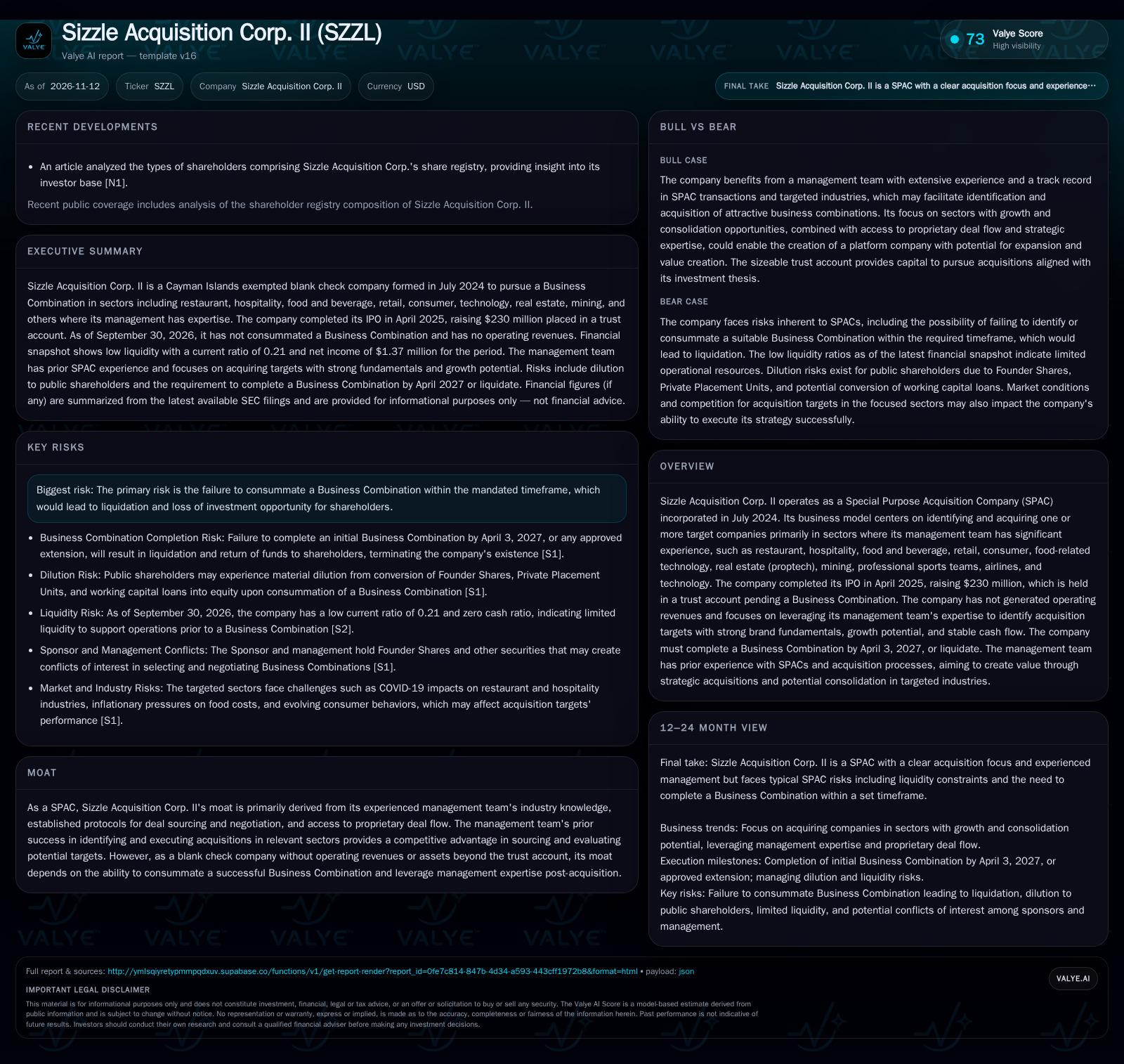
Sizzle Acquisition Corp. II (SZZL) is a SPAC with $230 million in trust and a management team targeting sectors such as hospitality, retail, and technology. No Business Combination has been announced, and the company must complete one by April 2027 or liquidate. The investment case now pivots on deal execution and the ability to leverage management’s sector experience.
Sizzle Acquisition Corp. II is at a critical juncture typical of late-stage SPACs: flush with $230 million in trust yet facing a shrinking timeline to consummate a Business Combination before forced liquidation in April 2027. While the company’s management brings a track record in SPAC transactions and deep sector expertise, the window for sourcing and closing an attractive acquisition is narrowing.
Sizzle’s Current Position: Trust Levels, Timeline Challenges, and Liquidity Constraints
As of November 2026, Sizzle Acquisition Corp. II holds $230 million in trust from its April 2025 IPO, with no operating revenues or Business Combination completed to date [S1]. [S2] The SPAC must complete a qualifying acquisition by April 3, 2027, or be forced to liquidate and return funds to shareholders [S1]. These facts frame a classic SPAC race against the clock, with Sizzle’s public shareholders also facing material dilution risk from founder and private placement shares if a combination is consummated [S1].
Understanding SPAC Economics: Potential Paths to Value Creation or Erosion
Sizzle’s business model is typical of SPACs: raise capital in trust, identify an acquisition target, merge, and transition to an operating company. Until a Business Combination, the company generates no operating revenues and incurs minimal but recurring expenses (legal, regulatory, administrative). The trust account capital is restricted and can only be used for an acquisition or returned in liquidation. Operational liquidity is therefore tight—most SPACs rely on sponsor loans or advances for working capital, which can further dilute public shareholders if converted to equity upon deal completion [S1].
Post-merger, the economics hinge on the acquired company’s revenue, cash flow, and growth prospects. If management can source a business with stable free cash flow, strong brand fundamentals, and consolidation potential, Sizzle could benefit from platform economics: leveraging fixed costs, cross-selling, and potential follow-on acquisitions. However, deal structure, valuation, and redemptions are critical—overpaying or facing high shareholder redemptions can erode the trust pool and limit the new entity’s growth capital. The risk of dilution from sponsor and founder shares also looms large, particularly if the eventual deal is not perceived as accretive by the market.
Navigating a Saturated SPAC Market and Building a Defensible Platform
Sizzle’s competitive edge, if any, derives from its management’s prior SPAC and sector experience, which could provide differentiated deal sourcing and negotiation capabilities [S1]. The stated focus on sectors such as hospitality, food and beverage, retail, proptech, and technology is broad, but aligns with areas where consolidation and platform strategies can work—provided the right target is found.
However, competition is fierce: scores of other SPACs, private equity funds, and strategics are chasing similar targets, often inflating valuations and compressing post-merger returns. The flexibility to pursue targets across multiple sectors and geographies is an advantage in theory, but can dilute focus and make it harder to build a coherent post-merger platform. The moat, such as it is, rests on management’s network and ability to identify proprietary or off-market deals. Without a clear or unique sourcing edge, Sizzle risks being a price taker in a crowded market, or left without a deal as the deadline approaches.
Value Potential When Sizzle Secures a Platform Amid Consolidation Trends
The bull case for Sizzle is built around a high-quality Business Combination that leverages management’s expertise to acquire a business with strong fundamentals, recurring cash flows, and room for consolidation in a fragmented market. If Sizzle can secure such a target—preferably at a rational valuation and with limited redemptions—the merged entity could use its public currency for follow-on acquisitions, benefiting from operational leverage and sector tailwinds.
Evidence supporting this scenario would include an announced LOI or merger with a credible, growing platform business in a sector where management has a track record, coupled with a low redemption rate and clear post-merger growth plan. Strong sponsor alignment (such as additional capital infusion or extended lockup periods) would further validate the upside case. Falsification would come from a deal announcement with a subscale, low-growth, or highly speculative target, or from heavy redemptions that leave the post-merger entity undercapitalized.
A Likely Scenario: Deal Pressures with Varied Shareholder Outcomes
The likeliest outcome for Sizzle is a negotiated Business Combination in 2026 or early 2027, as the SPAC approaches its deadline. In this scenario, management may feel pressure to close a deal—even if it means accepting less favorable terms or a less differentiated target. The resulting transaction could involve a business with moderate growth prospects in a familiar sector, but at a valuation that leaves limited upside for public shareholders after accounting for dilution and redemptions.
Confirming evidence would be a rushed or mid-tier target announcement, with founder and sponsor shares converting and a significant portion of public shareholders opting for redemption. The merged entity may still benefit from management’s operational expertise, but the initial post-merger trading could be volatile, and long-term value creation would depend on execution and the sector’s underlying growth. Falsification would be evidence of no deal progress or a failed shareholder vote, increasing the risk of liquidation.
Risks of Liquidation and Shareholder Dilution in Adverse Situations
The principal risk for Sizzle is failure to consummate a Business Combination by the April 2027 deadline, triggering mandatory liquidation and return of trust funds to shareholders [S1]. In this scenario, public shareholders would get their pro rata share of the trust (less any permitted expenses), but would forgo any upside from a successful deal. Sponsor and private placement shares would be rendered worthless.
Alternatively, a last-minute deal with a suboptimal target may be rushed through with high dilution and heavy redemptions, leading to a thinly capitalized post-merger company with limited growth prospects. Confirming evidence for this downside would include continued lack of deal activity as the deadline nears, negative shareholder sentiment, or the announcement of a speculative or distressed target. Falsification would require clear progress toward a credible deal or evidence of robust deal flow in the sectors Sizzle targets.
Key Milestones and External Influences Shaping Sizzle’s Outlook
Announcement of a Letter of Intent (LOI) or definitive agreement for a Business Combination, particularly in sectors aligned with management’s expertise.
Shareholder redemption rates upon deal announcement—high redemptions would signal lack of confidence and weaken the post-merger balance sheet.
Valuation and capital structure of the proposed merger target, including any additional PIPE (private investment in public equity) financing commitments.
Evidence of sponsor alignment, such as lockup extensions, additional capital commitments, or voluntary forfeiture of founder shares.
Updates on regulatory or shareholder vote milestones related to Business Combination approval.
Disclosure of any working capital loans or additional sponsor advances, and the terms under which these may convert to equity.
A useful metric would be the quality and size of the acquired target’s revenue, cash flow, and margin profile, if disclosed.
Disclaimer: This is research-only, informational analysis and not investment advice. It may include AI-generated interpretation and general industry context. Always verify important details using primary sources.

Comments