
Hims & Hers: Subscription Health at Scale—Margin Pressure, Platform Evolution, and the Next Phase of Digital Care
Hims & Hers Health’s integrated telehealth platform and recurring-revenue model have enabled rapid expansion across digital health verticals, but Q3 2026 results reveal margin pressure, regulatory scrutiny, and the operational complexity of scaling both product breadth and geographic reach. The next chapter hinges on execution in AI-driven personalization, cost management, and regulatory navigation.
Hims & Hers Health’s Q3 2026 miss on revenue and earnings underscores the operational and financial challenges of scaling a subscription-based digital health platform. While the company is investing in AI and international expansion, it faces margin pressure, increased regulatory risk—including an FTC lawsuit—and complex integration demands from new offerings and markets. The durability of its recurring revenue model and the effectiveness of strategic shifts, particularly in weight loss and preventive care, will determine whether recent setbacks are temporary or structural.
Hims & Hers Health, Inc. has built a recognizable consumer brand in digital health by combining telehealth, pharmacy fulfillment, and direct-to-consumer engagement—generating recurring revenue through subscriptions for a range of chronic and lifestyle conditions. However, the Q3 2026 earnings miss and net loss highlight the challenge of sustaining growth and margins as the platform expands into new therapeutic areas and geographies. Regulatory scrutiny, exemplified by a multi-state FTC lawsuit, and the need for ongoing investment in technology and compliance, create a complex path forward. The company’s next phase will test whether its integrated model can deliver both scale and profitability—or whether the friction of regulation, competition, and operational complexity will erode its early-mover advantage.
Recent Performance Highlights Strain Between Scale and Profitability
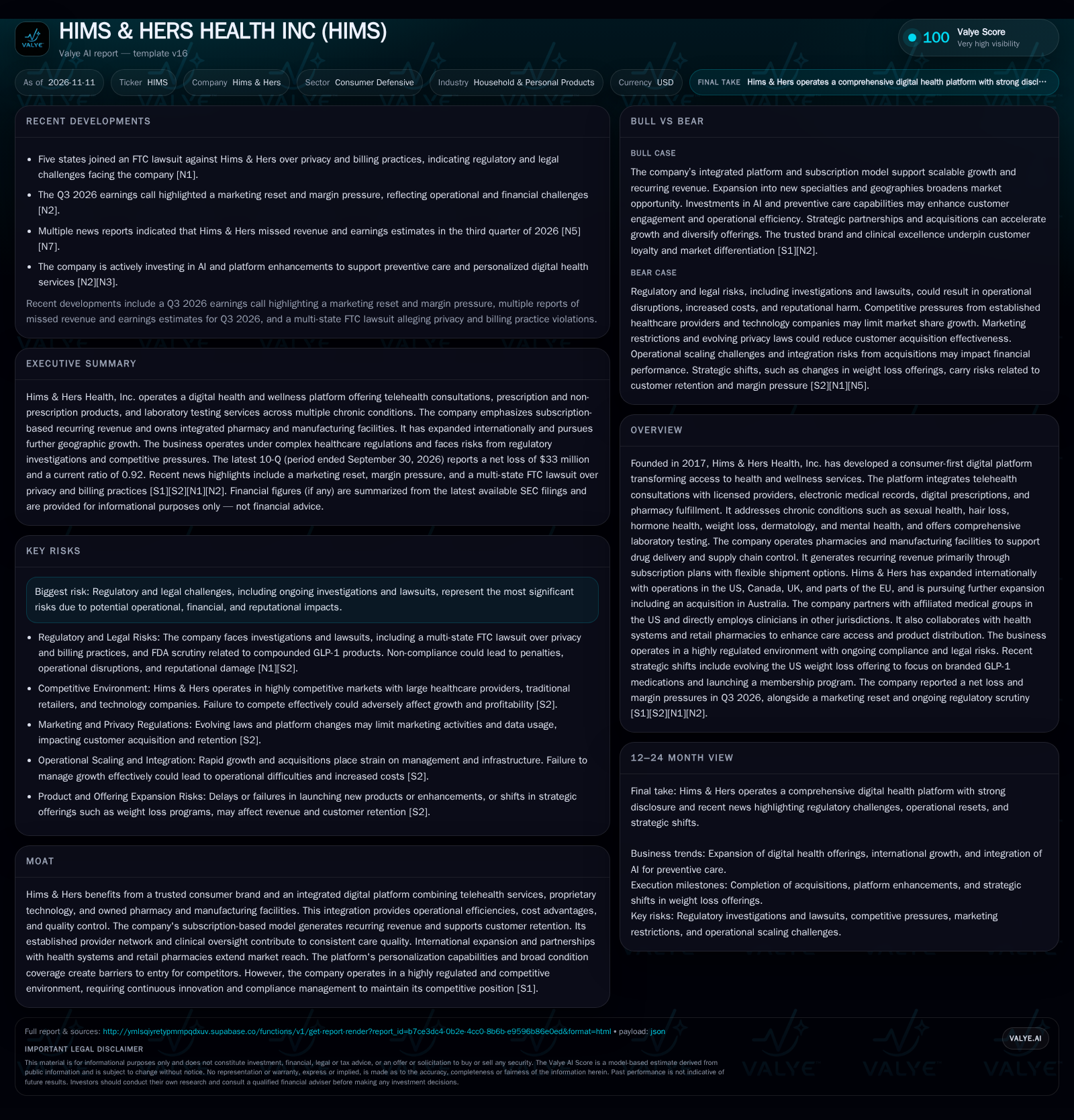
In Q3 2026, Hims & Hers reported a net loss of $33.04 million and basic/diluted EPS of -$0.14, with a current ratio of 0.92 and $605.6 million in cash and equivalents [S2]. These results missed both revenue and earnings estimates for the quarter [N5] [N7]. The company is facing intensified regulatory scrutiny, as evidenced by a multi-state FTC lawsuit over privacy and billing practices [N1]. Operationally, Hims & Hers is shifting its US weight loss strategy to focus on branded GLP-1 drugs with a new membership model, while investing in AI-driven platform enhancements and expanding internationally, including a pending acquisition in Australia [S1] [N2] [N3]. These developments collectively underscore the tension between rapid expansion, regulatory complexity, and the need to achieve sustainable margin improvement.
Subscription Revenue, Vertical Integration, and Margin Levers in Digital Health
Hims & Hers primarily generates revenue through subscription-based plans that provide recurring shipments of prescription and non-prescription health products, telehealth consultations, and laboratory testing [S1]. This model offers attractive revenue visibility, but it also ties the company’s top line to customer retention and ongoing engagement. The direct-to-consumer approach, supported by owned pharmacy and compounding facilities, allows for margin capture across the value chain and some control over cost of goods sold.
However, the economics of digital health subscriptions are sensitive to customer acquisition costs (CAC), churn, and regulatory compliance expenses. As Hims & Hers expands into higher-acuity and more regulated therapeutic areas (e.g., branded GLP-1s for weight loss), gross margin pressure may increase due to higher drug costs, additional clinical oversight, and complex reimbursement dynamics. AI investments could eventually yield operating leverage by automating clinical triage, personalization, or back-end workflows, but these savings may be offset in the near term by increased compliance, marketing, and technology costs.
The company reported cash and liquidity metrics for the period; these figures do not by themselves establish operating runway, investment capacity, financial flexibility, or financing capacity. [S2] The capital intensity of regulatory compliance, pharmacy operations, and international integration may limit near-term free cash flow even if revenue continues to grow.
Consumer Brand Strength Versus Entrenched Healthcare and Tech Players
Hims & Hers has differentiated itself through a trusted, consumer-facing brand and an integrated digital platform that combines telehealth, pharmacy, and personalized care [S1]. This positioning enables direct engagement and customer stickiness, particularly in stigmatized or convenience-driven health categories like sexual health, hair loss, and weight management.
The company faces intense competition from multiple fronts: traditional healthcare systems with telehealth divisions, retail pharmacy giants, specialized digital health startups, and large technology platforms entering virtual care. Many of these competitors possess deeper clinical infrastructure, larger marketing budgets, or broader geographic reach. The barriers to entry in digital health—compliance, clinical quality, and data security—are high, but not insurmountable for well-capitalized rivals.
Hims & Hers’ vertical integration (including owned compounding/manufacturing) and broad condition coverage provide some operational advantages, but regulatory and privacy risks are persistent counterforces. Its ability to maintain a differentiated, trusted experience while scaling internationally and moving up the clinical complexity curve will be central to sustaining its competitive position.
If Platform Personalization and Preventive Care Drive Retention and Expansion
The most favorable outcome for Hims & Hers would see its investments in AI and platform enhancements translate into superior customer engagement, lower churn, and increased cross-sell across chronic and preventive care categories [N2] [N3]. If the company can demonstrate that personalized digital health journeys—supported by owned pharmacy and integrated clinical oversight—drive measurable improvements in health outcomes and customer satisfaction, it could justify premium pricing and deepen lifetime value.
Successful execution in the branded GLP-1 weight loss vertical, including robust adherence and low adverse-event rates, would serve as a proof point for managing more complex, regulated therapies. International expansion, if paired with efficient localization and regulatory navigation, could unlock new markets without disproportionately increasing compliance costs.
Evidence of upside would include improving gross margins despite product mix shifts, declining CAC as AI-driven personalization takes hold, and regulatory settlements or resolutions that reduce headline risk. Sustained revenue growth alongside narrowing losses or a return to profitability would further validate the model.
Navigating Margin Pressure and Regulatory Friction While Pursuing Growth
The most plausible trajectory is one where Hims & Hers continues to grow revenue through new product launches, international expansion, and ongoing subscriptions, but faces persistent margin pressure and elevated compliance costs. The company may achieve modest operating leverage from AI and process improvements, but these gains are partially offset by increased spend on regulatory, legal, and integration-related activities.
Customer acquisition could remain expensive as competition intensifies and marketing channels become more regulated. The balance between expanding into new therapeutic areas and maintaining regulatory compliance will likely limit the pace of topline acceleration. The weight loss business, while a potential growth driver, could deliver only incremental margin improvement if branded GLP-1 drug costs remain high and clinical oversight requirements are stringent.
Confirmation of this scenario would come from continued net losses but narrowing operating deficits, stable or improving gross margins, and evidence of international market traction. Conversely, sustained margin erosion, regulatory setbacks, or a sharp increase in churn would suggest the business is struggling to scale profitably.
Escalating Compliance Costs and Churn Overwhelm Recurring Revenue
A negative scenario could unfold if regulatory and legal costs rise faster than anticipated—driven by ongoing FTC actions, privacy law changes, or operational compliance failures. This could lead to increased customer churn or restrictions on marketing and data use, directly impacting revenue growth and retention.
If the shift to branded GLP-1s in weight loss fails to deliver customer retention or if adverse events undermine trust, the company could experience both top-line stagnation and bottom-line deterioration. Integration missteps in new markets or product categories could strain management bandwidth and dilute the effectiveness of the core platform.
Confirmation of downside would include accelerating net losses, deteriorating gross margins, regulatory fines or settlements, and a slowdown in new customer acquisition despite continued investment. Evidence of increasing customer complaints, reputational hits, or forced changes to business practices would further validate this risk.
What Will Determine Whether Hims & Hers Can Scale Profitably?
Gross margin trends, especially as the product mix shifts toward higher-cost therapies like branded GLP-1s, would help reveal whether vertical integration and pricing power can offset regulatory and clinical expense.
Churn and retention metrics—if disclosed—are critical to assessing the durability of the subscription model and the impact of marketing or product changes.
Customer acquisition cost (CAC) and payback period: Monitoring how these evolve as marketing channels and regulatory regimes shift will be telling.
Resolution progress on the FTC lawsuit and any additional regulatory investigations will signal the company’s ability to manage headline and compliance risk.
Profitability of international operations and the integration pace of new markets, such as the pending Australia acquisition, would indicate the scalability of the platform abroad.
Evidence of AI-driven process or clinical efficiency gains—such as reductions in manual triage costs, improved personalization, or higher engagement rates—would help test the thesis that technology investment yields leverage.
Adoption and adherence rates for new membership models in weight loss or other chronic conditions, as these are likely to affect both unit economics and customer lifetime value.
Disclaimer: This is research-only, informational analysis and not investment advice. It may include AI-generated interpretation and general industry context. Always verify important details using primary sources.

Comments