
Turning Point Brands in Late 2026: Brand Leadership, Regulatory Complexity, and the Changing Landscape of Alternative Nicotine Products
Turning Point Brands commands iconic positions in rolling papers and chewing tobacco, but faces mounting regulatory costs and shifting consumer preferences. Its asset-light model and broad distribution are strengths, yet evolving FDA oversight and profit pressures raise questions about the sustainability of its current economics.
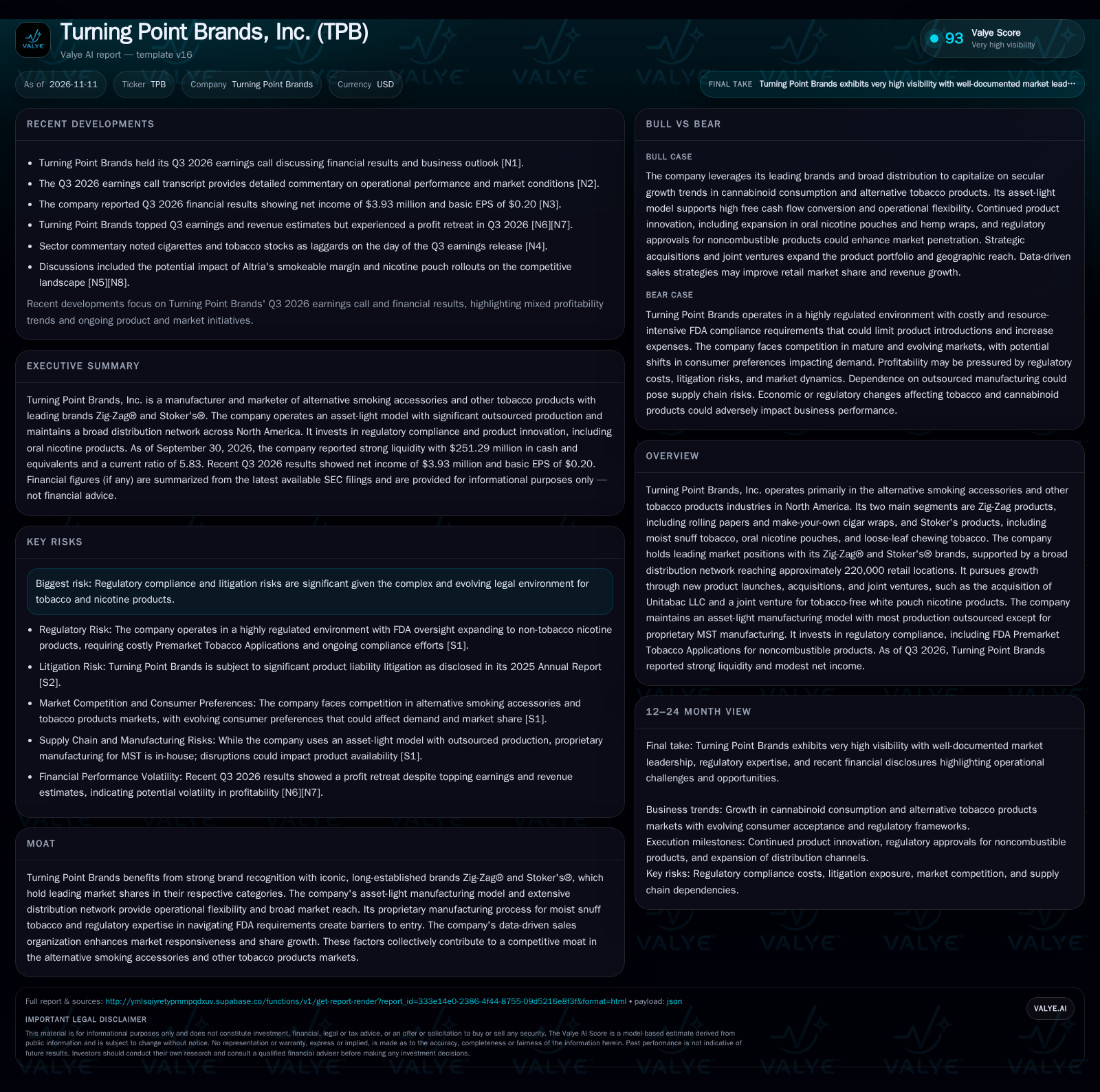
Turning Point Brands holds leading shares in U.S. rolling papers and chewing tobacco, leverages an asset-light manufacturing approach, and maintains reported liquidity position. However, Q3 2026 saw a profit retreat despite topping revenue estimates, as regulatory compliance costs and evolving consumer trends challenge margins. The company's ability to drive growth through product innovation and regulatory navigation will determine its forward trajectory. [S1] [S2] [N6] [N7]
Turning Point Brands, Inc. stands as a dominant force in North America's alternative smoking accessories and tobacco products sector, with household brands Zig-Zag and Stoker's anchoring its portfolio. The company’s broad distribution and asset-light manufacturing have long underpinned operational flexibility. Yet, as regulatory scrutiny intensifies and consumer preferences evolve, Turning Point faces a complex blend of opportunity and constraint. The Q3 2026 profit decline, despite solid sales, spotlights the pressure points of compliance costs and market dynamics. The central question is whether continued product innovation and regulatory navigation can offset mounting headwinds and sustain profitable growth.
Current Facts: Brand Dominance, Profit Pressure, and Regulatory Investment
Turning Point Brands currently holds leading market positions in its core categories: Zig-Zag® is the top premium and overall rolling paper brand in the U.S. with roughly 33% share, and Stoker’s® dominates the loose-leaf chewing tobacco market with 34.1% share and maintains a fast-growing position in moist snuff tobacco. The company’s products reach approximately 220,000 retail locations across North America, benefiting from a wide distribution footprint. [S1]
Financially, the company reported $3.93 million in net income for Q3 2026, but this represented a retreat in profit despite exceeding revenue estimates. As of September 30, 2026, Turning Point Brands had $251.29 million in cash and a current ratio of 5.83, indicating reported liquidity position. [S2] [N6] [N7]
On the regulatory front, the company has invested $34.8 million in FDA Premarket Tobacco Applications (PMTA) for noncombustible products, reflecting the high cost of compliance in a tightening regulatory environment. [S1]
These facts matter because they highlight both Turning Point’s entrenched brand strengths and the intensifying cost pressures from compliance and changing market dynamics. The company’s ability to translate brand leadership into sustained profitability is increasingly tested by regulatory and consumer shifts.
How the Asset-Light Model Shapes Economics and Margin Structure
Turning Point Brands’ core economics are defined by an asset-light manufacturing approach, with roughly 75% of net sales derived from outsourced production. This minimizes fixed capital investment and can enhance free cash flow conversion, but it also creates variable cost exposure and potential supply chain dependencies. The exception is moist snuff tobacco (MST), produced in-house using proprietary processes—this vertical integration may support higher margins in MST, but also introduces operational complexity and fixed cost risk.
Revenue is driven by volume and brand strength in mature product categories (rolling papers, chewing tobacco) and growth in newer segments (oral nicotine pouches, cannabis accessories). The company’s broad distribution to 220,000 North American retail locations provides significant volume leverage, but pricing power is limited by consumer price sensitivity and intense competition—especially as lower-priced alternatives and new nicotine delivery formats proliferate.
Operating leverage is potentially available from incremental sales growth, given the variable cost structure. However, regulatory compliance costs (notably the $34.8 million spent on PMTAs) are largely fixed and recurring, weighing on margins. The economics of new product launches—such as tobacco-free pouches or hemp wraps—depend on successful regulatory approval, consumer adoption, and the ability to command premium pricing or expand volume without excessive promotional spend.
Ongoing capital and funding needs are moderate given the model, but major regulatory or litigation events could create step-changes in required investment. The company reported cash and liquidity metrics for the period; these figures do not by themselves establish operating runway, investment capacity, financial flexibility, or financing capacity.
Brand Equity, Distribution Breadth, and the Threat of Substitution
Turning Point Brands’ moat is anchored by the iconic status of Zig-Zag and Stoker’s, both of which enjoy high brand recognition and loyalty in their categories. This confers a degree of pricing resilience and shelf-space priority, making it difficult for new entrants to immediately dislodge the company from retail channels.
The company’s extensive distribution footprint enables scale and reach that most smaller competitors cannot match, while data-driven sales strategies (e.g., use of MSAi analytics) may help optimize market share at the retail level. Its regulatory expertise and track record with PMTAs also create barriers to entry, as navigating FDA processes is costly and complex.
However, these advantages are counterbalanced by several forces: consumer preferences are shifting toward alternative nicotine products (such as pouches, vapes, and cannabis derivatives), which are often subject to less brand loyalty and more rapid innovation cycles. Regulatory changes could also level the playing field by imposing similar compliance costs on all players or by restricting certain product formats. Substitution risk is heightened by the availability of lower-cost or novel alternatives, especially among younger adult consumers.
Peer competitors include both established tobacco firms with broad portfolios and focused specialty brands in the cannabis and nicotine pouch segments. The company’s continued relevance depends on defending its core franchises while successfully innovating into new product categories.
If Regulatory Navigation and Product Innovation Drive Profitable Growth
The favorable scenario for Turning Point Brands rests on leveraging its brand equity and distribution to capture secular growth in alternative nicotine and cannabinoid products. If the company can successfully secure regulatory approvals for new noncombustible and oral nicotine products—translating its $34.8 million PMTA investment into market access—while maintaining cost discipline, it could expand its share in higher-growth segments.
Success would be confirmed by accelerating revenue and margin expansion in new product lines (such as tobacco-free nicotine pouches or hemp-derived products), increased shelf presence in both traditional and emerging retail channels, and evidence of higher free cash flow conversion. Regulatory clarity or streamlined PMTA approvals would further de-risk the innovation pipeline.
Falsification of this scenario would come from continued profit stagnation despite new product launches, persistent regulatory delays or rejections, or an inability to gain traction in alternative product formats. Watch for announcements of regulatory wins, strong volume growth in new categories, and improved profitability metrics as evidence supporting the upside.
Sustaining Market Leadership While Managing Margin Headwinds
The most plausible trajectory is that Turning Point Brands maintains its dominant positions in rolling papers and chewing tobacco, delivering steady (if modest) growth from its core franchises. Incremental gains may come from gradual expansion into oral nicotine and cannabinoid accessories, but these segments are likely to remain a small share of total revenue near term.
Margins remain pressured by ongoing regulatory compliance costs and competitive pricing dynamics, resulting in profit volatility similar to the Q3 2026 retreat. The asset-light model continues to support operational flexibility, but does not fully shield the company from compliance-driven cost escalation or shifts in consumer behavior.
Falsification would be signaled by significant market share erosion in core brands, an inability to control regulatory or litigation costs, or sustained declines in net income despite top-line stability.
When Regulatory and Consumer Shifts Overwhelm Brand and Distribution Strength
The adverse scenario unfolds if regulatory costs rise more sharply than anticipated, or if the FDA restricts or delays approval for key new products, effectively throttling innovation. Simultaneously, a rapid shift in consumer preferences away from traditional tobacco and rolling products toward unbranded or illicit alternatives could erode volume and pricing power.
In such a scenario, the company’s asset-light model would offer only limited protection, as fixed compliance and litigation costs would squeeze margins even on declining sales. Supply chain disruptions or adverse trade policy changes could further exacerbate operational stress, especially if they impact the proprietary MST manufacturing operations.
Confirmation would include a pronounced, sustained decline in net income, sharp contraction in core category volumes, regulatory setbacks, and visible liquidity drawdowns. If the company is forced to curtail innovation spending, lose retail placements, or face material litigation outflows, the downside thesis would be further validated.
Milestones and Metrics That Will Define Turning Point Brands’ Resilience
Volume and market share trends in Zig-Zag rolling papers and Stoker’s chewing tobacco—any erosion here would undermine the company’s core economic engine.
Revenue growth and margin contribution from new product categories such as oral nicotine pouches and cannabis accessories—a useful metric would be segment-level disclosure, if provided.
Updates on the status and outcome of key FDA Premarket Tobacco Applications, especially for novel or noncombustible products—these are critical to unlocking new growth.
Trends in regulatory compliance spending and legal expenses—a material increase could signal growing headwinds.
Changes in distribution reach (number of retail locations, new channel penetration), as reported or disclosed.
Evidence of supply chain stability or disruption, particularly in the proprietary MST manufacturing segment—any reported interruption would be a red flag.
Strategic announcements around acquisitions, joint ventures, or new product launches—successes here would indicate operational execution beyond the legacy base.
Disclaimer: This is research-only, informational analysis and not investment advice. It may include AI-generated interpretation and general industry context. Always verify important details using primary sources.

Comments