
FreightCar America in 2026: Customer Concentration, Backlog Dynamics, and the Search for Sustainable Margins
FreightCar America’s return to profitability in Q3 2026 marks a crucial inflection point, but persistent customer concentration, backlog declines, and raw material cost exposures raise questions about the durability of its recovery and its long-term competitive footing in the North American railcar market.
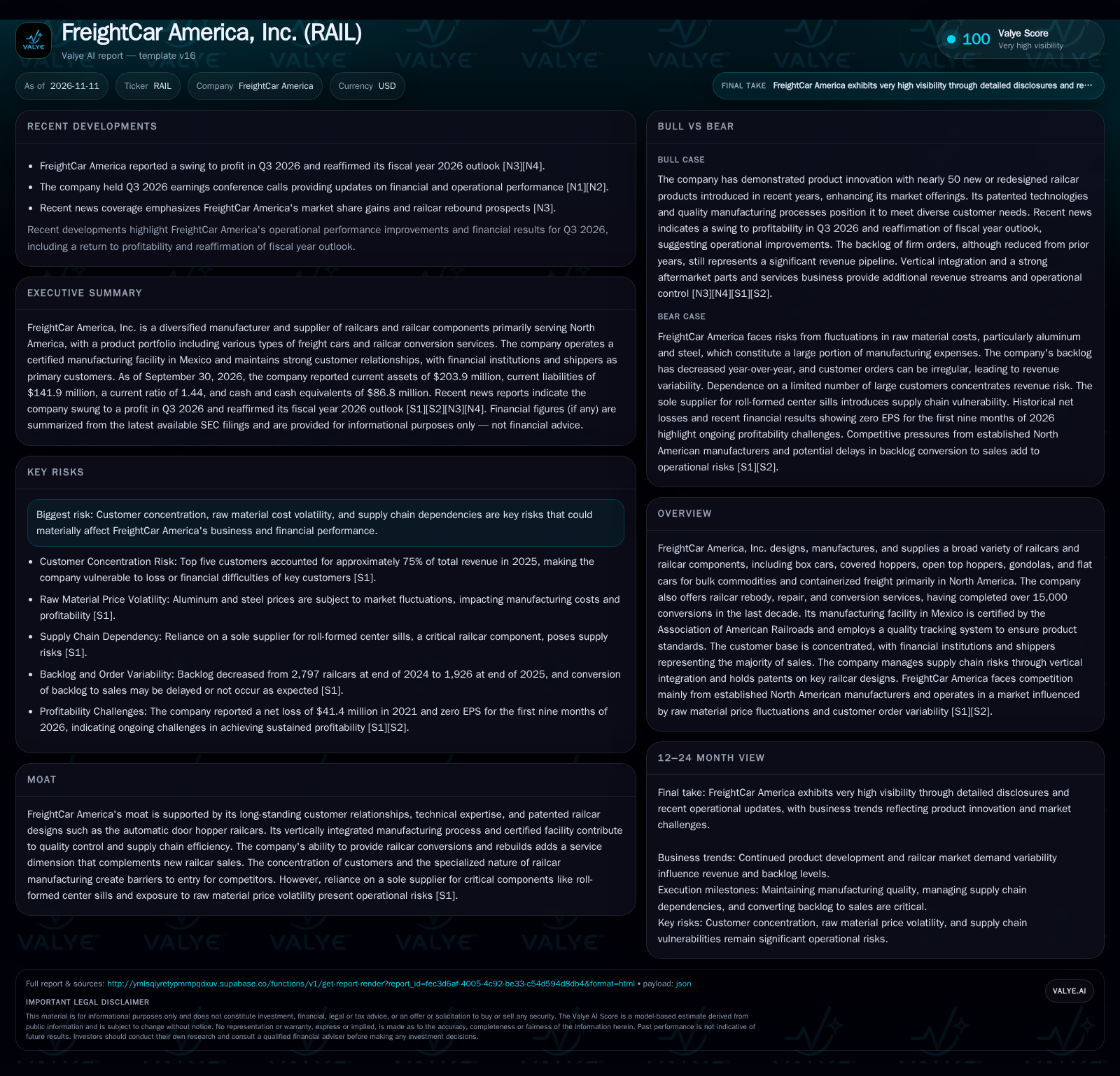
FreightCar America swung to a profit in Q3 2026 and reaffirmed its fiscal year outlook, signaling operational improvement. However, a shrinking backlog, extreme customer concentration, and exposure to steel and aluminum price swings suggest that the company’s recent momentum faces structural headwinds. The durability of its recovery depends on backlog conversion, diversification of its customer base, and its ability to navigate supply chain dependencies and cost volatility.
FreightCar America’s swing to profitability in Q3 2026 offers a rare positive signal in a sector defined by cyclical orders, margin pressure, and relentless cost volatility. Yet, beneath this headline improvement, the company’s customer base remains heavily concentrated, backlog is shrinking, and reliance on a single supplier for key components introduces ongoing vulnerability. With most revenue tied to a handful of financial intermediaries and the railcar order cycle showing little predictability, the company’s ability to sustain its recovery will depend on both operational discipline and progress in broadening its customer and product mix. The next phase will test not only FreightCar America’s manufacturing efficiency, but also the structural resilience of its business model in a market where demand, input costs, and competitive pressure all remain in flux.
Recent Profitability and Backlog Contraction Shape the 2026 Outlook
FreightCar America reported a profit in Q3 2026 and reaffirmed its full-year outlook, marking a notable rebound after several years of inconsistent results and prior net losses [N3] [N4]. However, the company’s backlog fell from 2,797 railcars at the end of 2024 to 1,926 railcars ($137 million) at year-end 2025, indicating a shrinking pipeline of firm future orders [S1]. Customer concentration remains a structural risk, with the top five customers accounting for 75% of 2025 revenue—predominantly financial institutions financing railcar fleets [S1]. Liquidity as of September 2026 stood at $86.8 million in cash and a current ratio of 1.44, but the first nine months of 2026 produced zero EPS, highlighting that profitability may not yet be durable [S2]. These factors collectively define the company’s near-term operating environment—one of operational progress but persistent structural headwinds.
Railcar Manufacturing: Volume, Mix, and Margin Volatility
FreightCar America’s core economics hinge on the manufacture and sale of a broad range of railcars—box cars, hoppers, gondolas, and flat cars—alongside aftermarket conversion and repair services [S1]. Revenue is driven by both new railcar deliveries and value-added rebuilds, with 4,125 railcars delivered in 2025 (3,714 new, 411 rebuilt) [S1]. The mix between new and rebuilt units can materially affect both revenue and margin, as rebuilds typically command lower selling prices but may deliver higher incremental margins due to lower material input and less competitive bidding.
Raw material costs (primarily steel and aluminum) are the dominant variable expense, exposing the company to substantial margin swings when commodity prices shift. FreightCar America attempts to mitigate some volatility through vertical integration of sub-assemblies and by holding patents on specialized car designs, but the company remains exposed to market pricing and supply chain disruptions [S1]. The reliance on a sole supplier for roll-formed center sills—critical in 66% of new railcars built in 2025—adds further risk to cost and production continuity [S1]. Fixed costs are embedded in the operation of its Mexico manufacturing facility, which supports scale but also creates operating leverage: high volumes can improve margins, but volume declines quickly pressure profitability.
Concentration, Patents, and the Challenge of Differentiation
FreightCar America operates in a concentrated North American market dominated by a handful of established railcar manufacturers. Its competitive position rests on several pillars: long-term customer relationships (especially with financial lessors), technical expertise, and a portfolio of patents including automatic door systems for hopper cars [S1]. The company’s ability to offer both new railcars and conversion services creates switching frictions for some customers, particularly those managing large, aging fleets.
However, the competitive landscape is unforgiving—major peers have broader product portfolios, greater scale, and, in some cases, captive leasing arms that deepen customer lock-in. FreightCar America’s reliance on a small set of financial institution customers leaves it vulnerable to shifts in leasing demand and to contract repricing. Product innovation and vertical integration offer some differentiation, but the company’s bargaining power remains limited by customer concentration and the commoditized nature of much of the railcar market.
From Backlog to Margin Expansion: What a Durable Recovery Would Require
A sustained recovery for FreightCar America would require the company to consistently convert backlog into profitable sales, broaden its customer mix, and maintain cost discipline in the face of input price volatility. The most favorable chain of events would involve a stabilization or rebound in railcar orders—perhaps driven by infrastructure investment, increased commodity shipments, or replacement cycles among fleet lessors—that restores backlog to multi-year highs.
Confirmation of this scenario would come from sequential growth in backlog, higher delivery volumes, and an improving sales mix weighted toward higher-margin specialized cars. Margin expansion would likely require either successful pass-through of input cost increases or a more favorable raw material environment. A broadening of the customer base—evidenced by a declining share of revenue from the top five customers—would signal reduced concentration risk. Sustained positive EPS across multiple quarters would further validate the durability of the turnaround.
Order Variability and Margin Compression Define the Most Likely Trajectory
The most plausible medium-term outcome is continued order and delivery volatility, with modest profitability in strong quarters offset by periods of margin compression when volumes or input costs move unfavorably. Backlog levels may remain below historical highs, reflecting a generally tepid railcar replacement environment and the lumpy nature of fleet investment by financial lessors.
This scenario would be confirmed by persistent customer concentration, ongoing reliance on a handful of large contracts, and only incremental improvement in EPS or operating margins. If raw material costs remain elevated or the company is unable to pass through increases, margin pressure could return quickly. The base case assumes the company maintains operational discipline and avoids major supply chain disruptions, but does not fundamentally change its risk profile or competitive standing.
Supply Chain Disruption or Customer Loss Could Trigger a Steep Reversal
A negative inflection could occur if FreightCar America loses a major customer, fails to convert backlog to revenue, or suffers a disruption in its supply chain—particularly concerning its sole supplier for roll-formed center sills. In such a scenario, the company could face sharp volume declines, underutilization of fixed manufacturing assets, and rapid margin erosion.
Confirmation of this downside would be a further drop in backlog, a sudden decline in railcar deliveries, or disclosure of contract losses from key customers. A spike in input costs without the ability to adjust pricing, or a supply interruption that halts production, could also produce negative operating leverage and a return to quarterly losses. The fragility of the customer base and the historical volatility in earnings suggest that downside risks can materialize quickly if external shocks are not managed.
Signals That Will Reveal the Strength (or Fragility) of the Recovery
Backlog levels and order intake, reported quarterly, as leading indicators of future revenue and production stability.
The proportion of revenue attributable to the top five customers—if disclosed—would help assess progress toward diversification.
Railcar delivery volumes by type (new vs. rebuilt) and by customer segment, to understand mix and margin potential.
Gross margin and operating margin trends, especially in relation to raw material price movements.
Announcements regarding alternative suppliers for critical components, particularly roll-formed center sills, as a measure of supply chain resilience.
Price escalation clauses or cost pass-through mechanisms in customer contracts—if disclosed—which would mitigate input cost volatility.
EPS and free cash flow performance across sequential quarters, to validate the sustainability of recent profits.
Any new customer wins, multi-year contract awards, or expansion into new geographies, which would support a longer-term growth thesis.
Disclaimer: This is research-only, informational analysis and not investment advice. It may include AI-generated interpretation and general industry context. Always verify important details using primary sources.

Comments