
Lucid Group’s Expansion Gambit: Technology Edge, Manufacturing Scale, and the Profitability Challenge
With advanced EV technology and ambitious manufacturing expansion in the U.S. and Saudi Arabia, Lucid Group is positioning for scale and broader market access. Yet persistent losses, high capital intensity, and the mid-decade push into new vehicle segments raise fundamental questions about the path to sustainable profitability.
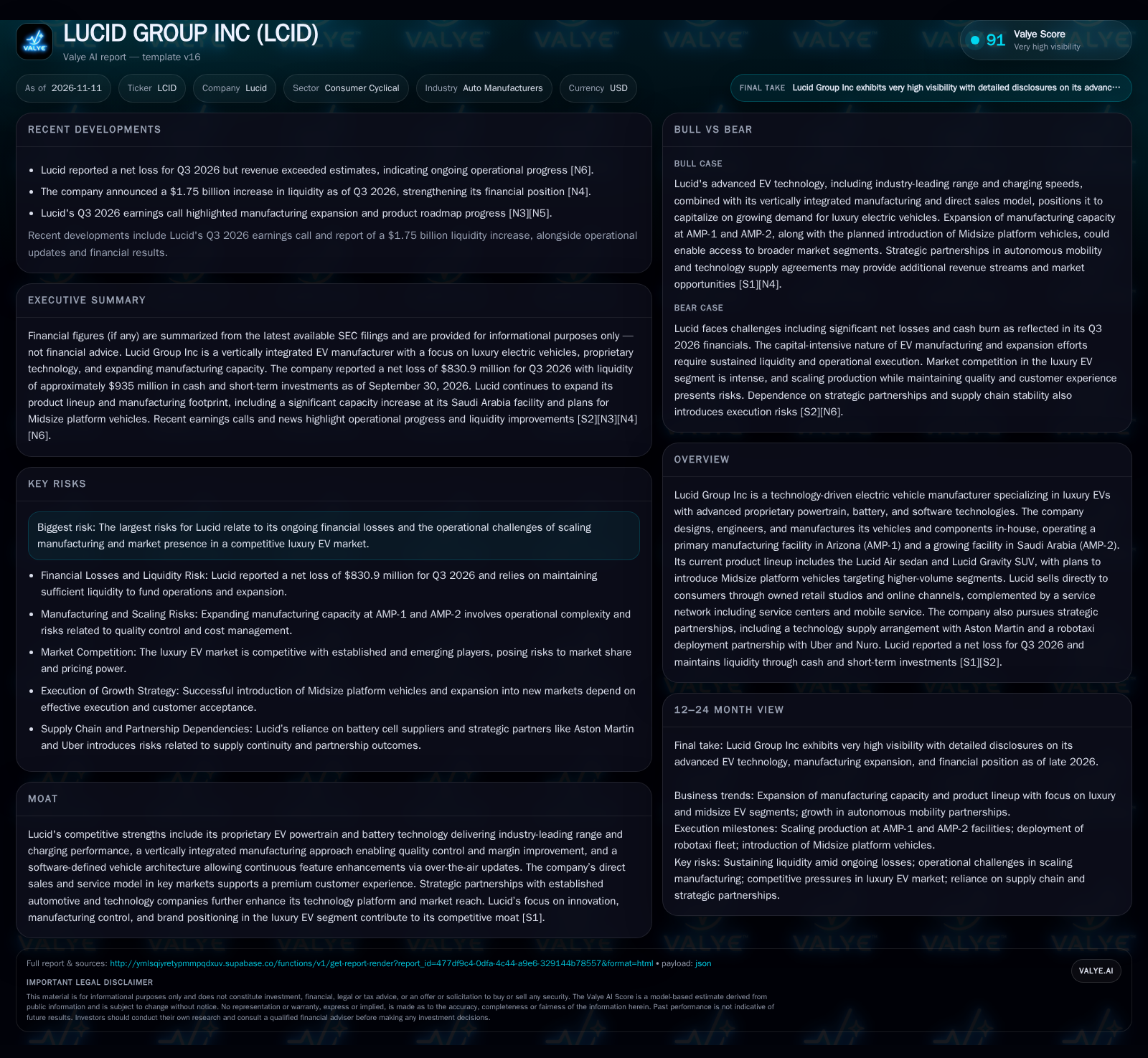
Lucid Group’s Q3 2026 results highlight continued operational progress—revenue beat expectations, and the company secured a $1.75 billion liquidity boost. The manufacturing ramp at its Arizona and Saudi facilities underpins plans to move beyond the luxury niche with upcoming midsize EVs and robotaxi deployments. The next phase hinges on execution, demand for new models, and the durability of Lucid’s technology advantage. [S2] [N3] [N4] [N6]
Lucid Group’s latest financials and operational updates underscore both the ambition and the risk embedded in its business model. The company is betting on proprietary technology, direct sales, and massive manufacturing scale to carve out a durable position in the premium and, soon, midsize EV markets. Recent liquidity raises and product milestones keep the growth story alive, but sustained losses and capital demands highlight the formidable hurdle of turning technological promise into commercial success. The next two years will reveal whether Lucid can translate scale and innovation into profitability before the competitive landscape tightens further.
Lucid’s Q3 2026: Liquidity Bolstered Amid Persistent Losses and Production Ramp
Lucid Group ended Q3 2026 with a net loss of $830.9 million, on quarterly revenue of $200 million that modestly exceeded expectations [S2] [N6]. The company’s cash and short-term investments totaled $935.5 million, and it reported a current ratio of 1.26 and a cash ratio of 0.43 as of September 30, 2026 [S2]. [N4] This context frames the near-term outlook: Lucid is aggressively scaling its Arizona and Saudi production facilities—targeting 90,000 and, eventually, 150,000 vehicles per year respectively—while preparing for the launch of midsize models and large robotaxi deployments [S1]. The company’s ability to convert this operational momentum into sustainable financial performance remains the central uncertainty.
How Lucid’s Vertically Integrated Model Shapes Its Path to Margin Expansion
Lucid’s business model is built on vertical integration—designing, engineering, and manufacturing its EVs and key components, including powertrains and batteries, in-house [S1]. This structure theoretically allows for tighter quality control, the capture of more value per vehicle, and the flexibility to innovate on both hardware and software. Direct-to-consumer sales through owned studios and online channels eliminate dealer margins but concentrate fixed sales and marketing costs on Lucid’s own books.
The economics of Lucid’s current product mix are dominated by the high upfront costs of luxury models (Air sedan, Gravity SUV) and the capital intensity of expanding production capacity. Industry experience suggests that fixed costs (plant, equipment, R&D) weigh heavily until volumes ramp, with gross margin improvement contingent on efficient scaling and favorable pricing. Lucid’s move into midsize vehicles and robotaxis could improve volume leverage, but will likely pressure average selling prices and may introduce more competitive price points.
A critical open question is whether Lucid’s proprietary technology—especially its leading range and charging speeds—can sustain premium pricing and lower warranty/service costs over time. The company’s software-defined vehicle architecture may enable higher-margin, recurring revenue streams from updates and features, but the commercial mechanics of these offerings have not been disclosed. The capital requirements for continued expansion are significant, and while recent liquidity infusions provide near-term support, long-term economics will depend on achieving high-volume production with positive unit margins.
Can Lucid’s Technology and Brand Sustain an Edge in an Intensifying EV Market?
Lucid’s main competitive levers are its proprietary EV powertrain and battery technology—delivering industry-leading range (up to 512 miles EPA-estimated for the Air Grand Touring) and rapid charging—and its software-centric vehicle architecture enabling over-the-air updates [S1]. These features differentiate Lucid in the luxury EV segment, where range anxiety and charging convenience are key purchase drivers. The company’s vertically integrated manufacturing and direct sales model echo the playbook that helped Tesla disrupt the auto industry, but Lucid faces a more crowded and mature market.
Competitive threats stem from both established automakers, who are rapidly improving their EV offerings and leveraging scale, and pure-play EV companies targeting both luxury and mass-market segments. As Lucid introduces midsize vehicles, it will encounter even more intense price competition and potentially lower switching frictions for consumers. Strategic partnerships—such as the technology supply deal with Aston Martin and robotaxi collaborations with Uber and Nuro—may extend Lucid’s reach and diversify revenue, but also introduce execution complexity and dependency risk.
The durability of Lucid’s advantage will hinge on its ability to maintain a tangible technology lead, deliver a consistently premium customer experience, and scale production without sacrificing quality. As battery and powertrain technologies commoditize, branding, customer service, and ecosystem integration could become increasingly important differentiators.
Scenario: Scale, Technology, and New Segments Drive Lucid Toward Profitability
In a favorable scenario, Lucid’s manufacturing ramp at AMP-1 and AMP-2 achieves high utilization, driving down per-unit production costs and enabling positive gross margins on both luxury and midsize models. Successful launches of new vehicles—including the Gravity SUV and midsize platform—expand the addressable market, while robotaxi deployments with Uber and Nuro generate incremental, higher-margin revenue streams. The company’s technology lead in range and charging remains a durable differentiator, supporting premium pricing and strong brand positioning.
Further, if Lucid’s software-defined vehicle architecture translates into meaningful recurring revenue from over-the-air updates and subscription features, the margin profile could improve beyond traditional auto economics. Confirmation of this scenario would come from sequential improvement in gross margin, narrowing net losses, and evidence of robust demand for new models (e.g., strong reservation backlogs or waitlists). Announcements of expanded technology licensing or platform partnerships would further validate the scalability and monetization of Lucid’s intellectual property.
Most Likely Trajectory: Incremental Progress, but Profitability Remains Distant
The most plausible near-term outcome is that Lucid continues to grow deliveries and revenue as new models launch and manufacturing ramps, but persistent net losses and modest gross margins remain headwinds. The company leverages its liquidity to support operating losses and capital expenditures, while gradually increasing vehicle volumes in both luxury and midsize segments. Strategic partnerships provide additional, but not yet material, revenue streams.
Gross margin may improve slowly as fixed costs are spread over more units, but pricing pressure in the increasingly competitive EV market limits upside. The company remains exposed to execution risks in manufacturing, supply chain, and new market entries. Confirmation of this scenario would be quarterly reports showing steady but unspectacular improvement in deliveries, revenue, and gross margin, with continued but narrowing operating losses. Signs of demand elasticity—such as the need for pricing incentives to move midsize models—would reinforce this middle path.
If Volume and Product Expansion Stall, Losses Could Compound and Strategic Options Narrow
In an adverse scenario, Lucid’s manufacturing ramp faces delays, cost overruns, or quality issues, preventing efficient scale-up and leading to persistent negative gross margins. Demand for new models may fall short of expectations, forcing aggressive discounting and eroding brand premium. The robotaxi and technology licensing initiatives could underdeliver, either due to regulatory delays or operational complexity, leaving the core vehicle business as the sole revenue engine.
Liquidity, while recently strengthened, could erode quickly if cash burn remains elevated and external financing becomes more expensive or unavailable. In this environment, Lucid may be forced to curtail expansion plans, delay product launches, or seek partnerships or capital infusions on less favorable terms. Evidence for this scenario would include declining order backlogs, deteriorating gross margin, or warnings about going-concern risks in filings. Any material recall, regulatory setback, or high-profile partnership breakdown would further exacerbate downside risk.
Milestones That Will Clarify Lucid’s Ability to Achieve Scale and Profitability
Quarterly gross margin progression, especially as new models and expanded plant capacity come online.
Reservation and order backlog trends for the Lucid Air, Gravity, and upcoming midsize vehicles, if disclosed.
Utilization rates at AMP-1 (Arizona) and AMP-2 (Saudi Arabia) facilities—actual production versus stated capacity.
Rate of cash burn versus liquidity and any additional capital raises or financing activities.
Evidence of recurring revenue from software-defined features, over-the-air updates, or technology licensing, if disclosed.
Retention and renewal of strategic partnerships, particularly with Uber, Nuro, and Aston Martin.
Any signals of price discounting, incentive spend, or margin pressure as Lucid enters the midsize segment.
Production ramp milestones and quality metrics (e.g., warranty claims, recalls) as volume increases.
Disclaimer: This is research-only, informational analysis and not investment advice. It may include AI-generated interpretation and general industry context. Always verify important details using primary sources.

Comments