
Essential Utilities: Regulatory Growth Engine Faces Merger Uncertainties and Capital Constraints
Essential Utilities delivered Q3 2026 revenue of $508.3 million and net income of $103.8 million, with profit growth driven by rate recovery and gas segment expansion.
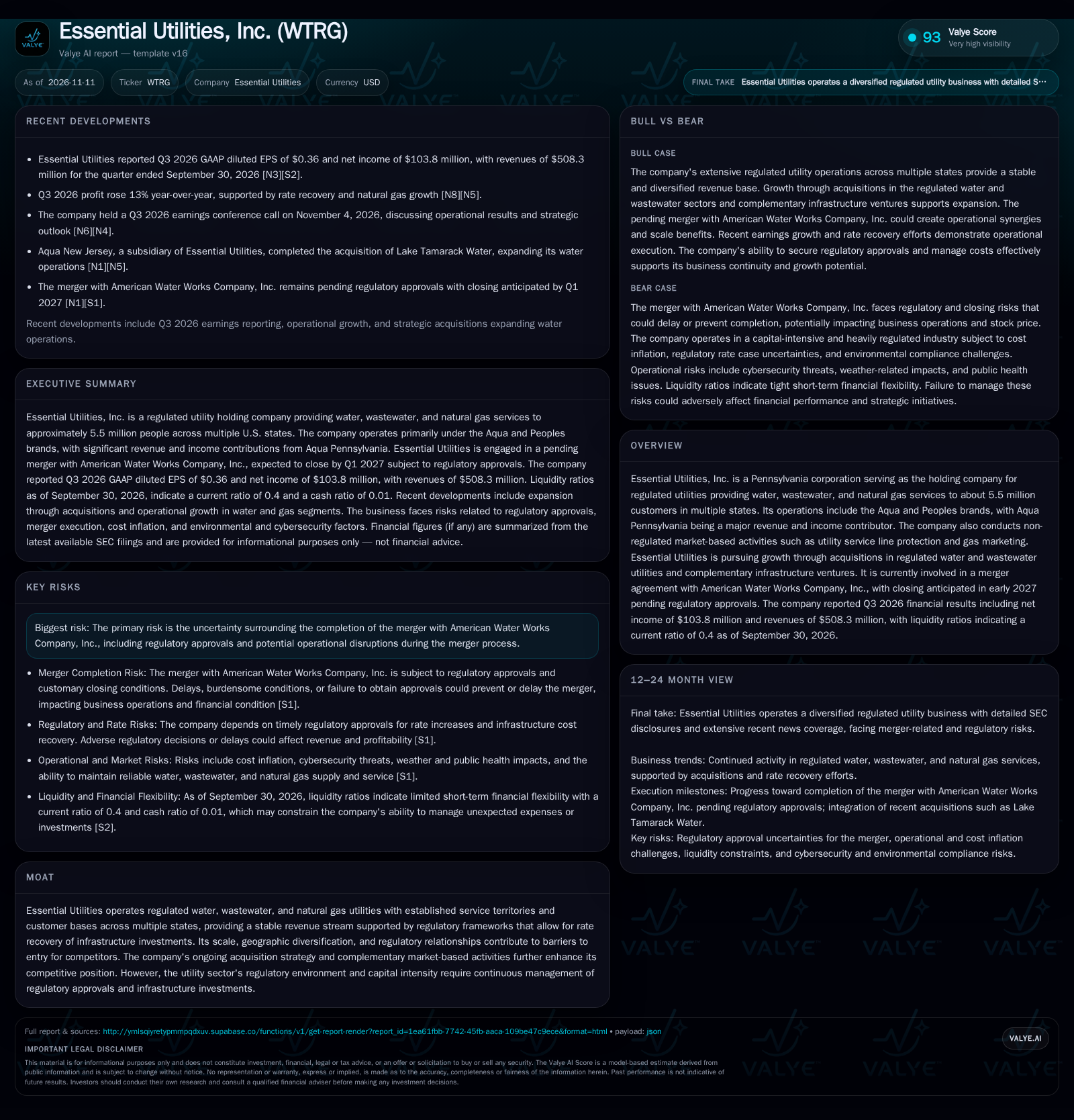
Essential Utilities delivered Q3 2026 revenue of $508.3 million and net income of $103.8 million, with profit growth driven by rate recovery and gas segment expansion. The company is progressing toward a merger with American Water Works but faces regulatory approval hurdles and operates with low short-term liquidity. Recent acquisitions in water and wastewater utilities have modestly expanded the customer base. The outlook hinges on regulatory outcomes, merger execution, and the company's ability to manage cost inflation and capital requirements in a highly regulated, capital-intensive sector. [S1] [S2] [N3] [N5] [N8]
Essential Utilities, Inc. stands at a pivotal juncture as a leading U.S. provider of regulated water, wastewater, and natural gas services across multiple states. The company’s recent financial performance underscores the stability and growth potential of its regulated model, but its ambitions are now defined by the high-stakes merger with American Water Works and the ongoing need to secure regulatory rate relief amid industry-wide cost inflation. With tight short-term liquidity and a capital-intensive growth strategy, Essential’s ability to navigate regulatory processes and execute its integration agenda will determine whether it can deliver on its promise of scale-driven efficiency and shareholder returns.
Recent Results and Strategic Actions Redefine Essential’s Near-Term Trajectory
Essential Utilities reported Q3 2026 revenue of $508.3 million and net income of $103.8 million, reflecting a 13% profit increase year-over-year, with positive contributions from both rate recovery and natural gas segment growth. These results signal operational momentum in the core regulated businesses. [S2] [N5] [N8]
The company is actively expanding through acquisitions, having recently completed water and wastewater system purchases in Pennsylvania and Texas, collectively adding several thousand new customers. While these deals are relatively small in absolute revenue terms, they reinforce Essential’s strategy of incremental, regulated market growth. [S2]
A transformative merger with American Water Works is pending, with shareholder approval secured and regulatory review underway. The transaction, if completed as targeted by Q1 2027, would create one of the largest regulated water utilities in the U.S. but is subject to potential delays or burdensome conditions. [S1] [N1]
The company reported cash and liquidity metrics for the period; these figures do not by themselves establish operating runway, investment capacity, financial flexibility, or financing capacity. [S2]
How Essential’s Regulated Model Generates Returns—and Where Pressure Points Emerge
Essential Utilities’ revenue model is anchored in regulated utility operations, where revenues are determined primarily by state-approved rates for water, wastewater, and natural gas services. This structure provides a high degree of revenue visibility and stability, as customer demand is inelastic and service territories are protected by regulation. The company’s largest operating subsidiary, Aqua Pennsylvania, accounts for a majority of water segment income, illustrating the outsized importance of specific state regulatory environments. [S1] [S2]
However, capital intensity is a defining feature. Infrastructure investments—pipelines, treatment plants, and distribution networks—require significant ongoing outlays, which must be recovered through periodic rate cases. This regulatory lag can create cash flow mismatches, particularly if cost inflation outpaces allowed returns or if rate increases face political or procedural delays.
Essential’s operating leverage is moderate: while the fixed asset base is high, incremental customer additions (especially through tuck-in acquisitions) can yield margin expansion if regulatory approval for cost recovery is efficiently managed. Non-regulated activities, such as service line protection and gas marketing, offer incremental margin but are not material to the overall economics.
The company’s low current and cash ratios emphasize its reliance on steady cash generation and external debt or equity financing for both maintenance and growth capital. [S2]
Barriers to Entry and Regulatory Moats: Strengths and Vulnerabilities in the Utility Landscape
Essential Utilities benefits from classic regulated utility moats: exclusive service territories, high upfront capital requirements, and regulatory oversight that discourages direct competition. Its multi-state footprint and the scale of Aqua Pennsylvania provide diversification and some negotiating leverage with regulators. [S1]
The merger with American Water Works, if completed, would significantly enhance scale and geographic reach, potentially enabling improved operational efficiency and capital allocation. However, the competitive environment is influenced less by traditional rivals than by the regulatory landscape, which can both protect and constrain incumbents. Regulatory lag, cost disallowances, or adverse rate case outcomes can erode returns even in the absence of direct competition.
Potential substitutes—such as private wells, decentralized wastewater treatment, or alternative heating sources—are generally not practical for most customers, reinforcing demand resilience. However, the sector faces emerging pressures from environmental mandates, aging infrastructure, and public scrutiny over water quality and affordability, which could drive up compliance costs or limit rate base growth.
If Regulatory Approvals Are Secured and Merger Synergies Realized, Scale Could Drive Superior Returns
The most favorable outcome for Essential Utilities would see timely regulatory approval and smooth integration of the American Water Works merger, unlocking operational synergies and a larger, more diversified rate base. In this scenario, Essential leverages its expanded scale to achieve procurement efficiencies, share best practices in rate case management, and accelerate acquisition-driven growth in regulated markets.
Confirmation of this scenario would require clear evidence of regulatory approval without onerous conditions, successful execution of integration plans, and continued positive outcomes in rate recovery across major jurisdictions. Additional indicators would include improvement in operating margins, reduction in per-customer operating costs, and successful refinancing or extension of debt on favorable terms post-merger.
Falsification would come from major regulatory delays, required divestitures, or failure to realize expected cost or revenue synergies in the post-merger period.
Steady-State Utility Economics Persist, but Execution Risks Rise During the Merger Window
The most plausible path is one where Essential continues to operate as a stable, moderately growing regulated utility, with incremental acquisition-driven expansion and periodic rate case wins offsetting inflation and regulatory lag. The company manages to secure needed rate relief in most major jurisdictions, and the merger with American Water Works proceeds—albeit potentially with delays or minor concessions—to close in 2027.
In this scenario, Essential’s earnings and cash flow remain resilient, but short-term liquidity constraints persist, requiring disciplined capital management and continued access to external financing. Operational performance is adequate, but not transformative, with margin expansion limited by cost pressures and regulatory constraints.
Evidence supporting this scenario would include continued revenue and profit growth in line with historical trends, incremental customer additions from new acquisitions, and no major regulatory or operational disruptions. Signs of divergence would be sustained cost overruns, adverse rate case outcomes, or an extended merger delay with associated integration uncertainty.
Regulatory or Integration Setbacks Could Expose Essential’s Capital Structure to Stress
The adverse scenario would be triggered by one or more of the following: failure to obtain timely or favorable regulatory approval for the merger, imposition of burdensome conditions (such as required asset sales or rate freezes), or a sharp deterioration in regulatory outcomes for rate recovery.
Operationally, a major cyber event, environmental compliance failure, or weather-related disruption could further stress cash flows, especially given the company’s low current and cash ratios. In this scenario, Essential might be forced to curtail growth investments, defer maintenance, or seek dilutive external capital.
Warning signs would include public regulatory opposition, legal challenges, credit rating downgrades, or negative trends in working capital and deferred capital expenditure. Confirmation would be a material decline in operating margins, negative free cash flow, or an inability to close the merger as planned.
What Will Determine Essential Utilities’ Ability to Deliver on Its Growth and Integration Thesis?
Progress and timing of regulatory approvals for the American Water Works merger, including any material conditions or required asset divestitures.
Rate case outcomes and timing of rate relief in key jurisdictions, particularly Pennsylvania, Ohio, and North Carolina, as these underpin the economics of the largest subsidiaries.
Post-merger integration execution: evidence of cost savings, operational synergies, or unexpected integration disruptions would help test the scenario.
Liquidity and working capital trends—monitoring short-term cash metrics, refinancing activity, and any reliance on external capital markets.
Acquisition pipeline and execution: continued ability to close and integrate incremental water and wastewater utility acquisitions.
Regulatory or legal challenges, including any public opposition or antitrust reviews that could delay or derail the merger.
Operating cost inflation and infrastructure investment needs versus allowed returns, as reflected in margin and cash flow trends.
If disclosed, trends in customer churn, service reliability, or regulatory penalties would provide additional insight into operational resilience.
Disclaimer: This is research-only, informational analysis and not investment advice. It may include AI-generated interpretation and general industry context. Always verify important details using primary sources.

Comments