
EZCORP in 2026: Pawn Growth, Revenue Diversity, and Digital Integration Dynamics
With the acquisition of SMG expanding its footprint to 1,590 locations across the U.S., Latin America, and the Caribbean, EZCORP faces both fresh growth opportunities and heightened operational and technological risks.
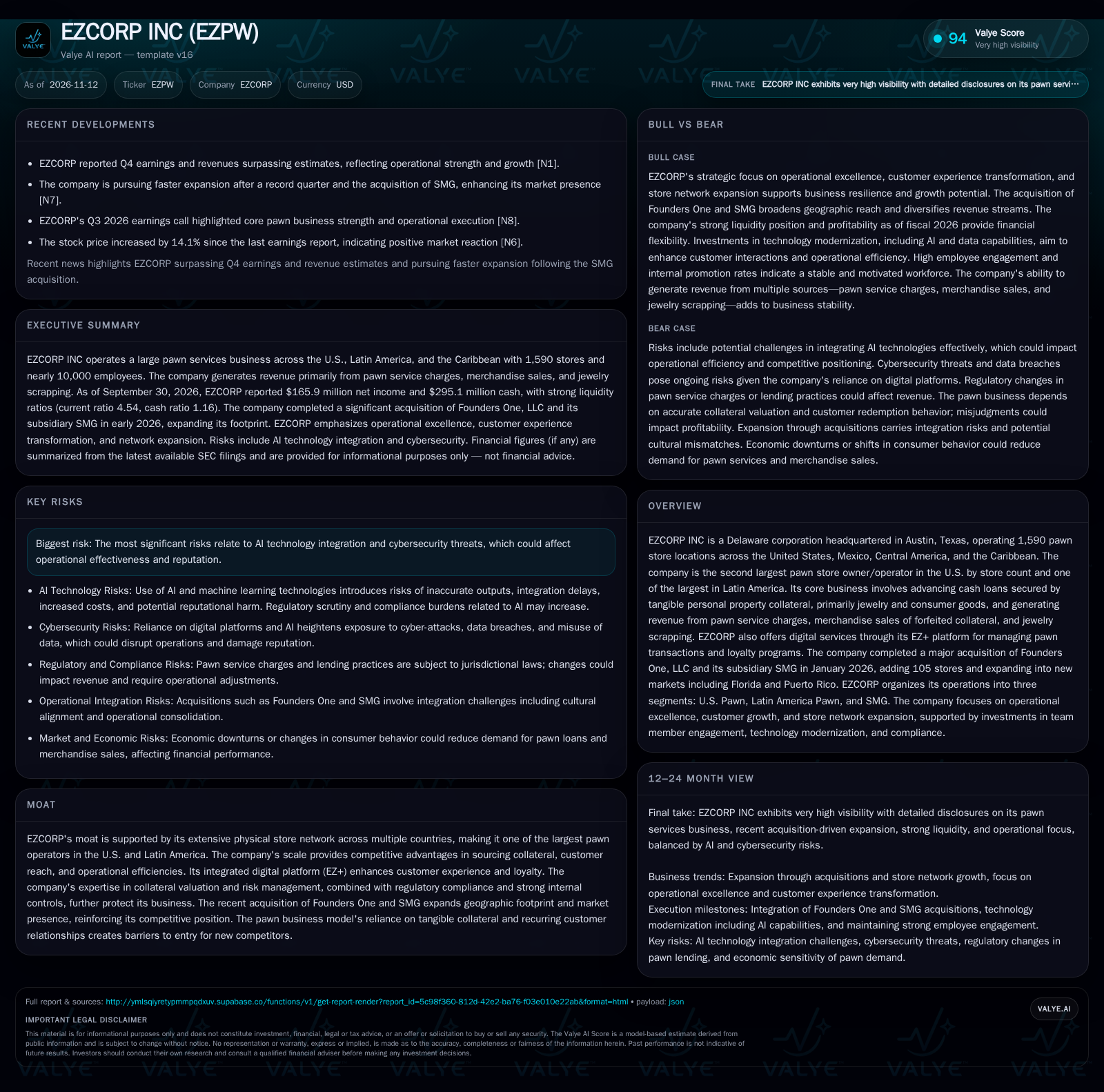
EZCORP is leveraging scale and recent acquisitions to strengthen its position as a leading pawn operator across the Americas. [S1] [N1] [N7]
EZCORP’s evolution from a regional pawn operator to a cross-continental network of 1,590 stores underscores the company’s ambition to leverage scale in a business defined by local knowledge and operational consistency. The recent acquisition of SMG and continued investment in digital capabilities signal a drive to modernize customer engagement and unlock new efficiencies. Yet, as the company navigates the integration of newly acquired stores, manages diverse regulatory environments, and pushes technology adoption, the real test will be whether these moves translate into sustained profit growth and defensible market share—especially as consumer behavior and regulatory scrutiny evolve.
Post-Acquisition Growth, Revenue Composition, and Financial Health
EZCORP’s acquisition of SMG in January 2026 expanded its network to 1,590 pawn stores, making it the second-largest pawn operator in the U.S. and a major player in Latin America and the Caribbean. This expansion brought new markets—most notably Florida and Puerto Rico—into EZCORP’s footprint, reflecting a deliberate strategy to diversify both geography and revenue streams. As of September 30, 2026, EZCORP reported $295.1 million in cash and a current ratio of 4.54, with pawn loans outstanding (PLO) at $402.8 million. Pawn service charges (PSC) remain the backbone of profitability, accounting for 35% of total revenue and 61% of gross profit in fiscal 2026. The integration of SMG’s 105 stores is now complete, with 100% ownership as of July 2026. Recent quarters have seen earnings outperformance and a notable 14.1% stock price increase, reflecting market optimism about the company’s operational execution and growth trajectory. [S1] [N1] [N6] [N7]
Pawn Business Fundamentals Underpin Returns and Risks
The pawn business model is fundamentally a high-frequency, small-dollar lending operation secured by tangible collateral. EZCORP extends cash loans against items such as jewelry and consumer electronics, generating interest through pawn service charges (PSC) that typically range from 12% to 25% per month, depending on jurisdiction. Loans are short-term (typically 30 to 90 days), and unredeemed collateral is sold through in-store channels, with additional revenue from jewelry scrapping. This model creates a dynamic revenue mix: PSC provides recurring, high-margin income when loan balances are high, while merchandise sales and gold/jewelry scrapping monetize forfeited collateral and purchased goods—offering downside protection if redemption rates fall.
Fixed costs (labor, rent, compliance) are significant due to the physical store footprint and regulatory requirements, but scale can deliver operating leverage if loan volumes and sales per store rise. Expansion through acquisitions and new stores requires upfront capital, but the model’s self-liquidating nature (as loans are repaid or collateral is sold) can support relatively rapid capital recycling. However, economic downturns can pressure both pawn demand (if unemployment falls) and the value of collateral (if gold or consumer electronics prices drop), affecting both loan quality and merchandise margins. Technology investments (such as the EZ+ platform and AI tools) may eventually lower transaction costs and improve customer retention, but also require upfront spending and introduce new integration risks.
Competitive Landscape Influenced by Scale, Regulation, and Digital Challenges
EZCORP’s scale—spanning 1,590 stores across the U.S., Latin America, and the Caribbean—confers sourcing, operational, and brand advantages that smaller local operators may struggle to match. Its multi-segment structure (U.S. Pawn, Latin America Pawn, and SMG) helps buffer region-specific shocks and enables cross-market learning. However, the pawn industry remains highly localized: regulatory environments, customer preferences, and collateral valuation expertise all vary by jurisdiction, limiting the direct transfer of best practices and increasing compliance costs.
Digital innovation is emerging as a new battleground. EZCORP’s EZ+ platform aims to deepen customer relationships and drive loyalty, but adoption rates, digital engagement, and transaction migration remain key unknowns. Fintech lenders and alternative credit providers (such as buy-now-pay-later services or payday lenders) threaten to erode share among tech-savvy or banked customers, especially if digital pawn offerings fail to deliver a comparable user experience. The company’s expertise in collateral management, compliance, and in-person service may deter new entrants, but regulatory tightening or disruptive digital models could compress margins or raise the cost of doing business.
Accelerated Integration and Digital Uptake May Boost Earnings Potential
A favorable scenario would see EZCORP successfully integrate the SMG acquisition, realizing operational synergies and accelerating store-level productivity in new markets like Florida and Puerto Rico. If the company leverages its scale to negotiate better sourcing terms, drive down per-store overhead, and optimize inventory turnover, operating leverage could expand margins even as the footprint grows. Widespread adoption of the EZ+ digital platform could reduce transaction costs, increase customer retention, and enable personalized offers or loyalty rewards, differentiating EZCORP from traditional pawn outlets and some fintech competitors.
This upside would be confirmed by rising same-store PSC and merchandise sales growth, improving gross margins, and higher digital engagement metrics (such as the share of transactions or redemptions initiated online). Evidence of successful cross-selling (e.g., product protection plans and jewelry VIP packages) and retention of high-performing employees—supported by internal promotion rates and engagement scores—would reinforce the case for sustainable earnings growth.
Store Growth and Operational Strength Support Ongoing Expansion
The most plausible outcome is that EZCORP maintains steady growth through incremental store openings, disciplined acquisition integration, and operational improvements. PSC remains the dominant profit driver, with merchandise sales and scrapping providing a buffer against fluctuations in pawn loan volumes. Technology investments yield gradual improvements in efficiency and customer experience, but digital adoption is uneven across regions and customer segments, limiting immediate margin expansion.
Revenue and profit growth track the expansion of the store base and incremental gains in same-store performance. Regulatory changes and economic cycles introduce periodic volatility, but the company’s geographic and segment diversification mitigates the risk of severe shocks. Confirmation would come from stable or modestly improving operating margins, consistent cash generation, and continued high employee engagement scores. Evidence of stalled digital migration, integration hiccups, or rising compliance costs would challenge this base case.
Earnings Could Suffer from Regulatory Changes, Digital Shortfalls, or Collateral Value Declines
A bearish scenario would see EZCORP struggle with the complexities of integrating SMG, leading to operational inefficiencies, rising costs, or cultural friction in newly acquired stores. If regulatory authorities in key markets tighten restrictions on pawn service charges, loan terms, or collateral handling, PSC margins could compress and compliance costs rise. A misstep in technology integration—such as cybersecurity incidents, AI model inaccuracies, or low customer adoption of digital tools—could undermine both customer trust and operational efficiency.
A sharp decline in the value of commonly pawned items (such as gold or electronics) would erode collateral recovery rates, forcing markdowns on merchandise sales and reducing the buffer that forfeited inventory provides. This scenario would be confirmed by falling same-store PSC, margin compression, rising shrinkage or loan losses, and negative trends in digital engagement or customer retention. Early warning signs would include regulatory actions, publicized data breaches, or sustained underperformance in newly acquired markets.
Factors Influencing the Long-Term Success of EZCORP’s Expansion
Same-store pawn service charge (PSC) growth rates by segment—if disclosed—would clarify whether integration and operational improvements are translating into higher per-store profitability.
Digital platform engagement metrics, such as the share of transactions conducted via EZ+ or online redemption rates, would help assess progress in digital transformation.
Gross margin trends in both PSC and merchandise sales, particularly in newly acquired markets, would signal the effectiveness of integration and pricing discipline.
Regulatory developments affecting pawn service charge limits, loan terms, or compliance requirements in major jurisdictions could materially impact revenue and cost structure.
Employee turnover rates and internal promotion percentages, especially in SMG-acquired stores, would provide insight into cultural integration and workforce stability.
Customer retention and repeat usage rates—if disclosed—would help test whether loyalty programs and digital tools are building defensible customer relationships.
Trends in collateral value recovery rates (jewelry, gold, consumer electronics) would indicate exposure to fluctuations in resale prices and loan loss risk.
Incidence and impact of cybersecurity events or significant technology integration issues, including AI-related errors or outages, would be critical for assessing digital risk.
Disclaimer: This is research-only, informational analysis and not investment advice. It may include AI-generated interpretation and general industry context. Always verify important details using primary sources.

Comments