
QuickLogic’s eFPGA Ambitions: IP Licensing, Niche Hardware, and the Challenge of Scaling in a Competitive Semiconductor Landscape
QuickLogic is doubling down on embedded FPGA IP and specialized programmable logic solutions for aerospace, defense, and industrial markets.
QuickLogic’s focus on eFPGA IP licensing and niche programmable logic hardware puts it at the intersection of rising demand for secure, flexible acceleration and the realities of a fiercely competitive, rapidly evolving semiconductor market. Recent financials show liquidity strength but underscore persistent operating losses and revenue pressure. The question is whether QuickLogic’s technology edge and government-aligned market focus can drive meaningful adoption and margin expansion before competitive and structural headwinds erode its position.
QuickLogic Corporation stands at a pivotal crossroads as it seeks to commercialize its programmable logic expertise through a dual strategy of embedded FPGA IP licensing and specialty hardware sales. The company’s commitment to mission-critical markets like aerospace and defense, coupled with its patented antifuse and eFPGA technologies, gives it a technical edge in applications demanding security, low power, and reliability. However, Q3 2026 results reveal persistent net losses and underwhelming revenue, highlighting the company’s uphill battle to achieve scale and sustained profitability in a sector where technological advantage alone is rarely sufficient. The next phase for QuickLogic will test whether its differentiated offerings and government-aligned focus can overcome the structural forces that have long constrained niche semiconductor players.
Recent Results: Liquidity Intact, Profit Elusive, and Revenue Lag
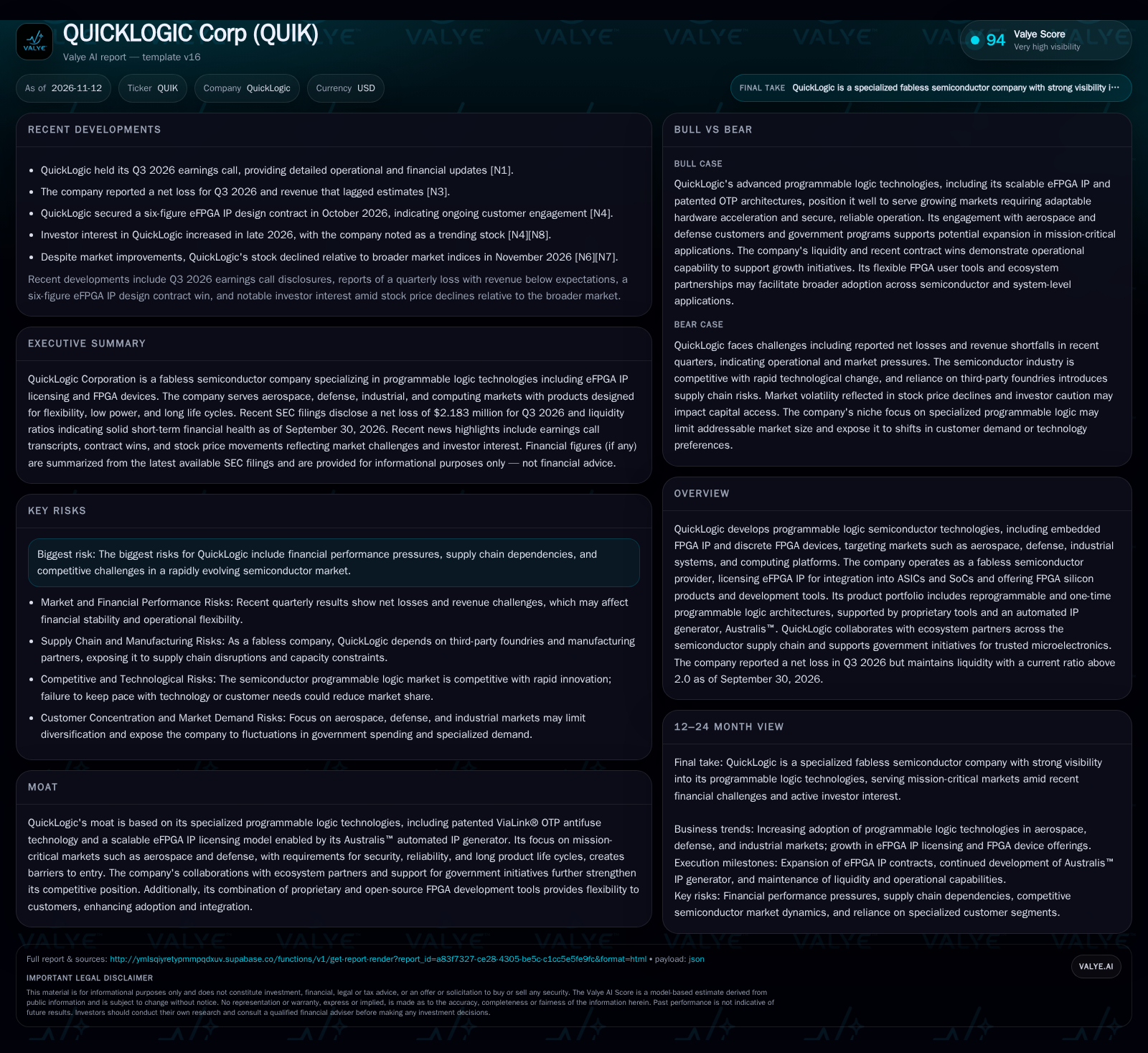
QuickLogic reported a net loss of $2.183 million for Q3 2026, with basic and diluted EPS of -$0.12 per share, and revenue falling short of market estimates [S2] [N3]. The company reported cash and liquidity metrics for the period; these figures do not by themselves establish operating runway, investment capacity, financial flexibility, or financing capacity. Stock price performance has lagged the broader market, reflecting investor caution amid these headwinds [N6] [N7]. Recent contracts in aerospace and defense leverage QuickLogic’s core strengths but have yet to materially shift the financial trajectory [S1].
How QuickLogic’s Model Could Unlock Operating Leverage
QuickLogic’s revenue engine is built on two pillars: licensing eFPGA IP to semiconductor and system companies, and supplying discrete FPGA devices for specialized hardware needs [S1]. The IP licensing model, especially with the Australis™ automated IP generator, offers a path to high-margin, scalable revenue if adoption accelerates: once developed, eFPGA IP can be licensed repeatedly with minimal incremental cost, theoretically driving operating leverage as design wins accumulate. However, up-front customization, integration support, and long sales cycles—especially in aerospace and defense—mean that actual revenue realization can be lumpy and protracted.
Discrete FPGA hardware sales are capital-light due to the fabless model but are typically lower margin and more exposed to pricing pressure and volume volatility. The mix between IP licensing and hardware sales will be a key determinant of gross margin trajectory. Meanwhile, professional services and integration support, while revenue-contributing, are unlikely to drive operating leverage due to their labor intensity.
Fixed costs include R&D for new IP blocks, toolchain development (notably the ongoing investment in Australis™ and open-source tool flows), and the expenses of ecosystem partnership management. Variable costs are dominated by third-party foundry, assembly, and test charges, which QuickLogic cannot easily compress. The company’s ability to shift its revenue mix toward software-like IP licensing, supported by automation and ecosystem leverage, is critical for sustainable margin expansion.
Specialization as Both Moat and Constraint in a Crowded Market
QuickLogic’s competitive position rests on technical differentiation: its eFPGA IP spans a wide range of process nodes (from advanced 12nm and below to legacy 350nm), while its proprietary ViaLink® OTP antifuse technology delivers instant-on, non-volatile, and radiation-tolerant programmable logic—features valued in aerospace, defense, and secure embedded applications [S1]. The Australis™ tool promises to reduce customization friction, making IP adoption more attractive for semiconductor customers needing tailored logic blocks.
However, the programmable logic space is fiercely competitive and dominated by large, resource-rich players offering broad portfolios, deep support, and pricing power. QuickLogic’s focus on mission-critical, low-volume segments creates a defensible niche but inherently limits addressable market size. Its reliance on ecosystem partners for design, foundry, and test introduces supply chain risk and reduces control over cost and schedule.
Potential substitutes include custom ASICs for high-volume applications, as well as programmable logic offerings from larger FPGA vendors, some of whom are moving into embedded IP. Rapid shifts in customer requirements, especially in security and edge AI, could erode QuickLogic’s differentiation unless it continues to innovate and secure new design wins.
Scaling IP Licensing Through Ecosystem Leverage and Government Spend
The bullish scenario hinges on QuickLogic successfully scaling its eFPGA IP licensing business by leveraging the Australis™ automated IP generator and ecosystem partnerships. If Australis™ enables rapid, low-touch customization for a broadening set of semiconductor partners, recurring licensing revenue could ramp with minimal incremental cost, driving margin expansion and improved earnings quality. Success in securing further government and defense contracts—especially as trusted microelectronics and supply chain security become national priorities—could yield high-value, multi-year engagements with limited competition.
Confirmation of this scenario would come from: (a) a rising cadence of eFPGA IP licensing deals with new foundry/process partners and semiconductor customers, (b) evidence of meaningful revenue mix shift toward IP licensing, (c) gross margin expansion, and (d) sustained contract wins in defense, aerospace, and critical infrastructure. Falsification would be indicated by continued revenue concentration in hardware sales, stagnant or declining IP deal flow, or lack of progress in margin improvement.
Incremental Adoption, Persistent Losses, and Niche Market Realities
The most plausible trajectory is one of incremental progress: QuickLogic continues to secure specialized contracts and modest IP wins in aerospace, defense, and select industrial/edge computing markets, but revenue growth remains lumpy and insufficient to fully absorb fixed costs. The mix between hardware and IP licensing stays relatively balanced, with only gradual improvement in operating leverage.
Operating losses persist, albeit potentially narrowing if cost discipline is maintained and professional services or integration fees provide some buffer. Stock performance remains volatile, tracking contract wins and investor sentiment around government/defense technology themes.
Evidence supporting this scenario would include: (a) ongoing but not accelerating contract activity, (b) continued net losses with stable or modestly improving margins, and (c) a lack of clear inflection in IP licensing revenue or customer diversification.
Structural Barriers: Market Share Loss and Margin Compression
In a negative scenario, QuickLogic fails to accelerate IP licensing adoption and remains overexposed to low-margin, project-based hardware sales. Larger competitors increase their focus on embedded programmable logic IP, leveraging scale and established customer bases to win new design slots. Supply chain disruptions or escalating foundry costs further compress margins, while customer concentration in defense or aerospace exposes the company to budget-driven demand shocks.
A continued inability to cover fixed R&D and operating expenses with gross profit could force QuickLogic into further cost cuts or strategic retrenchment, potentially shrinking its product portfolio or slowing toolchain innovation. Investor sentiment weakens as persistent losses and stagnant growth erode confidence.
This scenario would be confirmed by: (a) declining or stagnant top-line revenue, (b) further margin erosion, (c) loss of key contracts or customer relationships, and (d) lack of new design wins in both IP and hardware.
Milestones That Will Define QuickLogic’s Competitive and Financial Trajectory
The number and value of new eFPGA IP licensing agreements signed per quarter—especially with diverse process and foundry partners—would help test the scalability of the Australis™ model and the shift toward higher-margin revenue.
Gross margin trends, particularly the mix between IP licensing, hardware sales, and professional services, would indicate progress toward operating leverage and business model transformation.
Revenue concentration by end-market (defense, aerospace, industrial, computing) and by customer, if disclosed, would clarify diversification risk and exposure to demand shocks.
The cadence and size of new government or trusted microelectronics contracts, particularly those involving radiation-tolerant or secure programmable logic, are critical for sustaining the company’s niche.
Operating expense discipline—especially in R&D and ecosystem/toolchain development—will determine the company’s ability to absorb losses and invest for future growth.
Evidence of successful integration of QuickLogic IP into high-volume SoCs or ASICs, either via customer disclosures or industry partnerships, would validate the value proposition and open a pathway to scale.
Tracking Australis™ tool adoption and customer feedback, where available, would provide insight into ease of use, integration friction, and long-term stickiness of the IP licensing platform.
Stock price and trading volume trends, while not fundamental, could reflect shifts in investor confidence and market perception of QuickLogic’s progress toward sustainable growth.
Disclaimer: This is research-only, informational analysis and not investment advice. It may include AI-generated interpretation and general industry context. Always verify important details using primary sources.

Comments