
Westwater Resources: Building a U.S. Graphite Supply Chain Amid Construction, Market, and Financing Uncertainties
Westwater Resources is advancing its Kellyton Graphite Plant and Coosa Deposit projects to supply battery-grade graphite to U.S. battery manufacturers, leveraging proprietary purification technology but facing significant execution, market, and financial risks.
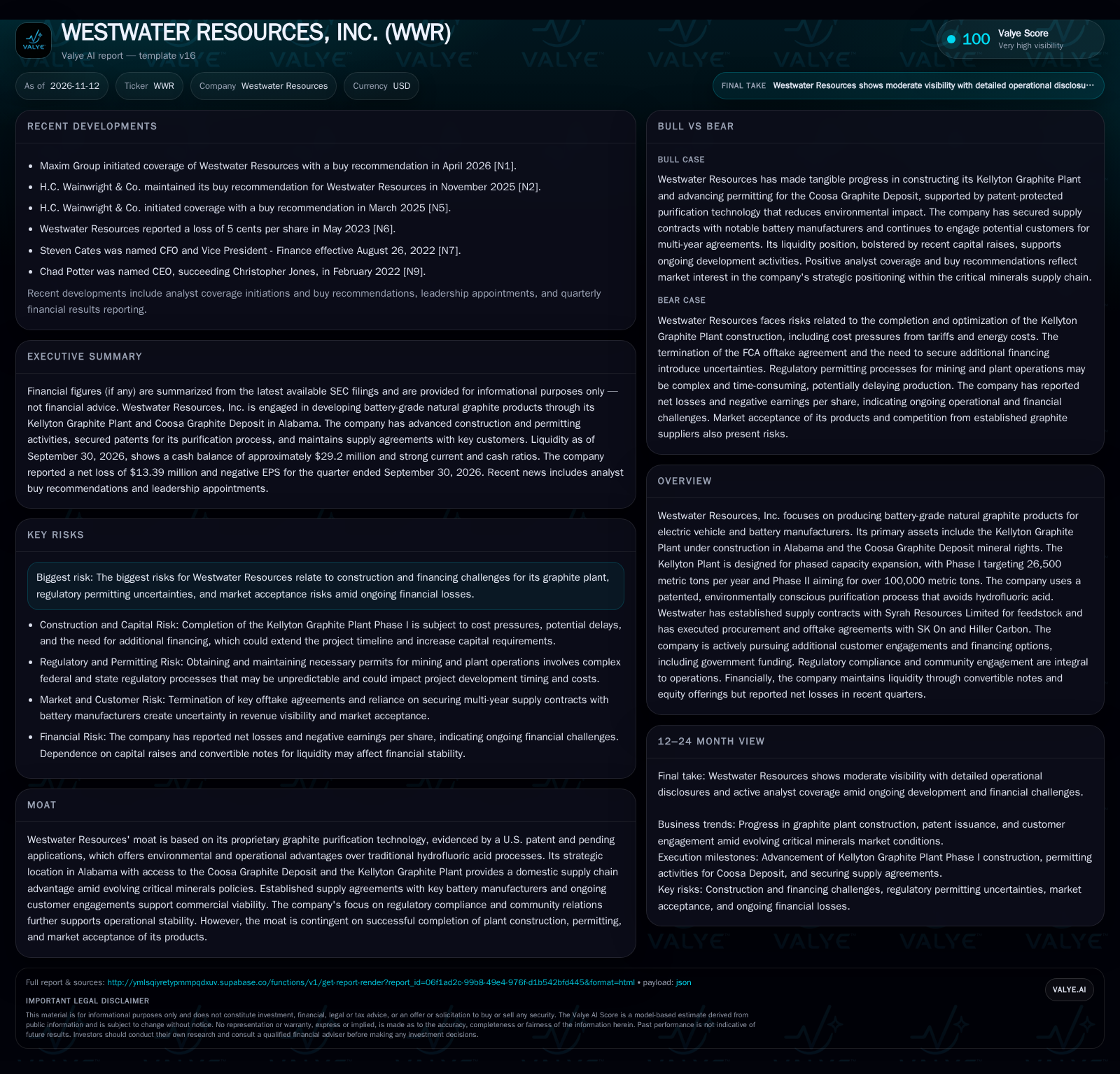
Westwater Resources is developing a domestic supply of battery-grade natural graphite, with Phase I of its Kellyton Plant under construction and a focus on environmentally friendly purification. The company has supply agreements in place but recently lost a key offtake partner, and continues to report losses as it seeks further contracts and funding. Execution on plant completion, customer conversion, and financing will determine commercial viability in the next 12–24 months. [S2]
Westwater Resources, Inc. is positioning itself as a critical link in the U.S. electric vehicle and battery materials supply chain by developing domestic sources of high-purity natural graphite. With the Kellyton Graphite Plant nearing completion of its first phase and a unique purification process that reduces environmental impact, Westwater aims to serve battery manufacturers seeking reliable, local supply. However, the company is still pre-revenue, has recently lost a major offtake partner, and faces ongoing construction and financing challenges. The next two years will be pivotal as Westwater attempts to translate operational milestones into commercial contracts and sustainable economics. [S2]
Recent Developments Redefine Execution and Commercialization Risks
Westwater Resources' current trajectory is shaped by several material developments. The Kellyton Graphite Plant, centerpiece of its strategy, remained under construction through 2025, with Phase I costs totaling $128.2 million and a targeted capacity of 26,500 metric tons per year. The company continues to guide toward a $245 million total Phase I investment, reflecting cost optimization efforts amid persistent capital intensity. [S2]
Commercially, Westwater has secured procurement and offtake agreements with SK On and Hiller Carbon, but experienced a setback when FCA terminated its offtake agreement in November 2025. This loss raises questions about product acceptance and revenue visibility, particularly as the company pursues further multi-year supply agreements for Phase II output. [S2]
On the technology front, Westwater received its first U.S. patent for a purification method that avoids hydrofluoric acid, offering a potential environmental and operational edge. The company maintains a cash balance of $29.2 million as of September 30, 2026, with a reported net loss of $13.39 million for the recent quarter, underscoring the pre-commercial, capital-consuming phase of its business. [S2]
Unit Economics and Capital Requirements in Graphite Production
Westwater’s business model centers on converting graphite concentrate into battery-grade products for sale to battery manufacturers. Revenue potential depends on the volume of graphite processed and sold, product mix (e.g., ULTRA-CSPG™ vs. SG Fines), and negotiated pricing with counterparties. Battery-grade graphite typically commands a premium over industrial-grade material, but pricing is highly sensitive to purity, particle size, and end-use requirements.
The capital structure is asset-heavy: the Kellyton Plant’s first phase alone is projected to cost $245 million, and cumulative investment had reached $128.2 million by end-2025. Westwater has historically funded construction through a mix of convertible notes and equity, raising approximately $67 million in 2025. The company reported cash and liquidity metrics for the period; these figures do not by themselves establish operating runway, investment capacity, financial flexibility, or financing capacity. [S2]
Operating leverage may be significant as production ramps, with high fixed costs (plant, labor, regulatory compliance) spread over a growing output base. However, the pace and reliability of customer contract conversion and production ramp-up will determine whether scale efficiencies can be realized before further dilution or debt is required. Raw material costs are partially de-risked through supply contracts, but Westwater remains dependent on third-party feedstock until Coosa is developed.
Domestic Supply, Patented Purification, and Market Entry Barriers
Westwater’s primary competitive advantage lies in its patent-protected purification process, which avoids hydrofluoric acid and claims a lower environmental footprint. This could appeal to U.S. and European battery customers increasingly focused on ESG compliance and supply chain transparency.
The company’s Alabama location—near major battery manufacturing initiatives—positions it as a potential domestic alternative to offshore graphite suppliers, which currently dominate the global market. U.S. critical minerals policy and incentives may bolster Westwater’s appeal relative to imports, especially from China, which controls a large share of global graphite processing.
However, the competitive landscape is intensifying. Established global suppliers offer scale, price, and reliability, while other U.S.-based graphite projects are also vying for customer contracts and government support. The durability of Westwater’s moat depends on successful plant commissioning, product qualification with demanding battery customers, and the ability to consistently meet volume, purity, and cost targets.
If Ramp Execution and Multi-Year Contracts Converge
A favorable outcome would see Westwater completing Kellyton Plant Phase I on budget, quickly scaling to full nameplate capacity, and converting customer samples into binding multi-year supply agreements. The company’s patented purification process could win over tier-one battery manufacturers, especially if regulatory or customer-driven ESG pressures make domestic, green graphite a procurement priority.
Confirmation of this scenario would come via announcements of additional offtake agreements, evidence of repeat orders or expanded commitments from SK On or Hiller Carbon, and successful qualification of product for high-performance battery applications. Additional government funding or grants could further accelerate development and reduce capital risk.
If realized, operating leverage would improve as fixed costs are absorbed by higher output, supporting a path toward positive cash flow and reduced reliance on external financing.
Commercialization Proceeds in Steps Amid Persistent Capital Needs
The most plausible trajectory is one of incremental progress: Westwater completes Phase I of the Kellyton Plant, but production ramp and customer conversion are gradual. The company secures some additional contracts, but possibly at lower initial volumes or with price concessions to incentivize adoption. The Coosa Deposit’s development advances but remains secondary until Kellyton achieves steady-state operations.
Ongoing net losses are likely as the plant ramps and R&D, SG&A, and compliance costs remain high relative to early revenues. Periodic capital raises may be required to bridge cash needs, with dilution risk if equity markets are unfavorable.
Evidence supporting this scenario would include periodic updates on construction milestones, delivery of additional customer samples, and modest but growing contract wins. Delays in Coosa development or muted customer uptake would tilt the base case toward a slower growth path.
Stalled Ramp, Customer Attrition, and Capital Constraints Threaten Viability
A negative scenario would see continued delays or cost overruns at the Kellyton Plant, leading to missed milestones and increased capital requirements. If product qualification takes longer than anticipated or additional offtake partners withdraw (as FCA did), Westwater could face prolonged pre-revenue operations and mounting financial strain.
In this scenario, the company’s cash reserves would erode rapidly, forcing dilutive equity raises or expensive debt. Failure to secure additional customer contracts or recurring orders would call into question the commercial viability of the purification technology and the sustainability of the business model.
Evidence for this scenario would include further contract terminations, repeated downward revisions to production guidance, inability to raise new capital on acceptable terms, or regulatory setbacks at Kellyton or Coosa.
Testing Westwater’s Trajectory: Execution, Contracts, and Funding
Progress and actual spend versus budget on Kellyton Plant Phase I construction and commissioning, including any update to the $245 million cost estimate.
Announcement and terms of new multi-year offtake agreements, especially with tier-one battery manufacturers or repeat orders from existing partners.
Customer qualification timelines: conversion rate from sample deliveries to binding contracts or recurring orders would help test product acceptance.
Any updates on volume, pricing, or contract duration for SK On and Hiller Carbon agreements, if disclosed.
Securing of government funding, grants, or incentives that could reduce capital requirements or accelerate project timelines.
Development milestones or permitting progress for the Coosa Graphite Deposit, including regulatory or environmental updates.
Quarterly cash burn and runway projections, especially in light of ongoing net losses and pending capital needs.
Evidence of operational issues—such as delays, cost overruns, or quality problems—at the Kellyton Plant.
Disclaimer: This is research-only, informational analysis and not investment advice. It may include AI-generated interpretation and general industry context. Always verify important details using primary sources.

Comments