
Astronics Corp: Navigating Aerospace Demand, Defense Expansion, and the Realities of Supply Chain Exposure
Astronics Corp enters late 2026 with strong net income, a diversified aerospace and defense portfolio, and new momentum in next-generation military aircraft.
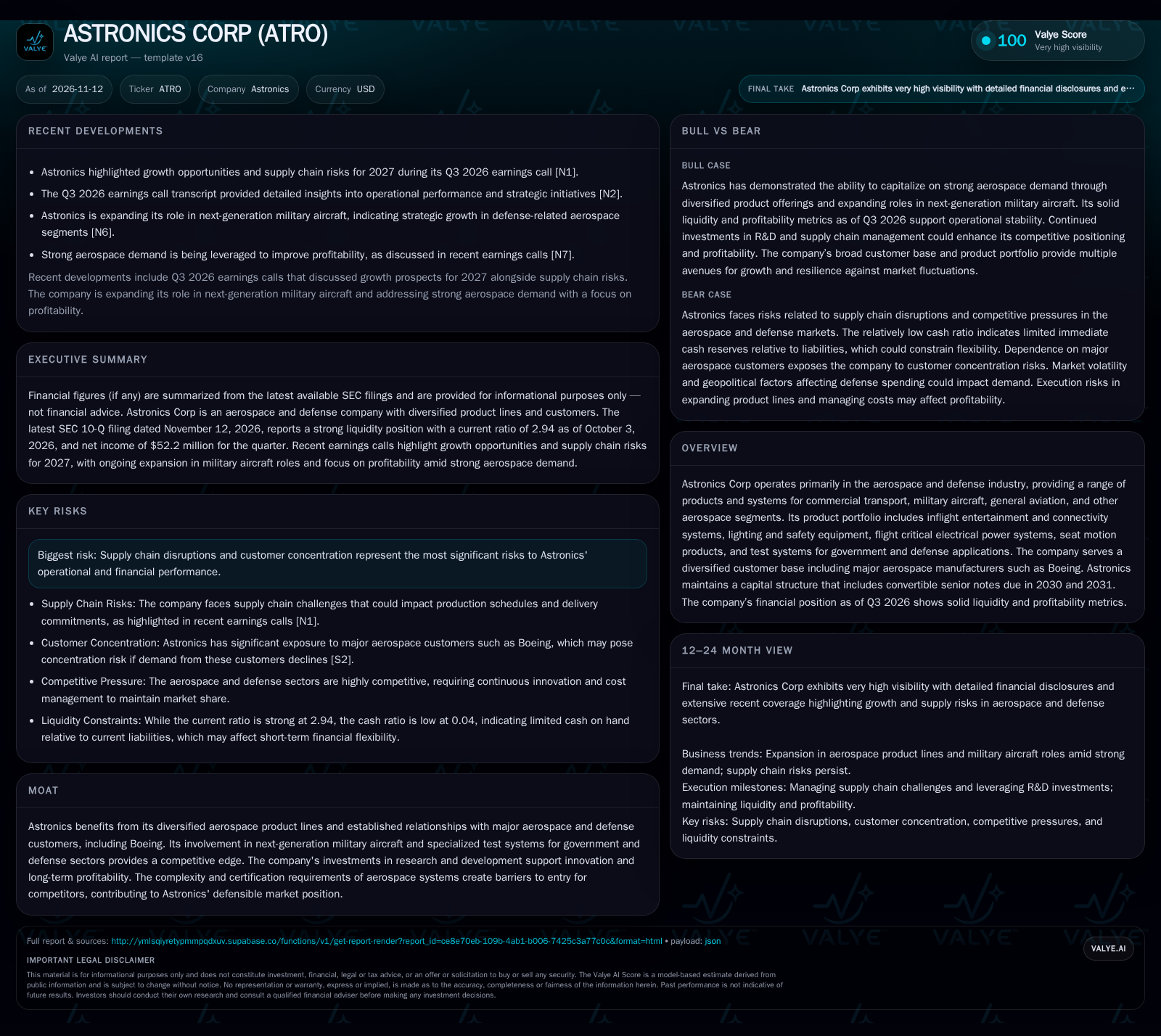
Astronics reported $52.2 million in Q3 2026 net income and a current ratio of 2.94, reflecting solid short-term financial positioning. The company’s expansion into next-generation military aircraft signals a strategic bid for defense growth. The company’s ability to convert robust aerospace demand into sustained margin improvement remains the central question for 2027. [S2] [N1] [N6]
Astronics’ ability to convert aerospace demand and R&D investments into sustainable margins—without succumbing to customer or supply chain shocks—will define its trajectory into 2027 and beyond. [S2] [N1] [N6]
Financial Strength Meets Operational Uncertainty in Q3 2026
Astronics closed Q3 2026 with net income of $52.2 million and diluted earnings per share of $1.08, reflecting a period of profitability after what had been a volatile stretch for many aerospace suppliers. The company reported cash and liquidity metrics for the period; these figures do not by themselves establish operating runway, investment capacity, financial flexibility, or financing capacity. [S2]
Strategically, Astronics is expanding its footprint in next-generation military aircraft, broadening its exposure to the defense end market at a time when commercial aerospace remains cyclical but military demand is more stable. The company continues to highlight supply chain risks for 2027, suggesting that the challenge of sourcing, logistics, and cost control is not yet resolved. These facts set the stage for a complex risk-reward calculus as Astronics pursues growth. [N1] [N6]
The company’s ability to dynamically allocate capital toward both sustaining current programs and investing in emerging defense opportunities will be a key determinant of resilience. Moreover, the timing and scale of supply chain normalization will likely influence not only cost structures but also the cadence of revenue recognition and backlog conversion, adding layers of complexity to financial forecasting.
How Astronics Monetizes Aerospace and Defense Complexity
Astronics generates revenue by supplying a broad array of systems—ranging from inflight entertainment and connectivity to lighting, safety, electrical power, and test solutions—to commercial aerospace, general aviation, and defense customers. Its commercial mechanics likely combine direct sales to OEMs, aftermarket and retrofit sales, and project-based contracts for specialized test systems. Pricing power is typically limited by the highly competitive, cost-sensitive nature of aerospace procurement, but Astronics’ focus on mission-critical, certified systems may allow for higher margins in certain product lines.
Variable costs are dominated by component sourcing, manufacturing, and program-specific engineering, while fixed costs include R&D, certification, and compliance overhead. The company’s investments in R&D are intended to support long-term differentiation and address evolving platform requirements, especially in defense. Operating leverage could improve as volumes recover and new programs ramp, but tight supply chains and inflationary pressures may erode gross margins if not managed aggressively.
The ability to balance inventory, collections, and payables without straining cash is a critical operating discipline.
A deeper understanding of Astronics’ revenue mix and cost structure reveals the nuanced challenges of monetizing aerospace and defense complexity. The company’s reliance on mission-critical, certified systems suggests that product development cycles are lengthy and capital intensive, implying that short-term margin improvements may be constrained by upfront R&D and certification costs. Furthermore, the competitive pricing environment necessitates continuous innovation to avoid commoditization, particularly as customers demand integrated solutions that reduce overall system complexity. If Astronics can leverage modular design principles or standardization across platforms, it could achieve economies of scale and reduce variable costs, thereby enhancing operating leverage as volumes increase.
Barriers to Entry, Customer Reliance, and the Fight for Share
Astronics’ competitive position is anchored by its broad, certified product portfolio and established relationships with major aerospace and defense customers—including Boeing. The complexity of aerospace certification and integration creates real switching frictions, as OEMs are reluctant to risk delays or compliance issues by swapping suppliers mid-program. In defense, long procurement cycles and rigorous qualification processes further insulate incumbents.
However, Astronics faces intense competition from both diversified aerospace suppliers and specialized niche players. Large Tier 1 and Tier 2 system integrators, as well as emerging technology firms, vie for the same contracts. While product breadth and R&D investment offer some insulation, customer concentration—especially reliance on Boeing—remains a vulnerability. Substitution risk is moderate for non-flight-critical systems but higher for commoditized components. The company’s ability to differentiate on integration, certification, and customer service will determine its margin resilience.
Supply chain fragility remains a competitive equalizer: even well-positioned suppliers can lose share or margin if they cannot deliver reliably or absorb cost shocks. Astronics’ success in managing these operational risks will shape its long-term market relevance.
Astronics’ competitive moat is partly derived from the high barriers to entry inherent in aerospace certification and integration processes. However, these same barriers can also slow the company’s responsiveness to technological shifts or evolving customer preferences. For example, emerging digital and software-centric capabilities in avionics and defense systems may require Astronics to adapt its product development and integration strategies rapidly. The company’s ability to anticipate these trends and invest strategically in complementary competencies—such as software integration, cybersecurity, or advanced materials—could enhance its differentiation and reduce substitution risk over time.
Aerospace Demand and Defense Expansion Drive Margin Recovery
The favorable scenario for Astronics hinges on robust commercial aerospace demand persisting into 2027, combined with successful expansion into next-generation military aircraft programs. If supply chain constraints ease and the company can convert its R&D investments into new platform wins, operating leverage could drive margin expansion. Incremental defense revenue—typically less cyclical and higher margin—would help offset volatility in commercial markets.
Confirmation of this scenario would come from continued sequential growth in net income, reports of new or expanded defense contracts, and evidence of gross margin improvement despite inflationary pressures. A rebound in cash flow from operations and reduced inventory days would further validate that supply chain and working capital risks are being managed effectively.
Falsification would be evident if new program delays, cost overruns, or supply disruptions prevent Astronics from scaling defense revenue or if margin recovery stalls despite top-line growth.
Sustained Demand, Persistent Constraints, and Margin Volatility
The most plausible trajectory is one in which Astronics continues to benefit from solid aerospace demand and gradual defense expansion, but supply chain bottlenecks and customer concentration risks persist. Revenue grows modestly, but margins remain volatile as the company manages inflation, component shortages, and potential program delays.
Evidence supporting this scenario would include stable or slightly improving net income, steady current ratios, and incremental new business in both commercial and defense segments. The base case is one of progress, but not breakout performance.
Supply Chain Disruptions and Customer Shocks Derail Progress
In the adverse scenario, renewed supply chain disruptions—whether from geopolitical events, supplier insolvencies, or material shortages—significantly impede production, leading to missed deliveries, cost overruns, and potential contract penalties. If a major customer like Boeing reduces orders or delays programs, Astronics could face sharp revenue declines, inventory build, and working capital stress.
This scenario would be confirmed by a sudden drop in net income, negative operating cash flow, or a further deterioration in the cash ratio. Announcements of program delays, lost contracts, or the need for emergency financing would signal that the company’s operational and potential financial flexibility has been breached. Prolonged exposure could threaten profitability, force asset sales, or require restructuring.
Milestones That Will Define Astronics’ Value Creation and Resilience
Gross margin trends by quarter—improvement would indicate supply chain and cost control progress; erosion would signal ongoing pressures.
Cash flow from operations—positive and improving cash generation would confirm that working capital and liquidity risks are being managed.
Defense segment revenue growth—acceleration here would validate the strategic expansion into next-generation military aircraft.
Customer concentration metrics—if disclosed, tracking revenue share from major customers like Boeing would help assess dependency risk.
Inventory turns and days sales outstanding—faster cycles would suggest operational discipline and reduced supply chain drag.
New program wins or contract announcements, especially in defense—these would be leading indicators of future revenue stability.
R&D expense as a percentage of sales—sustained investment would support long-term differentiation, but excessive spending without revenue conversion could pressure margins.
Any disclosures on supply chain disruptions or mitigation efforts—these would help gauge the company’s resilience to external shocks.
Disclaimer: This is research-only, informational analysis and not investment advice. It may include AI-generated interpretation and general industry context. Always verify important details using primary sources.

Comments